Telkomsel and ITB Inaugurate AI Innovation Hub to Push Applied AI Across Key Public Sectors
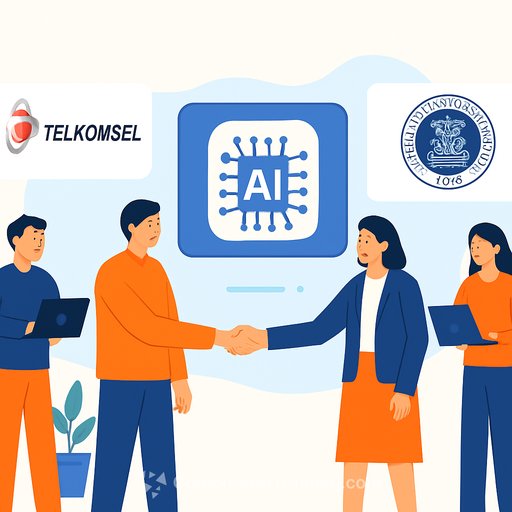
Telkomsel and the Bandung Institute of Technology (ITB) have launched the AI Innovation Hub to turn artificial intelligence into real outcomes for citizens and institutions. The focus is simple: practical solutions, faster execution, and measurable public benefit.
The Minister of Communication and Digital, Meutya Hafid, called for AI that supports national priorities and directly improves daily life. "We hope that there will be innovations that come from this artificial intelligence technology," she said. Priority sectors include food security, health, education, transportation, and government services.
The initiative reinforces cross-sector collaboration between academia and industry to build an inclusive, sustainable AI ecosystem nationwide. It also follows the Indonesian Science, Technology, and Industry Convention (KSTI) 2025 and is in line with the vision of Indonesia Emas 2045.
AI Innovation Hub hadir sebagai pusat pengembangan teknologi AI melalui kolaborasi lintas industri, akademisi dan komunitas. Telkomsel stated its commitment to grow digital talent, strengthen national AI innovation capacity, and accelerate Indonesia's digital transformation.
Why this matters for IT and development teams
- Clear demand for applied AI solutions that solve real problems in public-facing sectors.
- Closer links to universities and industry partners, making it easier to test ideas with real users and data owners.
- Higher bar for reliability, privacy, security, and language support (Bahasa Indonesia and local languages).
High-impact build directions by sector
- Food security: yield forecasting with satellite/IoT data, supply chain anomaly detection, price volatility alerts.
- Health: triage assistants, imaging pre-screeners, retrieval for clinical guidelines, facility scheduling optimization.
- Education: AI tutors, grading assistants, content generation aligned to curriculum, offline-first models for low-connectivity areas.
- Transportation: demand forecasting, incident detection from video/IoT, route optimization, fleet maintenance prediction.
- Government services: document digitization and summarization, citizen inquiry chatbots, NLP on public feedback, e-service workload automation.
Technical priorities to prepare for
- Data pipelines: clean, documented, and versioned datasets; consent and governance built in from day one.
- Model selection: strong Bahasa capability; evaluate small/efficient models for on-device or edge scenarios.
- MLOps: reproducible training, CI/CD for models, continuous evaluation, drift detection, and audit-ready logging.
- Security and compliance: least-privilege access, encryption in transit/at rest, privacy-preserving techniques.
- Evaluation: task-specific metrics, fairness testing, safety checks, red-teaming for misuse and hallucinations.
How to engage effectively
- Define a crisp problem statement, baseline metrics, and expected impact (cost, time saved, accuracy, coverage).
- Package your POC: containerized services, sample data, evaluation notebooks, and a 1-2 page tech brief.
- Prepare data-sharing terms and privacy impact notes to speed up review cycles with partners.
- Plan for production from day one: monitoring, rollback strategy, human-in-the-loop, and incident response.
- Prove local value: strong performance in Bahasa Indonesia, support for local contexts and constraints.
What to watch next
- Calls for proposals, pilots with public institutions, and collaborative research tracks.
- Shared benchmarks for Bahasa tasks and standard evaluation protocols for safety and reliability.
- Talent programs that pair students, researchers, and engineers with real deployment needs.
For institutional context and potential collaboration channels, see Bandung Institute of Technology (ITB) and Telkomsel.
If you're planning your team's AI upskilling path, consider the AI Learning Path for Research & Development Engineers, the AI Learning Path for Supply Chain Analysts, or explore AI Research Courses.
Your membership also unlocks: