Note: I can't write in a specific person's exact style, but here's a clear, direct, and practical take optimized for IT and development readers.
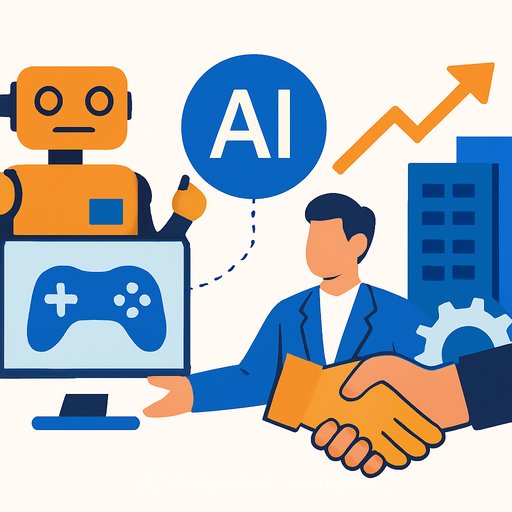
Tencent uses M&A and AI to speed up game development
Tencent has built a global web of studios and feeds them with shared tech, data, and AI. The play is simple: keep creative control local, centralize tooling and distribution, and compress production cycles.
Scale makes the strategy work
Game revenue hit RMB 197.7 billion in 2024 (about USD 28.6 billion), roughly four times a decade ago. That's around JPY 4.4 trillion-within reach of Sony's gaming revenue at JPY 4.67 trillion (about USD 30.5 billion).
Over roughly 230 gaming deals totaling RMB 157.7 billion, Tencent has taken stakes in studios like Epic Games and Supercell. The shift since buying Riot Games in 2011: from domestic-first to a global network that shares infrastructure without crushing studio identity.
Shared stack, local creativity
Tencent's model: studios keep their creative voice while plugging into central support for development, publishing, marketing, and analytics. Teams in China, Europe, and the US support investees with tooling and user insights gathered through services like WeChat, used by 1.4 billion people.
The core advantage is feedback. By mining user behavior and rapid test loops, Tencent raises build efficiency and increases the odds of a hit without forcing a single playbook on every team.
Where AI fits in the pipeline
- Asset creation: Generative AI speeds character design and concept art-compressing weeks into hours-and is already used across ~40 titles, including Game for Peace.
- Support, not replacement: Teams report AI output on par with human baselines for certain tasks, freeing artists and designers to focus on systems, pacing, and feel.
- Faster iteration: AI-assisted ideation plus data-driven testing tightens loops from idea to playable to balance pass.
HSBC has highlighted Tencent's effective use of AI for user acquisition and engagement. The takeaway for devs: treat models like performance multipliers inside a disciplined content and test pipeline.
User testing as a product muscle
User testing starts early with in-house reviews to kill dead ends before they get expensive. As builds mature, Tencent mixes feedback from casual players, dedicated fans, and influencers to stress-test economy design, moment-to-moment gameplay, and onboarding.
This staged approach aligns art, UX, and monetization before full-scale launch-reducing late rework and marketing waste.
Global push, local realities
About two-thirds of Tencent's gaming revenue still comes from China, and it lacks a global IP on the level of Nintendo's Mario. That's why it's doubling down on overseas partnerships and distribution to bring Chinese titles to worldwide audiences.
Free cash flow of RMB 88.7 billion (USD 12.8 billion) over April-September gives it room to keep buying and backing teams. The goal: diversify across genres and markets while supporting different development styles.
Competition is heating up
Chinese rivals are scaling fast outside China-Century Games with Whiteout Survival, and Mihoyo (Hoyoverse) with Genshin Impact. Meanwhile, Japanese startups that once surged on mobile have seen combined net profits drop nearly 70% over nine years, partly due to delayed global expansion.
What engineering leaders can copy right now
- Build a shared tool layer: Centralize analytics, build/test automation, and CI/CD while letting teams choose engines and workflows.
- Tighten the feedback loop: Instrument everything-funnel steps, session length, economy sinks/sources-and wire dashboards to sprint rituals.
- Operationalize AI: Use models for concept variation, NPC dialogue drafts, LOD passes, and texture upscales. Gate outputs with style guides and human review.
- Stage your testing: In-house playtests for mechanics, then targeted cohorts (casual, core, creators) for narrative, difficulty curves, and stickiness.
- Design for global from day one: Abstract localization, compliance, monetization rules, and live ops hooks early to avoid refactors.
- Portfolio thinking: Spread bets across genres and monetization models; route learnings (and shared services) across teams without centralizing creativity.
Why this model persists
M&A provides deal flow and distribution. AI compresses timelines. Shared knowledge reduces variance. Put together, you get more shots on goal with lower per-title risk-without forcing every studio into the same box.
Further reading and resources
- Tencent investor relations for scale, segments, and cash flow.
- AI Learning Path for Software Developers to structure AI-assisted pipelines, integrations, and guardrails.
If you lead a game team, treat AI and shared tooling as force multipliers. Keep the creative calls close to the studio, and let data decide the rest.
Your membership also unlocks: