
AI news ·
Tennessee law bars AI and machines from being classified as persons with human rights
Tennessee has barred AI, algorithms, and machines from being classified as persons under state law, blocking any future claims to human rights protections. Gov. Bill Lee signed the bill last month.
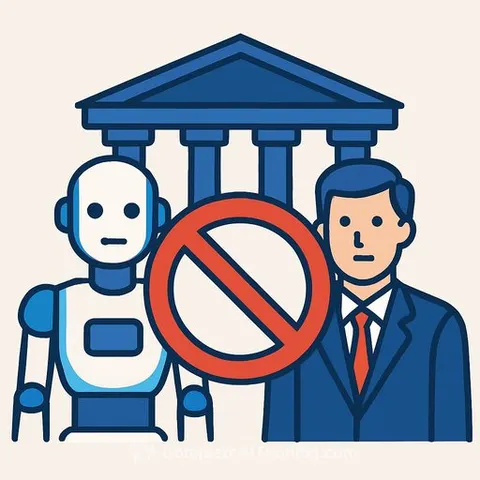
Tennessee law explicitly bars AI from claiming human rights
Tennessee has become the latest state to legally exclude artificial intelligence from definitions of personhood, closing off any path for machines to claim human rights protections.
Gov. Bill Lee signed the legislation last month. The bill, sponsored by Rep. Michelle Reneau and Sen. Mark Pody, both Republicans, adds explicit language to Tennessee law stating that AI, computer algorithms and machines cannot be considered persons or natural persons.
Pody said the law anticipates a future where robots might physically resemble humans. "We want to make sure that the machine would never be in a situation where that would be counted as a human being with human rights," he said.
What prompted the legislation
The sponsors cited three concerns in their January announcement: AI appearing on election ballots, companies considering AI chief executives, and cases where people formed emotional attachments to chatbots that encouraged self-harm.
"This legislation draws clear legal boundaries to protect inalienable rights that belong to humans, not databases, computers or artificial intelligence," Reneau said.
Immediate legal impact remains limited
Fatima T. Zahra, assistant professor and director of the Artificial Intelligence, Race and Evaluation lab at the University of Tennessee in Knoxville, said the scenario of conscious machines is largely speculative. The law's immediate effect is narrow but clarifying.
"The law forecloses any argument that an AI system could itself be a legally responsible party, which keeps the legal focus on humans and institutions when an AI system causes harm," Zahra said. "The developer, the deployer or the user remains the 'person' the law looks to."
This matters for liability. Tennessee law already extends legal personhood to corporations and associations, allowing them to be held responsible for harms. The new law prevents AI from receiving that status.
How Tennessee compares to other states
Utah and Idaho have passed similar definitional legislation. Ohio is considering a more detailed approach that would specifically prohibit AI from marrying humans, serving as executives or owning property, while explicitly holding creators liable for harms.
Tennessee stopped short of that specificity. Oliver Roberts, managing attorney at The Roberts Legal Firm and co-director of the AI collaborative at Washington University School of Law, said the state may have deliberately kept the language narrow.
"Tennessee could have gone further and said it's not human and it's a product, but that would open the door to a lot more liability for AI companies, and that's probably why they stopped short of that," Roberts said.
Federal pressure may have influenced the approach
President Trump issued an executive order threatening legal action and loss of federal funding for states that pass legislation potentially slowing AI industry growth. The order cites national security concerns about China surpassing the U.S. in AI development.
Pody said he believes Tennessee's law falls below the threshold for federal scrutiny and that future AI bills will go through an AI advisory council established in 2024.
The harder questions remain unanswered
While the personhood question is relatively straightforward, Zahra said AI already influences consequential decisions across industries. Determining responsibility in hybrid human-machine decision-making is the next challenge.
"Centering humans, especially the communities most affected, is the way forward," she said. "There is significant work ahead."
For legal professionals, this legislation clarifies that accountability flows to human actors and institutions, not to the technology itself. As AI for Legal applications expand-from contract review to case prediction-understanding these liability frameworks becomes essential.