Tensor and Arm team up to deliver AI-defined compute for the first personal Robocar
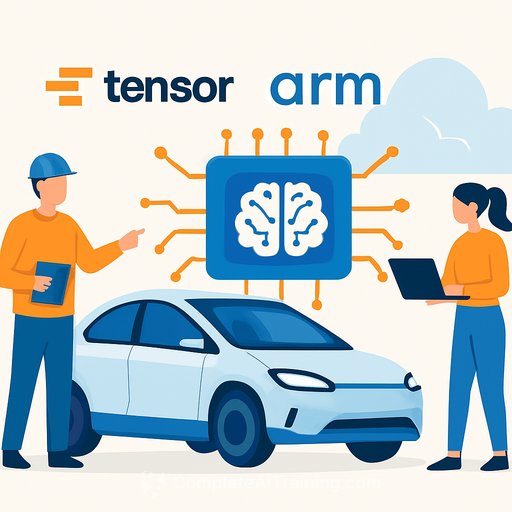
Tensor and Arm announced a multi-year collaboration to build the compute backbone for what Tensor calls the world's first personal Robocar. Launch is planned for 2026 across the US, EU, and Middle East. The focus: an AI-native vehicle architecture that distributes safety-capable intelligence from the onboard supercomputer down to the smallest sensors.
This isn't autonomy bolted onto a legacy platform. Tensor is designing the vehicle around agentic AI and foundation models, then pairing it with deep hardware and software integration. The result: a car with 400+ Arm-based cores, NVIDIA-accelerated AI processing, and a sensor suite dense enough to support continuous perception across varied conditions.
What's new (and why it matters)
Each Tensor Robocar integrates 433 Arm-based cores - the highest concentration of Arm tech in a consumer vehicle to date. Using the Arm compute platform and its broad software ecosystem (22M+ developers), Tensor can deploy AI across heterogeneous domains while staying within tight safety, thermal, and power envelopes.
The goal is Level 4 autonomy at scale in 2026. By distributing compute across the vehicle, Tensor aims to raise reliability and redundancy while keeping latency low for perception and decision-making.
Inside the compute architecture
- Total cores per vehicle: 433 Arm-based cores
- Neoverse AE: high-throughput AI processing for autonomy workloads
- Cortex-X: agentic AI cabin experiences and peak performance system control
- Cortex-A: drive-by-wire, lidar processing, redundancy, and general compute
- Cortex-R: real-time, safety-critical systems
- Cortex-M: low-power subsystem management
Arm's platform lets Tensor place the right workload on the right core, then scale it with strict safety and power budgets. It runs in concert with NVIDIA-accelerated AI to support Tensor's autonomy stack. For teams evaluating architectures, this is a clear example of domain-specific compute mapped to safety-critical requirements. See also: Arm architecture overview.
Sensors and connectivity
The Robocar leans on dense, diverse sensing to maintain environmental awareness and resilience across conditions.
- 37 cameras
- 5 lidars
- 11 radars
- 22 microphones
- 10 ultrasonic sensors
- 3 IMUs + GNSS
- 16 collision detectors
- 8 water-level detectors
- 4 tire-pressure sensors
- 1 smoke detector
- Triple-channel 5G connectivity
It's a full-stack bet: tight coupling between the autonomy models, sensor fusion, and the distributed compute fabric that runs them.
Why this is useful for product, IT, and development teams
- Vertical integration as a strategy: The autonomy stack and compute platform are co-designed. That reduces interface risk and helps meet safety, latency, and thermal targets.
- Distributed safety-capable compute: Autonomy isn't just in a central box. Intelligence extends to edges and subsystems, which can simplify failover and reduce single points of failure.
- Ecosystem leverage: Arm's toolchains, safety certification paths, and developer base shorten time-to-integration across vendors.
- Workload placement: Mapping perception, planning, and actuation across Neoverse, Cortex-X/A/R/M aligns compute cost with risk and timing needs.
- Supplier network: Tensor's list (Autoliv, ZF, Continental, NVIDIA, AMD, Qualcomm, Samsung, Oracle) signals focus on safety systems, silicon diversity, and manufacturing scale.
Quotes from the partners
"Autonomous vehicles are a leading example of how AI is shifting to the physical world, requiring high-performance, safe and power-efficient compute foundations," said Drew Henry, EVP of Physical AI Business Unit, Arm. "With its software ecosystem, Arm provides the foundation for physical AI innovation. Tensor's Robocar pairs a clear vision with the engineering rigor needed to bring autonomy to market at scale."
"Delivering personal autonomous vehicles at scale requires advanced engineering for safety, redundancy, reliability, and power efficiency," said Dr. Jewel Li, Tensor COO. "Our collaboration with Arm leverages their expertise in AI-capable compute so the Tensor Robocar moves from advanced tech to real roads, safely and reliably."
Markets and timing
Tensor plans to commercialize the personal Robocar in 2026 across the US, EU, and Middle East. The company positions it as the first AI-agentic, fully autonomous vehicle built for private ownership at scale.
For your next step
If you lead product, study how Tensor maps safety-critical functions to specific cores and sensors-then mirror that clarity in your own system architecture. For engineering leaders, consider how distributed AI across domains impacts testing, certification, and field reliability.
Helpful reads: AI for Product Development and AI for IT & Development.
Your membership also unlocks: