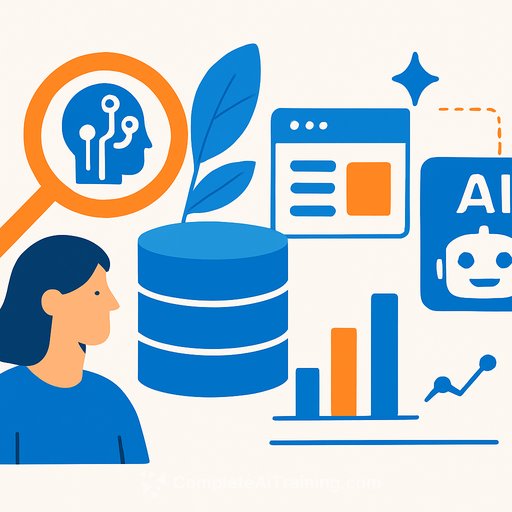
Teradata updates Enterprise Vector Store: hybrid search, multi-modal embeddings, and fewer moving parts for AI teams
Teradata is rolling out a significant update to Enterprise Vector Store, introduced at the Gartner Data & Analytics Summit in Orlando. General availability is slated for April. The goal is simple: make it easier for teams to ship accurate, production AI with less glue code and fewer external systems.
Vector indexing isn't new, but agentic AI turned it from optional to required. As models and agents demand large, high-quality context, vector stores have become the backbone for retrieval-augmented generation (RAG) and multi-modal search. This release leans into that reality.
What's new
- Hybrid search: Combine semantic and keyword search to improve precision and recall over using either alone.
- Multi-modal embeddings: Store and retrieve text, audio, and images with richer semantic representations to support agent workflows and content-heavy apps.
- Automatic ingestion: Integration with Teradata Unstructured to bring in multiple unstructured data types without extra pipelines.
- Higher-dimension embeddings: More expressive vectors to surface task-relevant results faster.
- LangChain integration: Direct hookup to build enterprise-scale RAG pipelines and move from prototype to production with less friction. See the docs at LangChain.
Why it matters for IT and development teams
Enterprises have been stitching together agents from many components. Consolidating hybrid search, multi-modal support, ingestion, and pipeline tooling inside the core data platform removes a lot of that complexity. That means fewer systems to secure, tune, and scale - and a shorter path from POC to production.
Analysts note that while most data platforms now offer vectors, broad support for unstructured data types and automatic ingestion is still rare. Teradata's move helps close that gap, especially for teams standardizing on a single platform for analytics and AI.
Context: vectors go mainstream
Specialist vector databases (e.g., Pinecone, ChromaDB) set early standards. As vector search became essential for GenAI, platforms like Databricks and Snowflake added native capabilities so customers didn't need extra infrastructure. Teradata entered in 2025 with Enterprise Vector Store and has been iterating based on observed AI use cases since.
RAG and agents depend on volume and quality. Without enough relevant context - especially from unstructured data, which makes up the bulk of enterprise knowledge - models drift and hallucinate. Vector indexing operationalizes that unstructured data so it's queryable and trustworthy in production workflows.
What's in this release (in practical terms)
- Better retrieval quality: Hybrid search tends to improve relevance on noisy corpora and long-tail queries.
- Multi-modal agents: Single store for documents, images, and audio so agents can reason across formats.
- Less pipeline toil: Built-in ingestion simplifies ETL for PDFs, media, and other files.
- Tuning headroom: Higher-dimension embeddings can capture finer semantics for niche domains.
- Faster path to prod: Native LangChain integration reduces custom glue for RAG orchestration.
Who should care
- Platform teams consolidating analytics and AI into one governed stack.
- App teams building task-specific agents that need reliable retrieval across text, images, and audio.
- Enterprises standardizing on Teradata and looking to avoid separate vector databases.
How to evaluate (quick checklist)
- Define target tasks: Identify 2-3 agent workflows (e.g., support assist, claims triage, catalog search) and their data modalities.
- Corpus readiness: Inventory unstructured sources and test auto-ingestion via Teradata Unstructured.
- Retrieval metrics: Benchmark recall@k, MRR/NDCG, and hallucination rate under hybrid vs. pure semantic search.
- Latency and scale: Measure P95 query latency at production concurrency; project storage and egress costs.
- Security and governance: Validate row-/column-level controls, lineage, and audit trails across modalities.
Integration notes
- LangChain: Use native connectors for indexing pipelines, retrievers, and evaluation loops. Keep prompts and retrievers versioned for rollback.
- Embedding dimensions: Start with defaults; increase only if domain-specific terms are missed in retrieval. Re-indexing cost should be part of the plan.
- Hybrid search tuning: Calibrate weights between keyword and semantic scores on a labeled validation set; revisit after every major corpus update.
Competitive landscape
Most platforms (roughly 95%) now include vectors. Where Teradata aims to stand out is multi-modal support at scale and automatic ingestion - areas that reduce integration burden for enterprise teams. Analysts also point to a broader industry need: stronger support for operational (OLTP) data alongside analytics (OLAP) as agentic AI blurs the line between the two. Some peers moved in this direction via PostgreSQL-based additions in 2025.
Use cases that benefit first
- Service and knowledge agents: Retrieve policies, PDFs, transcripts, and images to resolve tickets faster.
- Content and media search: Multi-modal discovery for creatives, marketing, and compliance reviews.
- Life sciences and biomedical: Cross-referencing papers, images, and sequences for research support.
What's next from Teradata
Teradata signals continued focus on agentic workloads, with deployment wherever customers run - any cloud, on-prem, or hybrid - and with an emphasis on speed, cost, and security. Expect more investments that reduce the parts list needed to build and operate production AI.
KPIs to track post-launch
- Retrieval precision/recall by modality and task.
- P95/P99 end-to-end latency for RAG queries.
- Cost per 1K queries (compute + storage + egress).
- Content freshness lag and embedding drift indicators.
If you're building RAG and agent workflows and want more background on embeddings and evaluation, explore our resources on Generative AI and LLM.
Your membership also unlocks: