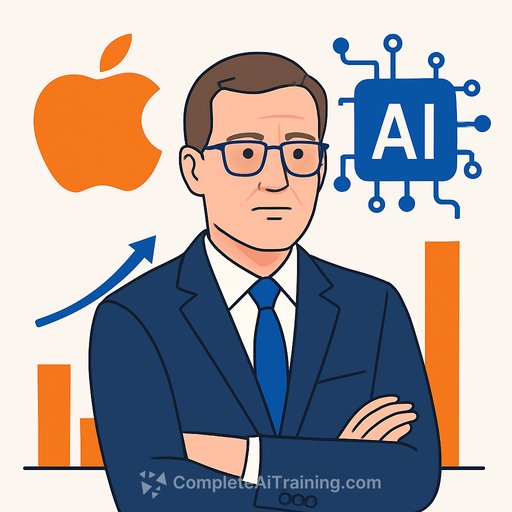
Apple's AI Crossroads: Why John Ternus Is Emerging as the Successor-in-Waiting
Apple is under pressure to show a clear, credible AI strategy. As calls mount for a leadership change, attention is fixing on John Ternus, SVP of Hardware Engineering, as the leading internal candidate to succeed Tim Cook.
Insiders point to a deliberate uptick in Ternus's public presence, supported by PR orchestration. A key signal: Apple's secret robotics team was moved in April from AI chief John Giannandrea to Ternus's hardware group-an explicit bet on AI fused tightly with devices.
Why Ternus, and why now
Ternus is a product-first operator who understands Apple's advantage: silicon, sensors, and tight integration. If AI is going to be Apple's next era, the company may choose to embed it deeply into iPhone, Mac, and wearables rather than chase a me-too chatbot.
This is the strategy Apple knows how to execute. It's also the one that could move fastest without blowing up Apple's privacy stance or brand. Ternus's track record makes him the logical face of that approach.
The critics' case for change
LightShed Partners analysts Walter Piecyk and Joe Galone argue Apple needs a product-focused CEO, not a logistics-first leader. They've publicly called for Cook's replacement.
Dan Ives of Wedbush, typically positive on Apple, is warning about a potential "BlackBerry Moment" if Apple stalls on generative AI. Former CEO John Sculley is pushing a move toward agentic AI-and hinting that Cook's retirement may be on the horizon.
Execution gaps Apple must close
- Siri is widely considered behind competitors-functionally and in perception.
- The Apple Intelligence refresh has slipped, with key features reportedly pushed to 2026.
- Critics cite recent misses, including Apple Vision Pro and "iPhone Air," as symptoms of a stalled innovation pipeline.
What a product-first AI strategy would look like
- On-device AI as default: Lean into privacy, latency, and battery via Apple silicon and NPUs. Cloud where it adds clear value.
- Feature-level wins: Ship tangible improvements to photos, messaging, search, health, and workflow-monthly, not yearly.
- Agentic building blocks: Routines, automation, and cross-app actions that feel native, safe, and reliable.
- Developer leverage: Give third parties tools to build agents that respect Apple's permission model.
Scenarios to plan against (12-18 months)
- Ternus becomes CEO: Hardware-led AI acceleration; clear on-device roadmap; tighter silicon cadence.
- Status quo with Ternus elevated: Cook remains; Ternus effectively "AI COO" driving integration and delivery.
- External AI heavyweight added: Dual-track leadership-software agents + device AI. Cultural friction risk increases.
- Minimal change: AI slips again. Services steady near term, brand perception weakens.
Signals to watch
- Org moves: More AI+robotics teams shifting to hardware; new cross-functional "agent" groups.
- Roadmap tells: WWDC demos tied to shipping dates, not concepts; Siri upgrades with real task completion.
- Capex and partners: Data center spend, on-device LLM performance, deals with model providers that preserve Apple's privacy story.
- Hiring patterns: Agent frameworks, multimodal, energy-efficient inference, and ML systems engineers moving into product teams.
Implications for executives and boards
- Platform exposure: Don't bet on a single AI ecosystem. Design products and workflows for multi-platform agents.
- On-device readiness: Budget for AI features that run locally-privacy, compliance, and speed improve.
- Automation first: Prioritize agent use cases tied to revenue and cost-sales ops, CX triage, field service, dev productivity.
- Messaging reset: Prepare comms for an Apple narrative shift from services to device-led AI.
- Supply and channels: If AI features drive upgrade cycles, align inventory, trade-in offers, and carrier incentives early.
Risks to manage
- Execution: Hardware cadence won't fix weak software agents; both need credible milestones.
- Focus drift: A hardware-first push could starve services growth if not balanced.
- Regulatory and privacy: Agent capabilities must align with global privacy laws and Apple's brand promise.
- Talent: Integrating AI researchers into product teams takes cultural and incentive alignment.
Bottom line
Apple needs visible, near-term AI wins that feel unmistakably Apple: fast, private, and useful. Ternus is the strongest internal bet to deliver that by embedding AI into devices people already use daily.
If leadership backs a product-first plan and ships relentlessly, the company can reset the narrative and the roadmap. If delays drag into 2026, the market will set the story for them.
Upskilling leaders on practical AI deployment can shorten that gap. See role-based learning paths here: Complete AI Training - Courses by Job
Your membership also unlocks: