
AI news ·
Texas computer science enrollment falls 20% as AI reshapes hiring and curricula
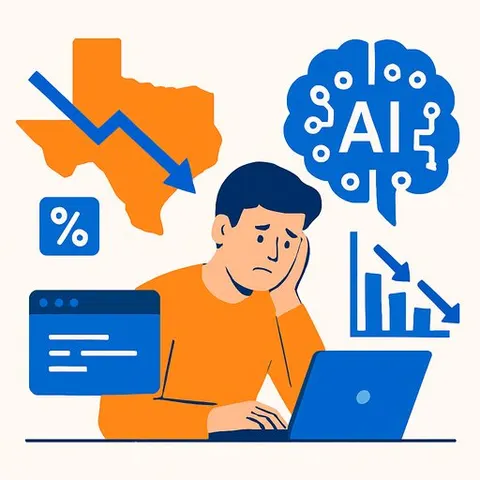
Texas computer science admissions have fallen roughly 20% as software job postings drop and recent graduates face 7% unemployment. Universities are adding AI coursework while students submit hundreds of applications to land a single interview.
Texas universities rework computer science programs as hiring slows
Computer science admissions across Texas have dropped roughly 20% as software engineering jobs become scarcer, forcing universities to reshape their curricula and prepare students for an uncertain market where artificial intelligence now handles tasks once reserved for human developers.
The shift marks a sharp reversal from the golden age that followed the 2008 recession, when six-figure starting salaries were nearly guaranteed for graduates from top programs. Major tech companies spent the early 2010s recruiting high schoolers into coding, promising stable, lucrative careers.
Software development job postings in the U.S. have plunged since a 2022 hiring peak, according to Federal Reserve data. Recent college graduates with computer science degrees face unemployment rates around 7%, among the highest for any field.
Students confront a different job market
Derek Do, a third-year computer science major at the University of Texas at Austin, said students initially dismissed AI concerns as a joke. That attitude shifted once the industry took the technology seriously.
"I've applied to a billion jobs, as everyone has too," Do said, describing the competitive hunt for internships and entry-level positions.
Parth Patki, a spring 2025 graduate from UT Austin, experienced the market's volatility directly. He landed a software engineering job at an international cybersecurity firm after an internship there, but was laid off six months later when the company restructured to capitalize on AI efficiency gains.
Patki applied to an average of 25 jobs daily for two months before receiving an interview offer from one of only two companies that responded. He now works as a machine learning engineer at PayPal, but said he prioritizes saving money against future layoffs.
"I know that I'm replaceable," Patki said. "Every day, I'm reminded that I'm replaceable."
Universities introducing AI coursework
Department chairs at UT Austin, the University of Texas at San Antonio, and Baylor University said anxiety about the job market is a constant topic among students and faculty.
All three schools have introduced new AI curricula in response. Peter Stone, chair of UT Austin's computer science department, said foundational AI classes are now part of the undergraduate experience.
Fred Martin, chair of UTSA's computer science department, noted that the median wage for early-career computer science graduates remains higher than any other degree field. Underemployment rates-the percentage working jobs unrelated to their degree-are also lower for computer science graduates than most other fields.
"Definitely, it's harder to get jobs," Martin said. "But our kids, the ones who have internships, who know how to talk to people and have the chops, they totally have jobs. They get great jobs."
Jean Gao, chair of Baylor's computer science department, predicted that AI could eventually create more jobs in software development by making it cheaper for non-tech companies to build AI-powered tools. She said students need to differentiate themselves in a tighter market.
"Computer science is just like glue, in every field you need it, like health care, insurance, finance, cyber security, everywhere needs computer science," Gao said. "So that's why students need to make themselves different."
Students adapting their strategies
Vivian Tran, a senior at UTSA and president of the campus' Association for Computing Machinery chapter, said many of her peers are pursuing master's degrees to avoid entering the job market now.
Tran submitted 250 internship applications before securing a summer position as a software engineer at Uber. She said the job market is difficult but not impossible, though it demands more than a degree alone.
"The other end of the spectrum, there's people that are solely dedicated to the grind: doing elite code problems and building projects to put on your resume, networking events," Tran said.
Danielle Nyame, a freshman computer science major at UT, remains optimistic about her prospects. She hopes to apply AI to work in business or social justice, using the technology to build tools that help society rather than replace workers.
"AI will not be able to take over every single aspect of this field, but it will be able to help aid with the work that is done in this field," Nyame said.
For educators preparing students for this market, the message is clear: technical skills alone no longer suffice. Students need internship experience, networking ability, and the capacity to work alongside AI rather than compete against it. Consider exploring AI Learning Path for Software Developers to understand how the field is evolving.