
AI news ·
The basic unit of work shifts to AI tokens as enterprises rethink management
AI replaces human hours with tokens as the basic unit of work. Deloitte Israel warns firms must measure business value per token instead of just cutting consumption.
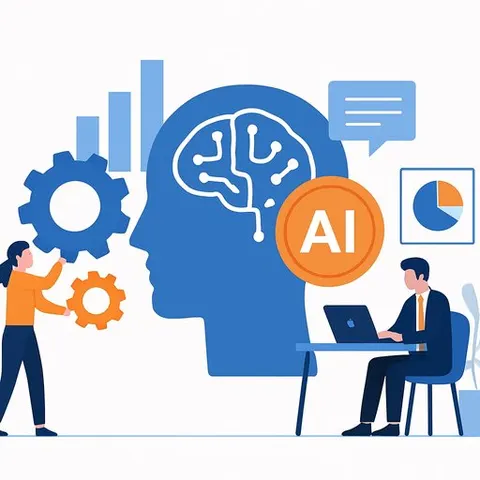
The next wave of enterprise AI adoption is reshaping the basic unit of work, shifting from human hours to a new metric: tokens. Organizations that treat this shift as just another IT budget line risk missing the chance to convert intelligence into measurable business value, according to a new analysis from Deloitte Israel.
For more than a century, management has relied on people, time and money. Budgets, workplans and compensation models were built around them. But when an AI agent writes code, reviews a contract or summarizes thousands of documents in minutes, the organization begins to rely on a new unit of production - one that cannot be measured only in human working hours.
Tokens, the billing unit for large language models, are emerging as the consumption unit of this new workforce. "Tokens are not merely the billing unit of language models; they are the consumption unit of the new workforce," Deloitte Israel consultants wrote. Just as the work hour has long measured human labor, tokens are becoming a way to measure work performed by AI models.
Many executives compare this shift to the move to cloud computing, where pricing models changed and FinOps emerged. But the comparison misses the essence of the transformation. Cloud changed how organizations consume infrastructure; it did not change the basic unit of production. AI changes that assumption. For the first time, organizations are relying on a non-human productive force, which means the economics on which the organization relies are changing as well.
The cost-control trap
As AI budgets grow, many organizations respond with usage limits, quotas and pre-approvals. Any reduction in token consumption is presented as a success. Yet this may be precisely the strategy that harms competitiveness. "A factory does not succeed because it saved steel, but because it produced more value from every ton it purchased," the consultants said. "In the same way, an AI-based organization will not win because it consumed fewer tokens, but because each token generated more business value."
The central question will not be only how much AI costs, but what return is generated by each unit of consumed intelligence. Organizations that manage this change through cost controls alone may save on the wrong resource and miss the opportunity to turn intelligence into measurable business value.
Redefining performance and team structures
The shift affects how organizations measure employees, reward them and build teams. Many performance models still rely on time, workload or the number of tasks completed. Yet an employee who uses AI tools well can produce output that once required an entire team. This does not make human talent less important. As more tasks are performed with AI, the value of people who exercise judgment, ask the right questions, review outputs and translate technological capability into business outcomes will increase.
A new management language
The AI discussion cannot remain solely in the hands of technology departments. The CIO must explain how models are selected and value is measured. The CFO must understand the economics of intelligence. HR must update performance models, and control, risk management and corporate governance functions must redefine their success metrics. Token economics is becoming a new management language for the entire organization. Building this language requires rethinking how organizations measure work - a shift explored in AI for Management resources.
Organizations that fail to adopt this mindset risk managing a 21st-century enterprise with a 20th-century economic model. A decade from now, it may be hard to understand how organizations tried to manage AI-based enterprises using models built for a world in which only humans produced work. The challenge is not just technical, but strategic - a topic addressed in AI for Executives & Strategy.
Why this matters for management
Executives who treat AI as another expense line will fall behind. The organizations that lead will build a management language that measures not only work, but capability; not only cost, but return; and not only employees, but the combination of people, machines and intellectual capital. The shift from managing hours to managing intelligence is not a technology decision - it is a fundamental redefinition of how the enterprise creates value. Those who continue to manage with an economic model built for the 20th century will not fall behind because their model is slightly less intelligent. They will fall behind because they are measuring the wrong things entirely.