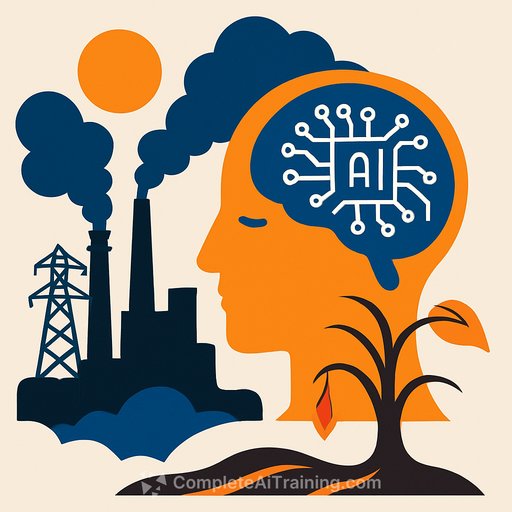
The Environmental Impact of Artificial Intelligence
Artificial intelligence demands enormous amounts of energy and water while generating significant pollution. For anyone concerned about the planet, using AI raises serious ethical questions. The biggest new challenge for Earth's environment comes from massive data centers. These centers currently consume about 1.5% of global electricity, and studies predict their energy use will double within five years, reaching nearly 945 terawatt hours annually.
To put that in perspective, one terawatt hour can power all of California for about ten days. The main driver behind this surge is generative AI, which requires heavy computational power.
Why Energy Consumption Is a Problem
Many data centers supporting AI run on coal, diesel, or methane. This fuels pollution that disproportionately affects nearby communities, often poor and communities of color already facing environmental injustices. This creates a harmful cycle of environmental and social impact.
Because of this, some environmental writers and organizations have made a clear choice: no AI-generated writing or art. The environmental cost of using AI tools like ChatGPT or Google Gemini is too high. Creating AI-generated images demands even more energy than text generation, making it an even tougher ethical call.
Beyond Environmental Concerns: Accuracy and Ethics
Environmental impact aside, AI-generated content often lacks accuracy. Generative AI can produce plausible but false information, a problem known as “hallucination.” This undermines trust in AI-produced work, which is critical for writers who rely on facts.
There’s also the issue of how these AI models are trained. They use vast amounts of existing written work without the consent or compensation of original authors. For writers, this raises serious ethical and intellectual property concerns.
Moreover, AI-generated writing tends to feel mechanical and uninspired. Even when grammatically correct, it lacks the nuance and voice that human writers bring to their work. Attempts to pass off AI-generated content as genuine journalism are usually easy to spot.
A Clear Stance for Writers
Given these factors, some publications have banned AI-generated submissions outright. Writers using AI to prepare articles risk being blacklisted. This approach serves both readers and the planet by prioritizing quality and sustainability.
If you’re a writer who cares about the environment, consider avoiding generative AI for articles, emails, school papers, artwork, research, and editing. The environmental cost combined with frequent inaccuracies make these tools ethically problematic for environmental and creative work alike.
Exceptions Worth Noting
- AI can be invaluable for scientific research that involves analyzing massive datasets. Humans can’t process terabytes of data alone, and AI helps find solutions to critical issues like climate change and species extinction.
- Using AI to develop more energy-efficient AI systems is a practical step forward. While it doesn’t erase past damage or other ethical concerns, reducing AI’s environmental footprint is necessary.
For writers who want to learn more about AI and its responsible use, there are resources and training available that focus on ethical AI application and energy-aware tools. Exploring these can help balance technology use with environmental responsibility. For example, Complete AI Training offers courses that might help you understand AI’s capabilities and limitations without compromising your values.
In the end, the choice to avoid AI-generated content isn’t just about the environment—it’s about maintaining integrity in your work and protecting communities affected by AI’s hidden costs.
Your membership also unlocks: