Thermo Fisher partners with NVIDIA to scale AI and automation in scientific instrumentation
January 14, 2026 | Wednesday | News
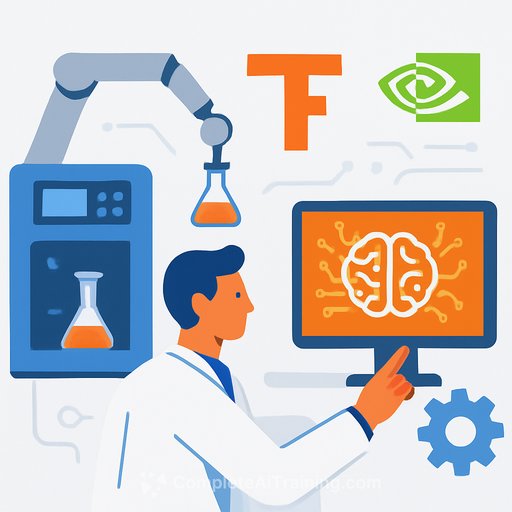
Thermo Fisher Scientific has announced a strategic collaboration with NVIDIA to bring AI-based solutions and laboratory automation to a broader set of instruments and workflows. The focus is simple: increase automation, improve accuracy, and shorten time-to-result across Research and clinical labs.
The partnership connects Thermo Fisher's instruments, lab software, and data infrastructure with the NVIDIA AI platform. The goal is an integrated stack that reduces manual steps, streamlines data handling, and accelerates discovery without adding complexity for scientists.
What's actually coming to the bench
Thermo Fisher will combine its instrument and software expertise with NVIDIA's AI infrastructure-referencing components such as NVIDIA DGX Spark, and model frameworks like NVIDIA NeMo and NVIDIA BioNeMo-to create more intuitive, AI-aware instrumentation. Expect interfaces that surface the right insights at the right time and workflows that guide scientists instead of slowing them down.
Under the hood, the collaboration aims to tie device telemetry, sample metadata, and analytical outputs into AI models that can assist with method setup, data QC, and interpretation. The ambition is a smoother path from sample to decision.
Why it matters for your lab
- Fewer manual steps and handoffs, reducing error rates and variability.
- Faster analysis cycles with AI-assisted preprocessing, QC, and reporting.
- More consistent user experience across instruments and software.
- Better use of existing data assets by connecting instruments, LIMS/ELN, and analytics.
- Clearer path to scaling automation across multiple sites and teams.
Where AI can make an immediate dent
- Imaging: segmentation, feature extraction, and experiment-to-experiment reproducibility.
- Sequencing: pipeline orchestration, secondary analysis support, variant interpretation assistance.
- Mass spec and proteomics: peak detection support, spectral matching suggestions, anomaly flagging.
- QC and maintenance: predictive alerts from instrument logs and usage data.
- Automation: smarter scheduling and error recovery across robots and instruments.
Technical pieces to watch
- NVIDIA compute and model frameworks (e.g., NeMo and BioNeMo) paired with Thermo Fisher instruments and lab software.
- Data connectors that bring device, run, and sample data into AI workflows with auditability.
- User experience that prioritizes guidance and traceability over black-box outputs.
For background on NVIDIA's model stacks, see NVIDIA NeMo and NVIDIA BioNeMo.
What to look for in 2026
- Validation and regulatory alignment for regulated labs (GxP-ready workflows, audit trails).
- Data governance: privacy, model provenance, and version control for AI-assisted analyses.
- Total cost and deployment patterns: on-instrument, on-prem, or hybrid with cloud bursts.
- Interoperability: LIMS/ELN integrations, open APIs, and support for existing pipelines.
- Model update cadence and transparency around training data and evaluation.
Practical next steps for lab leaders
- Map 2-3 high-friction workflows (time sinks, error-prone steps) as pilot candidates.
- Assess data readiness: instrument logs, metadata quality, and storage architecture.
- Loop in IT early to align on compute, security, and integration approach (see AI Learning Path for CIOs).
- Plan enablement: SOPs for AI-assisted tasks, and short training for scientists and QA.
- Request a roadmap session with vendors to clarify fit, timelines, and validation plans.
Thermo Fisher's broader ecosystem and partner network suggest this won't be a one-off integration. The direction is clear: instruments, software, data, and scientists working in a unified environment that actually speeds up science rather than adding another layer to manage.
If your team is building AI skills for lab workflows, consider the AI Learning Path for Technology Managers.
Your membership also unlocks: