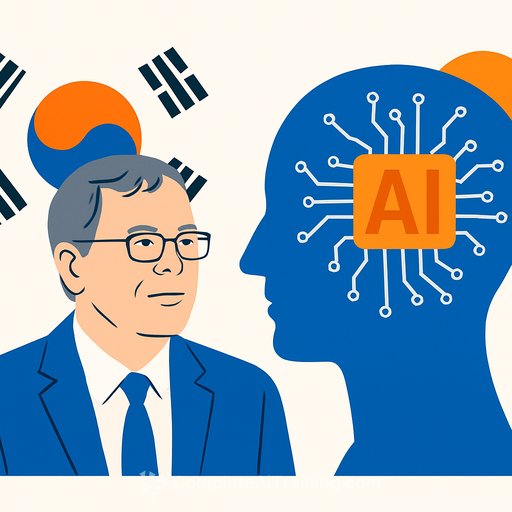
Restoring Korea's R&D Engine Meets AI Ambition - Tim Hunt's Hard Truths for 2026
Korea's R&D budget is back in growth mode. The National Assembly set the 2026 national R&D budget at 35.5 trillion won-up 5.9 trillion won (19.9%) from 2025. The conversation is shifting from "how much" to "what counts as outcomes" and "how to make discoveries."
Policy is betting on artificial intelligence. The plan: deploy an "AI research colleague" across the full research cycle, build science-and-tech foundation models, and aim for Nobel-level results by 2030. Tim Hunt, however, offers a sober counterweight: science is not a knowledge business; it deals with ignorance. AI won't explore the unknown for us.
Who is speaking
Tim Hunt, 83, is a British biochemist and 2001 Nobel laureate in Physiology or Medicine. He discovered cyclin, a key regulator of the cell cycle, sharing the prize with Leland Hartwell and Paul Nurse. He recently visited Korea for a lecture at Yonsei University.
AI: Powerful tool, weak compass for the unknown
Hunt credits AI's impact where data are deep and rules are relatively stable. AlphaFold's protein structure predictions are "remarkable," yet they lean on analogy with past data and must be confirmed experimentally. That's not the same as finding questions that look impossible on paper.
He cautions against expecting AI to "solve everything." When systems like Deepseek, ChatGPT, and Gemini disagree, that's a signal to verify rather than assume an answer exists out of the box. Use AI for logistics and known-knowledge tasks; be wary in unexplored biology.
- Use AI to speed literature triage, draft code, and structure protocols-then validate.
- Do not let AI choose research questions in areas where biology is still opaque.
- Disagreement across models = design a discriminating experiment, not a debate.
Reference: AlphaFold overview
What actually leads to Nobel-level work
Hunt's principle: tackle what peers quietly consider "theoretically impossible." He found cyclin because he looked over time and saw a protein disappear. The method existed for a decade; the insight came from asking a different question and watching dynamics, not snapshots.
In later work, his group probed mitotic exit. They observed large-scale dephosphorylation triggered by a short calcium pulse-evidence that mitotic exit isn't a single switch, but a sequence of enzymes acting in order. A key reagent tip from another lab sparked the path. Curiosity plus good timing beat rigid planning.
Serendipity favors prepared labs
- Run time-course experiments by default; biology is temporal.
- Recreate pivotal reagents in-house to remove friction and test variants.
- Design reversible toggles (e.g., calcium pulses) to expose hidden states.
- Chase small anomalies fast. A one-day check can change a project's trajectory.
- Pair senior intuition with a hungry postdoc who brings fresh questions.
Funding is back. Define outcomes that matter.
With budget restored, the real job is deciding what counts. Papers, patents, and prototypes are visible-but discovery often looks like "waste" until it compounds. Hunt's framing is blunt: science is expensive, and most searches fail. Want breakthroughs? Protect the right kind of "waste."
Policy guidance for Korea's science leaders
- Balance basic and applied. Let companies carry more of the application load when possible.
- Commit to long horizons. mRNA vaccines took ~50 years of steady problem-solving before saving lives during the pandemic.
- Build translators inside government-scientific advisers who can convert lab language into political decisions and protect multi-year bets.
- Aim AI funding at clear use cases (data-rich domains, tooling) and fence off exploratory science from hype cycles.
Reference: 2023 Nobel Prize in Physiology or Medicine (mRNA)
Culture that compounds results
- Independence: recruit the slightly disobedient who follow curiosity over instruction.
- Selection: reward good questions, not just output volume.
- Tolerance: keep people trying after failure; make the next experiment easy to run.
- Clusters: gather top talent and let them collide. Science isn't completely egalitarian; quality concentrates.
Playbook for PIs and research managers in 2026
- Allocate 10-20% of lab time to "unknowns" with tight, falsifiable endpoints.
- Institutionalize time-lapse and perturbation assays in screening pipelines.
- Set an AI usage policy: where it's allowed (code, search, summaries) and where it stops (hypothesis choice in murky biology).
- Require pre-registered success criteria for major experiments; update monthly.
- Run a quarterly "impossible list" meeting: identify one idea peers consider unworkable and scope a cheap test.
- Hire for complementarity: pair method builders with clue-spotters.
- Maintain a reagent and protocol library with versioning; note anomalies and near-misses.
What scientists do when AI "answers everything"
Hunt's stance is refreshingly human: if AI always spits out the right answer, that would be horrible-we might all have to become pop singers. Progress needs "I don't know." That's the job description.
One practical add-on for teams adopting AI
If your lab is formalizing AI skills for literature review, coding, or analysis, you can skim curated options by role here: AI courses by job. Keep it pragmatic: choose courses that map to a current bottleneck, then run a small pilot before scaling.
Bottom line
Invest in AI where it shortens loops. Invest in people and questions where AI can't see. Protect the space for "impossible" ideas, and then design the smallest experiment that could prove everyone wrong.
Your membership also unlocks: