
AI news ·
Tokyo university opens unmanned lab staffed entirely by robots to automate medical research
Tokyo's Institute of Science has opened a fully automated lab where 10 robots run medical experiments with no human staff on-site. The university plans to scale to 2,000 robots by 2040.
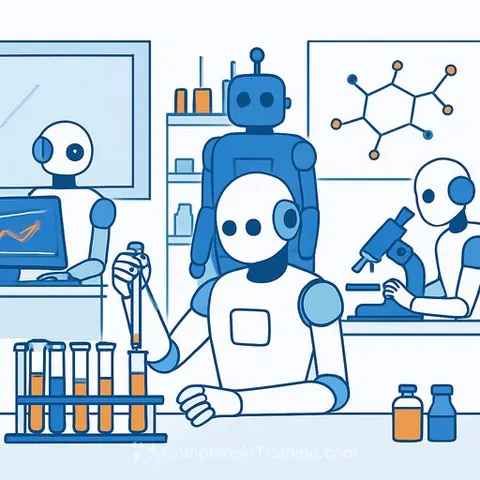
Tokyo University Opens Fully Automated Research Lab With 2,000-Robot Vision
The Institute of Science Tokyo has opened a laboratory where robots conduct medical experiments without human staff present, marking an escalation in automation across research institutions facing labor shortages and the need to reduce human error.
The Robotics Innovation Center, located on the university's Yushima campus, currently operates 10 robots, including a humanoid model called Maholo LabDroid. The facility has no human researchers on-site during operations.
The robots perform precise laboratory tasks: transferring measured amounts of reagents, opening temperature-controlled equipment doors, and handling cell cultivation work. Two-arm designs allow them to execute delicate procedures once reserved for experienced researchers.
The university plans to expand to approximately 2,000 robots by 2040, automating nearly all research tasks from hypothesis generation through experimental verification. This integration of robotics with artificial intelligence represents a substantial shift in how research institutions approach scientific work.
Keiichi Nakayama, head of the center, said at the facility's opening in mid-April that "we want to make Japan's science the best in the world," citing AI and robotics as essential tools. Robots participated in the ribbon-cutting ceremony.
Maholo has already been deployed at a hospital in Kobe focused on ophthalmology, where it performs clinical research tasks including cell culture work with induced pluripotent stem cells. Researchers who operated Maholo in Kobe have joined the Tokyo center.
Research institutions increasingly turn to automation to address staffing constraints and improve experimental consistency. The move reflects broader industry pressure to maintain research output while managing operational costs.
For professionals in research roles, understanding how to work alongside automated systems will become essential. AI Agents & Automation courses and AI Research Courses can help researchers develop skills needed in partially or fully automated laboratory environments.