AI's Verification Tax Is Breaking Legal Trust
Picture this: a senior partner spends her evenings checking every citation in an associate's brief. Local counsel racing to validate cites in a last-minute filing from national counsel. A judge double-checking a clerk's research for fear that a chatbot slipped into the workflow.
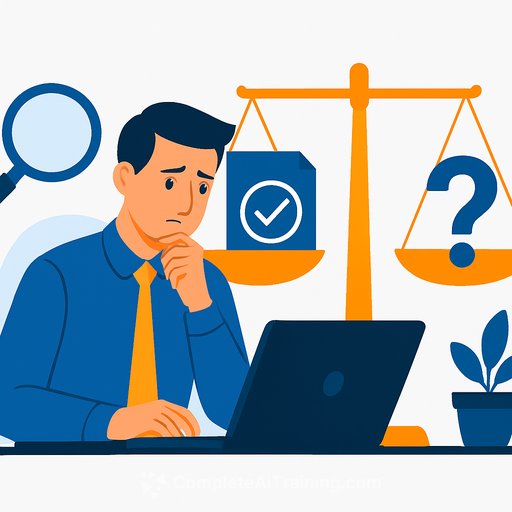
That's the new cost of AI in law. The verification burden. And it's turning the promise of efficiency into a tax on trust.
Why the Bubble May Burst (Part III)
Law runs on reliance. Partners rely on associates. Judges rely on clerks. Local counsel rely on national counsel. That system works because there's a baseline of training, accountability, and shared standards.
LLMs don't share that baseline. They fabricate authority with confidence. One slip by a talented but overloaded associate who pulls a cite from ChatGPT can lead to sanctions, public embarrassment, and lasting damage with clients.
As more people quietly weave LLMs into research and drafting, the frequency of hallucinated or misapplied authority rises. The result is predictable: trust erodes between the people who have always kept the machine moving.
The Risks May Be Too Great to Trust
Law demands precision. A single fake case or misfit citation can cascade through a motion, a ruling, or an appellate record. We're seeing fines, ethics scrutiny, and real reputational harm. Malpractice carriers are paying attention.
So ask yourself: can any signatory-lawyer or judge-skip verification now? Can you rely on a representation that "no AI was used" and sign your name anyway? In practice, that means every brief and opinion gets cite-checked by the person whose name is on it.
That's not a sustainable system. The cost of verifying can exceed the time saved by AI. And if every link in the chain re-checks everything, the entire leverage model of legal work starts to wobble.
But What About Humans?
Humans carry professional risk in their heads. We know the consequences of making up a case. We understand context, and we can explain our reasoning. AI doesn't have skin in the game. It sounds right even when it's wrong.
Will overworked associates use an LLM in a crunch? Of course. Will local counsel get a brief at 4 p.m. for a 5 p.m. filing with zero time to validate dozens of cites? Happens weekly. That's the verification trap: the tool is easy, the cost lands on the person who signs.
What You Can Do Now
- Ban high-risk use cases: No generative tools for case research, citation drafting, or fact assertions-unless every citation is independently verified in primary sources.
- Use tools that show their work: Prefer systems that link every statement to a verifiable source with a working URL or docket, and make "no source, no claim" a rule.
- Require human citators: Run every cited authority through a citator and confirm jurisdiction, posture, and proposition support. Build this into the checklist, not the heroics.
- Adopt a written AI policy: Define allowed tools, banned uses, disclosure requirements, logging, and supervision. Make violations a training and discipline issue.
- Triage verification: For high-stakes filings, verify every cite. For lower-risk work, sample with escalation thresholds. Document the scope you checked.
- Lock down procurement: IT should disable public chatbots on firm devices and approve only tools with privacy, audit trails, and firm-managed data boundaries.
- Add disclosures to workflows: Require associates, clerks, vendors, and co-counsel to certify whether AI assisted and what verification they performed.
- Train for failure modes: Teach teams the red flags of LLM output: fake reporters, wrong courts, anachronistic cites, and quotes that don't appear in the source.
- Measure the ROI honestly: Track hours saved vs. hours spent verifying. If the math doesn't work for a use case, cut it.
The Real Play
AI can help with templates, tone edits, outlines from your own materials, and summarizing documents you already trust. It struggles where truth, context, and citation quality decide outcomes.
Use it where the stakes are low and the sources are yours. Keep it away from research and drafting that touches the record, the court, or opposing counsel-unless you're ready to verify every line.
The Bottom Line
Law isn't anti-technology. It's pro-accountability. Until verification is cheap, reliable, and built into the tools, the risk of use is too big to trust for high-stakes work.
Choose restraint. Build policy. Train your team. Protect the trust that keeps your practice running-and your signature safe.
See role-based AI training paths to help your team use these tools responsibly without burning time on rework.
Your membership also unlocks: