
AI news ·
Top law schools restrict AI use in classrooms to preserve the Socratic method
Three top law schools are banning laptops and restricting AI to preserve classroom debate. Meanwhile, 58 percent of lawyers use AI for daily tasks.
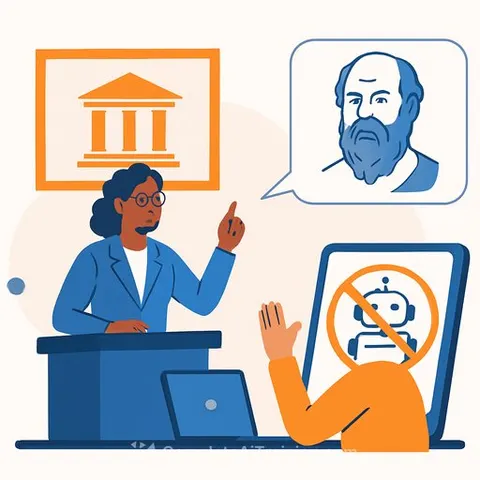
Three of the nation's top law schools-UC Berkeley, the University of Texas at Austin, and the University of Chicago-are rolling out new restrictions on student use of generative AI in the classroom. The University of Chicago Law School will ban laptops, tablets, and phones for first-year students beginning this fall, a move designed to prevent large language models from disrupting the Socratic dialogue that has defined legal education for generations.
UC Berkeley's law school implemented a default prohibition on AI use for any work submitted for credit starting this summer, while UT Austin's dean urged faculty to ensure students remain "not distracted by (let alone relying upon) whatever might be taking place on their screen." The policies reflect a growing concern among legal educators that AI tools short-circuit the intellectual rigor students need to become effective lawyers.
Preserving the Socratic method
Adam Chilton, dean of UChicago Law, said the laptop ban targets a specific problem: students using AI to sidestep the demanding back-and-forth that law professors use to teach legal reasoning. "You don't want students simply putting in the case name into Claude or ChatGPT, asking it for a summary and the questions their professor is likely to ask, and then just reading those answers when you call on them," Chilton said. The concern is amplified from earlier debates about laptops in classrooms, where the distraction factor alone was already a point of contention.
UChicago is also adding an in-person oral exam component to the substantial research paper required for the law degree. Chilton framed the ability to think and respond without AI assistance as perhaps the most durable skill an aspiring lawyer can build. "[These restrictions] force students to think for themselves, be able to answer a question on the fly, listen to arguments, respond to arguments and think about what the reasons are for themselves," he said. "It's exactly the kind of skill [lawyers] need in a high-pressure meeting with a client, a negotiation, hearing or a trial."
Skills that AI cannot replicate
The push to protect live discourse and debate in law school comes as law firms increasingly assign document review and summarization work to AI rather than junior associates. Chilton predicted that human lawyers will continue to own the courtroom for the foreseeable future. "I don't think we're going to have robots arguing in court for us," he said. "It's still going to be humans that stand in front of a judge and stand in front of a jury and make oral arguments."
Balancing restrictions with AI fluency
The new policies are not blanket rejections of AI. UChicago's first-year students will write without AI in their legal research and writing courses but may use it for research, revisions, and preparing oral arguments-with a professor providing feedback on both the student's work and their use of AI tools. The school will continue offering elective courses on the responsible and ethical use of AI in legal practice. According to an American Bar Association report, 58 percent of lawyers have integrated generative AI into daily tasks like drafting correspondence and conducting general research, while 54 percent use it for brainstorming and 47 percent for summarizing documents. AI for Legal training has become a practical necessity as firms expect new hires to arrive with these competencies.
UC Berkeley's law school takes a similar approach, allowing instructors to override the default AI ban for courses "designed intentionally to teach AI fluency." Erwin Chemerinsky, dean of Berkeley Law, emphasized that the policy is also about accountability-a lesson underscored by practicing attorneys who have faced sanctions for filing briefs containing AI-generated errors. "When students are instructed about AI from the beginning of law school, they're reminded that AI sometimes hallucinates cases, quotes and gets things wrong," Chemerinsky said. "We're teaching students that they're responsible for the work they turn in. When you turn a brief in to court, you're responsible for it."
Why this matters for legal professionals
For lawyers already in practice, the classroom restrictions signal what law schools believe the profession will continue to value: the ability to reason, argue, and respond without a machine intermediary. As firms offload more document-level tasks to AI, the premium shifts to the skills these policies protect-oral advocacy, quick analytical thinking, and personal accountability for the work product that bears your name. The same attorneys who use AI daily for research and drafting are still expected to stand before a judge and own every word.