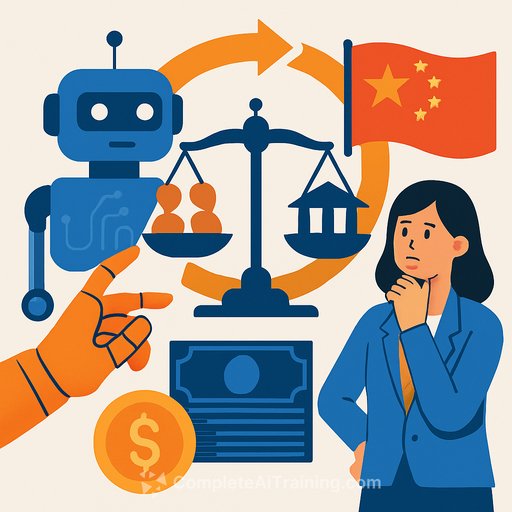
Tort Liability for Risks of Generative AI in China’s Circular Economy and Financial Industry
Abstract
This study examines tort liability linked to the risks of generative artificial intelligence (AI) in China's circular economy (CE) and financial sectors. Based on survey data from 60 companies, analyzed through structural equation modeling, it identifies how risk events and legal disputes vary by company size and sector.
Key findings show that large CE firms face more data breaches and technical faults, while smaller financial firms encounter more legal disputes and data leaks. Data leakage strongly correlates with legal liability (coefficient = 0.72, p < 0.001). Erroneous decisions and technical failures also impact liability.
The study highlights that technology implementation, legal environments, and management practices mediate the relationship between risk and liability. These insights help companies improve risk management, ensure compliance, and protect legal and financial interests.
Introduction
The circular economy (CE) and financial industry are vital for sustainable development and economic growth. CE emphasizes efficient resource use and recycling to reduce environmental impact. The financial sector supports economic activities through financing, risk management, and investments.
Both sectors face increasing challenges from global economic shifts and technological advances. Resource depletion and pollution push CE development, but progress varies worldwide, especially in developing countries. Simultaneously, financial globalization and digitalization increase market volatility and data security risks.
Green transition policies, like low-carbon city initiatives, encourage CE growth. AI technologies, including generative AI, help optimize resource recycling and energy efficiency. In finance, AI enhances risk assessment and transaction monitoring but raises concerns over data privacy and legal liability.
Generative AI applications in CE involve resource recycling and waste management, while in finance they support investment analysis and risk control. However, rapid AI deployment brings new risks such as data breaches, algorithmic bias, and ambiguous liability, creating urgent needs for clearer legal frameworks.
Under China’s Civil Code, tort liability covers damages from statutory breaches, including negligence and product liability. This study focuses on how generative AI risks translate into tort liability within CE and financial sectors, offering practical insights for policymakers and enterprises.
Literature Review
Research has explored CE policies, financial innovations, and AI applications separately but rarely their intersection. Studies emphasize challenges like enforcement gaps in CE, regulatory shortcomings in finance, and AI risks like algorithmic bias and data security.
Generative AI, especially generative adversarial networks (GANs), improve marketing and supply chain resilience but raise ethical and liability questions. Legal research highlights difficulties assigning responsibility for AI-caused harm, with debate over fault-based versus strict liability approaches.
Internationally, frameworks are evolving to address multi-causal AI risks, yet most focus on healthcare or autonomous driving. Few address cross-sector risks in CE and finance or consider composite liability models. This study fills that gap by analyzing China-specific enterprise data.
Application Research of AI Technology in Tort Law
Research Framework and Theoretical Basis
The study integrates CE theory, financial theory, and AI theory to analyze generative AI risks. CE theory promotes decoupling economic growth from resource use through recycling and ecological protection. Financial theory covers market operations, product innovation, and risk management.
AI theory includes machine learning (ML), deep learning (DL), and natural language processing (NLP). Generative AI extends these by simulating human creativity and improving data analysis. Together, these foundations support understanding of AI’s role and risks in CE and finance.
Research Object and Data Collection Method
The study targets enterprises in CE and finance that actively use generative AI. It covers small, medium, and large companies to ensure diversity. Preference is given to firms with known risk incidents or legal disputes linked to AI applications.
A multi-stage sampling process selected 60 companies representing a balanced mix of sectors and sizes. Data collection involved a detailed questionnaire addressing company background, AI use, risk events, legal disputes, response measures, and legal awareness.
Five management representatives per company completed the survey to gather comprehensive insights. The questionnaire combined quantitative and qualitative questions to capture the complexity of AI risk and liability.
Key Takeaways for Finance and Legal Professionals
- Data Leakage is a Major Liability Driver: Enterprises should prioritize data security measures, especially large CE firms and smaller financial institutions.
- Legal Ambiguity Requires Attention: The unclear scope of tort liability in AI-related incidents calls for proactive legal compliance and risk mitigation strategies.
- Management and Regulatory Factors Matter: Organizational practices and the legal environment can mediate risk exposure and liability outcomes.
- Cross-Sector Risks Demand Integrated Approaches: Solutions must consider both CE and financial sectors to address AI’s multifaceted challenges effectively.
For financial and legal professionals working with AI in these sectors, understanding these dynamics is critical to safeguarding operations and navigating evolving regulations.
Further Resources
For those interested in deepening their expertise on AI applications in finance and legal risk management, consider exploring courses on generative AI and compliance at Complete AI Training.
Your membership also unlocks: