AI helps LSU scientists fill water-quality data gaps - with an eye on the Gulf "dead zone"
Louisiana State University researchers built an AI tool to predict nitrogen and phosphorus where monitoring data are thin or missing. The goal: give planners and policy teams faster, defensible signals to cut nutrient export and shrink the Gulf of Mexico's seasonal hypoxic "dead zone."
Their approach estimates nutrient loads in rivers and streams and how much gets retained in soils. That retention signal points to where restoration or management changes will keep nutrients on land instead of fueling algal blooms downstream.
What the model actually does
- Fills spatial and temporal gaps where water-quality stations are absent or inconsistent.
- Predicts nitrogen and phosphorus in surface waters and estimates soil retention across sub-watersheds.
- Flags places that already hold nutrients well and sites that leak them downstream.
"That's a big difference that can also help planners and decision makers say, 'Where do we need to restore throughout the watersheds? … How can we increase the capacity of those places that retain nutrients like this?'" said lead author and LSU postdoctoral researcher Mariam Valladares Castellanos.
Why train in Puerto Rico?
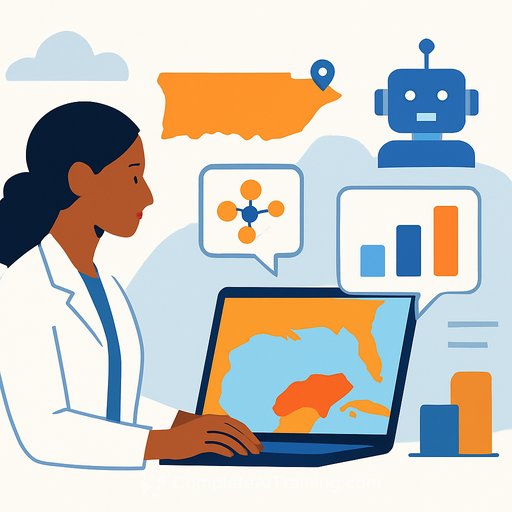
Puerto Rico's 3,500 square miles pack mountains, valleys, and coastal plains into a tight footprint. That diversity gives the model a wide range of watershed behaviors to learn from without the sprawl of the Mississippi River Basin.
Data scarcity is the real constraint. Many watersheds lack long-term, high-frequency monitoring because stations are expensive to build and maintain. The AI fills those blind spots so analyses don't hinge on a handful of gauges.
From island lab to the Mississippi River Basin
After proving the concept in Puerto Rico, the team's aim is to apply the same method across the Mississippi River Basin. The intent is straightforward: identify where to restore wetlands, riparian buffers, and soils so less nitrogen and phosphorus reach the Gulf.
"When you want to inform policy, you don't want to have blind spots because then you might be inferring or creating assumptions that then might not apply to those areas that don't have data," Valladares Castellanos said. Their study was published in October in Science of The Total Environment. This work contributes to ongoing Research into AI applications in environmental hydrology.
Context from the Chesapeake
Matthew Baker, a professor at the University of Maryland, Baltimore County, is applying AI to hydrology and restoration in the Chesapeake Bay. He sees value beyond better predictions: clearer attribution of why watersheds behave the way they do.
"The exercise now is to examine the many different ways that we can use artificial intelligence to augment our understanding … with greater resolution [and] greater accuracy," Baker said.
Why this matters for the Gulf "dead zone"
The hypoxic zone forms when nutrient-driven algal blooms deplete oxygen near the seafloor. A tighter map of sources, sinks, and retention helps target fixes that actually move the needle. See a concise primer from NOAA.
With continued model refinement-more inputs, better uncertainty treatment, stronger validation-LSU's team expects tighter error bounds. "We are always trying to get closer and closer to the real world conditions," Valladares Castellanos said.
Practical takeaways for agencies and research teams
- Fuse monitoring, soils, land cover, topography, and precipitation into gap-filling models; maintain a lean but high-quality ground-truth network for calibration.
- Map nutrient retention, not just loads. Use both to prioritize wetlands, floodplain reconnection, riparian buffers, cover crops, and controlled drainage.
- Run sensitivity and scenario analyses to expose leverage points and avoid overfitting to sparse stations.
- Quantify uncertainty and communicate it in plain terms for policy and spend decisions.
If you're building similar models
Upskill your team on practical AI for environmental data analysis and modeling. See curated resources on Data Analysis. Life-science teams working on ecological or biogeochemical modeling may also find the AI Learning Path for Biochemists helpful for broader modeling and analysis techniques.
Your membership also unlocks: