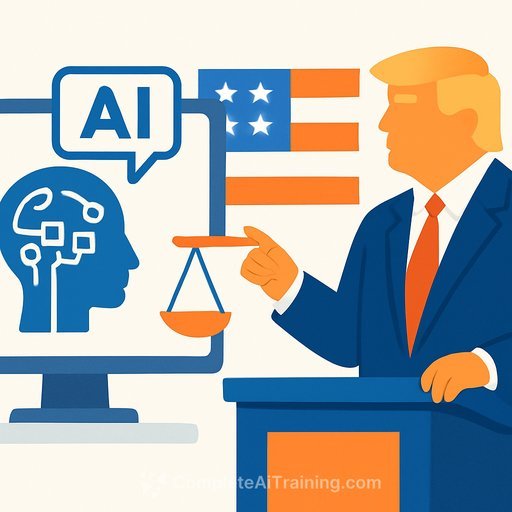
Trump Administration Calls for Federal AI Preemption, Uncertain Path Forward
The White House released a policy framework on March 20, 2026, outlining the Trump administration's legislative recommendations for AI governance. The framework pushes Congress to establish federal preemption of state and local AI regulations, a move that would centralize control over AI development at the federal level.
The administration characterizes AI development as "an inherently interstate phenomenon with key foreign policy and national security implications." It argues that states should not regulate AI development or penalize AI developers for third-party misuse of their models.
The framework does not recommend creating a new federal agency. Instead, it calls on Congress to support AI development through existing regulatory bodies and industry-led standards, while providing grants, tax incentives, and technical assistance to small businesses deploying AI tools.
What This Means for Employers
Several states and cities-including California, Colorado, Illinois, Texas, and New York City-have already enacted laws regulating how employers use AI in hiring, promotion, and other employment decisions. Federal preemption would override these existing rules.
That shift creates a practical problem for legal teams. Federal preemption could reduce employers' obligations under state AI regulations while potentially raising questions about compliance with longstanding federal and state antidiscrimination laws. Multinational employers face additional pressure, as many countries restrict AI use in employment decisions.
For organizations with AI for Legal teams, understanding both the current regulatory patchwork and the administration's stated intentions is essential to compliance planning.
Implementation Remains Unclear
Congress has shown limited appetite for the framework so far. Previous executive orders from the administration have not been fully implemented, particularly regarding efforts to identify "onerous" state laws. Whether Congress will act on this framework in the near term remains uncertain.
The framework reflects the U.S. position in a global debate over AI regulation. The European Union's AI Act, by contrast, prioritizes protecting individual rights and freedoms over promoting innovation.
Legal professionals should monitor congressional activity on this issue while continuing to track state-level regulations. The current regulatory environment remains fragmented, and any federal preemption legislation would likely take months to develop and pass.
AI for Executives & Strategy covers how organizations can align governance structures with emerging regulatory frameworks.
Your membership also unlocks: