Genesis Mission: A national AI push aimed at faster scientific discovery
US President Trump has directed the Department of Energy (DOE) to launch the Genesis Mission, a unified AI platform intended to accelerate breakthroughs across core areas of science and engineering. The order frames this as a race for technological leadership, with urgency compared to major historic national projects.
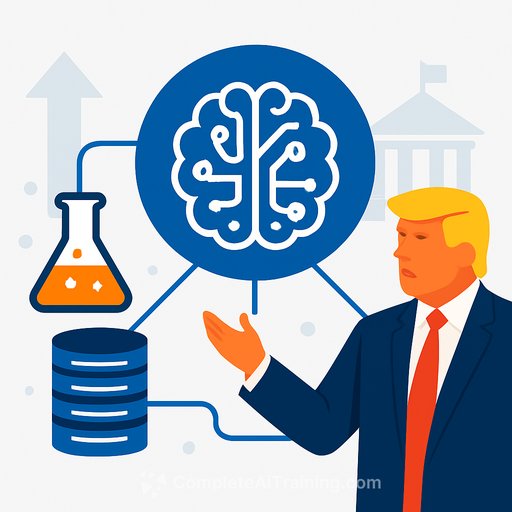
At its core, Genesis will link federal compute, government datasets, and the DOE's National Laboratories into a single discovery system. The goal: train scientific foundation models, deploy AI agents to test hypotheses and automate workflows, and deliver measurable advances in fields that matter to national competitiveness and energy security.
What the DOE will build
The DOE will connect supercomputers, facilities, and research programs across its 17 National Labs with industry and academia, tapping the expertise of roughly 40,000 scientists, engineers, and technical staff. Think of an integrated platform where data, models, compute, and experiments form a closed loop.
- Train scientific foundation models on prioritized federal datasets.
- Develop AI agents to propose experiments, run simulations, and analyze results.
- Target "energy dominance," including fusion feasibility and grid modernization to meet rising demand.
- Unify on-premises HPC with cloud resources and industry partner infrastructure.
Leadership and structure
The DOE has the lead. While Secretary of Energy Chris Wright is accountable for Genesis, implementation sits with the Under Secretary for Science, Dr. Darío Gil (formerly a senior VP and research director at IBM).
"We are linking the nation's most advanced facilities, data, and computing into one closed-loop system to create a scientific instrument for the ages," Gil said. The stated ambition is to double R&D productivity and solve challenges once thought out of reach.
Deadlines researchers should track
- Within 90 days: Inventory all federal compute resources available to Genesis (DOE sites, cloud systems, and partner capacity).
- Within 120 days: Identify initial government datasets and model assets for the program.
- Before that: Submit to the White House Office of Science and Technology Policy (OSTP) at least 20 science and technology challenges for Genesis to target.
- Within 270 days: Demonstrate an initial operating capability for at least one selected challenge.
Expected focus areas
- Nuclear fission and fusion energy
- Quantum computing
- Critical materials
- Advanced manufacturing
- Semiconductors and microelectronics
Funding and resource reality
The order doesn't specify new funding. The practical read is that DOE will reallocate or coordinate from existing budgets and facilities while it scopes needs. That may mean re-prioritization, shared queues, and tighter coordination across labs and program offices.
If you run large campaigns on DOE systems, expect updated allocation policies, more emphasis on data readiness, and requests for projects that can plug into the Genesis stack.
What this means for scientists and research teams
- Data readiness: Inventory your datasets, document metadata, and align to FAIR practices. Clean labels, provenance, and versioning will decide what gets onboarded first.
- Access and portability: Containerize workflows (e.g., Apptainer/Singularity), standardize job specs (Slurm), and validate portability across HPC and cloud.
- Governance: Define model cards, evaluation plans, and human-in-the-loop review for high-consequence decisions. Prepare for reproducibility checks.
- Security and compliance: Map data to sensitivity tiers; review export controls, cybersecurity, and publication policies for dual-use results.
- IP and collaboration: Clarify ownership, licensing, and data-sharing MOUs with lab and industry partners ahead of time.
- Measurement: Propose clear success metrics (e.g., cycles to insight, cost per experiment, predictive accuracy against baselines) for any Genesis-aligned effort.
- Engage early: Contribute challenge ideas through your lab or institution's channels so your domain gets represented in the OSTP submission.
Economic backdrop: why urgency is high
AI-related investment has been a major contributor to recent US GDP growth, according to multiple reports, which raises two pressures at once: deliver tangible scientific outputs and justify spend with clear ROI. If the market cools, scrutiny will rise. Projects that show measurable efficiency gains, validated predictions, and deployable tools will get prioritized.
Open questions to watch
- How will access be allocated across labs, universities, and industry partners?
- What standards will govern data quality, security, and model evaluation?
- How will IP be handled for models trained on federal data and lab infrastructure?
- What oversight will address reproducibility, safety, and dual-use risks?
- Will there be dedicated funding lines, or will programs be consolidated under Genesis?
Where to monitor updates
Expect calls for information, concept papers, and FOAs to flow through DOE and OSTP channels. Bookmark official sites and watch your lab's program office communications:
If your team needs to skill up on AI methods
For groups planning to align with Genesis but still building ML capability, curated training can speed up adoption and help meet governance expectations. A practical place to start is role-based curricula relevant to research and engineering teams: Complete AI Training - courses by job.
Your membership also unlocks: