Trump Order Seeks to Override State A.I. Laws: What Legal Teams Need to Know
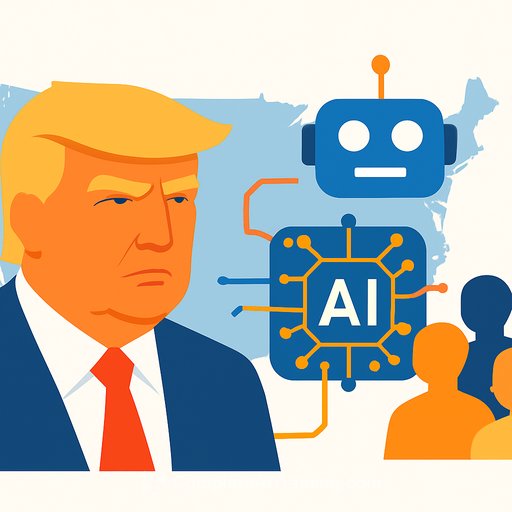
President Trump signed an executive order that seeks to displace state A.I. laws by establishing a single federal framework. The order directs the attorney general to sue states and "overturn laws" seen as obstacles to "United States' global A.I. dominance," and threatens to withhold federal funds for broadband and other projects if states keep those laws in place.
The administration argues a unified approach is necessary to avoid a patchwork of rules and to keep pace with China. "It's got to be one source… You can't go to 50 different sources," the president said, alongside officials including David Sacks, described as the A.I. and crypto czar.
What the Order Signals
- Preemption push: A federal A.I. "framework" intended to supersede conflicting state rules on safety and consumer protection.
- Litigation posture: Broad authority for the Department of Justice to challenge state laws viewed as barriers to national A.I. priorities.
- Funding leverage: Direction to condition or withhold federal funds (e.g., broadband) if states retain their A.I. statutes.
- Industry alignment: Continues a pattern of limiting regulation, opening federal data access, easing A.I. infrastructure, and loosening chip export barriers.
The Core Legal Questions
The big issue: Can an executive order, without new congressional authorization, preempt state A.I. laws? Expect immediate challenges from states and consumer groups. The fights will center on preemption, the Spending Clause, the Administrative Procedure Act (APA), and Tenth Amendment limits on federal control of state policymaking.
Preemption: Can an EO Displace State Law?
Preemption typically flows from statute or valid agency rules issued under a clear delegation from Congress. An executive order, standing alone, usually cannot override state law. The government may argue that national A.I. strategy implicates foreign affairs and national security, but courts scrutinize efforts to use executive policy to negate state statutes absent congressional backing.
Watch for arguments over conflict and obstacle preemption and whether any existing federal statutes actually occupy the field. Without a clear legislative hook, the preemption claim faces a steep climb under the Supremacy Clause. See background on the clause here: Cornell LII: Supremacy Clause.
Spending Clause and Funding Threats
Conditioning or withholding federal funds must be tied to statutory authority, stated unambiguously, and not be unduly coercive. The order's direction to withhold broadband and related funds will be tested against those limits. Expect cites to South Dakota v. Dole and NFIB v. Sebelius, and arguments that sweeping conditions require clear congressional authorization.
In the background looms the major questions doctrine after West Virginia v. EPA. If the administration relies on existing grant statutes to impose far-reaching A.I. conditions, courts may ask whether Congress clearly authorized that scale of policy choice. Case overview: West Virginia v. EPA (LII).
Tenth Amendment and Anti-Commandeering
The federal government cannot command states to legislate or regulate in a particular way. Preemption is different-it nullifies conflicting state law-but it requires valid federal law to do the nullifying. Attempts to force repeal or non-enforcement of state A.I. laws through executive direction, rather than statute, invite anti-commandeering and ultra vires claims.
APA and Ultra Vires Theories
If agencies implement the order via guidance, grant conditions, or enforcement actions, those steps are subject to APA review. Expect challenges that any binding effect exceeds statutory authority, lacks notice-and-comment where required, and is arbitrary or capricious. Courts may also question whether the attorney general has a cause of action to "overturn" state laws without a statutory preemption basis.
Litigation Forecast
- Plaintiffs: States, AG coalitions, and consumer groups. Tech companies may intervene or file amicus on both sides.
- Claims: Violations of the Spending Clause and Tenth Amendment, lack of statutory authority, APA violations, and improper preemption.
- Relief sought: TROs and preliminary injunctions. Venue shopping will be intense; expect quick appellate activity.
- Timeline: Fast. Funding threat dates, agency implementation memos, and grant cycles will drive emergency motions.
What Counsel Should Do Now
- Do not abandon state compliance. Maintain current controls until a court says otherwise or an agency issues lawful, final rules.
- Map exposure. Inventory all applicable state A.I. statutes (safety, disclosures, auditing, consumer rights) and identify highest-friction conflicts with the anticipated federal approach.
- Assess grant risk. List all federal funding streams (especially broadband and infrastructure). Review statutory terms for conditions, waiver authority, and clawback risk.
- Contract updates. Add change-in-law and allocation-of-risk clauses for A.I.-related obligations with vendors and partners.
- Documentation. Track compliance investments and reliance interests; this record supports equitable arguments if funding conditions shift.
- Regulatory watch. Monitor DOJ filings, OMB/agency guidance, and any interim final rules. Prepare comment outlines now in case notices drop on short timelines.
- Litigation prep. Draft templates for TRO/PI briefs or amicus participation. Line up declarations on operational harm and grant dependencies.
Strategic Considerations for In-House Teams
- Two-track planning: One plan if state laws remain in force; another if a federal standard prevails. Build controls that can toggle by jurisdiction.
- Governance: Stand up a cross-functional A.I. committee (legal, security, data, compliance) to make fast calls as rules shift.
- Board communication: Provide a concise risk memo on potential funding exposure, litigation scenarios, and compliance spend.
Bottom Line
This order sets up a federalism fight with immediate operational stakes. Until courts rule or agencies issue lawful, final regulations, assume state A.I. requirements still matter-and plan for both outcomes.
If your legal team is building A.I. fluency across business units, this curated resource may help: A.I. courses by job role.
Your membership also unlocks: