What Are President Trump's Plans for State AI Laws?
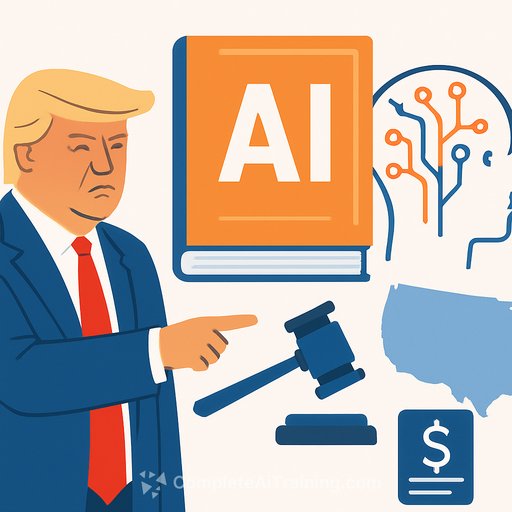
President Donald Trump is preparing an executive order to curb state authority over AI regulation and replace it with a single federal framework. The goal is to end the state-by-state rulemaking that major tech firms argue is costly and inconsistent.
The draft order goes beyond policy signaling. It would direct the Department of Justice to sue states with AI laws and instruct federal agencies to withhold certain funding-such as broadband grants-from states that keep them on the books.
For legal teams, the immediate question isn't policy-it's authority. Can an executive order preempt state law? Short answer: that's on very shaky ground.
Key facts
- Executive order would block state AI regulations and install a single federal approval regime
- Draft directs the U.S. Attorney General to challenge state AI statutes in court
- Funding leverage: agencies would withhold grants from states with AI laws
- Legal experts argue only Congress can preempt state law
- Tech sector largely backs a single framework to avoid a patchwork of rules
What the order appears to do
- Asserts federal primacy over AI governance and approvals
- Instructs DOJ to pursue litigation aimed at invalidating state AI laws
- Conditions certain federal funds on the absence or repeal of state AI measures
At the same time, the administration has reversed several Biden-era AI safeguards and loosened export restrictions-signaling a deregulatory posture.
The legal hurdles
Preemption requires Congress. Under the Supremacy Clause, preemption typically flows from a federal statute or a valid agency rule grounded in clear statutory authority. An executive order alone does not displace state law.
Anti-commandeering doctrine. The federal government cannot dictate what state legislatures may or may not enact. The Supreme Court's decision in Murphy v. NCAA makes this plain: Congress (and by extension, the Executive) cannot issue direct orders to states to refrain from legislating.
Agency authority and the major questions doctrine. Preemptive effect typically comes through agency rulemaking tethered to a statute. Without clear congressional authorization, a sweeping attempt to set national AI rules-and extinguish state police-power regulations on consumer protection, safety, or elections-faces serious risk. Expect challenges invoking the major questions doctrine and the APA.
Spending Clause limits. Withholding federal funds to coerce state policy changes runs into South Dakota v. Dole and NFIB v. Sebelius constraints: conditions must be unambiguous, related to the program's purpose, and not so coercive as to cross the line from pressure to compulsion. Retroactively altering grant terms also raises appropriation and reliance issues.
Where states stand now
States moved first. All 50 states and U.S. territories introduced AI bills this year, and 38 enacted roughly 100 AI-related laws. Common features: pre-deployment risk testing, consumer privacy safeguards, and deepfake restrictions tied to elections.
For a running tally of state activity, see the National Conference of State Legislatures' coverage of AI bills and laws here.
Expected litigation posture
- Immediate suits by states and civil groups seeking declaratory and injunctive relief (Tenth Amendment, anti-commandeering, Spending Clause, APA).
- Venue likely in circuits with active federalism jurisprudence; look for multi-state coalitions and quick TRO/PI motions.
- Preliminary injunction odds favor challengers if the order directly restricts state lawmaking or conditions funds broadly and punitively.
- Agency rules/guidance implementing the order will draw independent APA challenges on statutory authority, arbitrariness, and preemption scope.
Tech sector's position-and the counterweight
Large AI firms and investors argue that a single federal framework reduces cost and compliance friction, especially for smaller players. Opponents-including consumer advocates and child-safety organizations-argue that preempting state rules would remove the only meaningful checks currently in force.
Practical steps for in-house and outside counsel
- Do not stand down on state compliance. Until a court enjoins state laws or an agency promulgates a valid, preemptive rule, current state obligations remain enforceable.
- Map your exposure. Maintain an inventory of applicable state AI statutes (risk testing, privacy, deepfakes, disclosures) and related deadlines.
- Track grant conditions. If your organization or clients rely on federal broadband or tech grants, monitor agencies for new or revised conditions; assess Dole/NFIB risk if conditions pressure states or recipients.
- Prepare for dual-track compliance. Build a baseline control set that meets the strictest common state requirements to reduce variation costs.
- Engage early on federal rulemaking. If agencies issue ANPRMs or NPRMs under existing statutes (FTC Act, Communications Act, etc.), submit comments on statutory bounds, preemption clauses, and cost impacts.
- Plan for rapid litigation holds. Anticipate TRO/PI developments and be ready to pivot compliance posture if courts enjoin parts of the order or agency action.
What to watch next
- Final executive order text. Look for explicit preemption claims, funding mechanisms, enforcement timelines, and agency assignments.
- First-filed challenges. Plaintiffs, venues, and the framing of Tenth Amendment and Spending Clause arguments will set the tone.
- Agency guidance and rules. Scope, statutory hooks, and any express preemption provisions or savings clauses.
- Congressional activity. Whether a federal AI bill resurfaces with clear preemption language-or a savings clause preserving state police powers.
Bottom line
A federal AI framework through executive action faces steep constitutional and administrative barriers. Preemption without Congress is the weak link; funding penalties raise additional risk. Until courts say otherwise, state AI laws remain active-and compliance programs should treat them that way.
Your membership also unlocks: