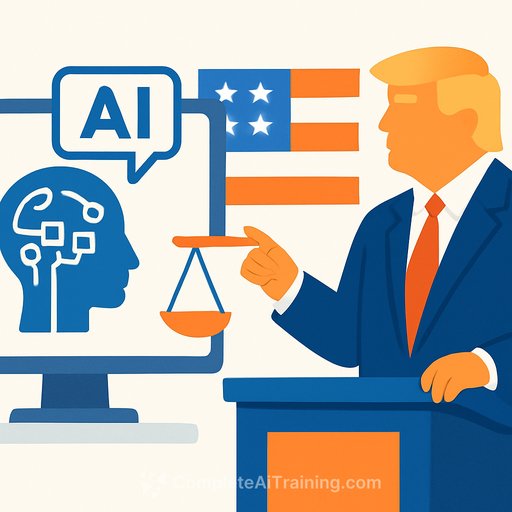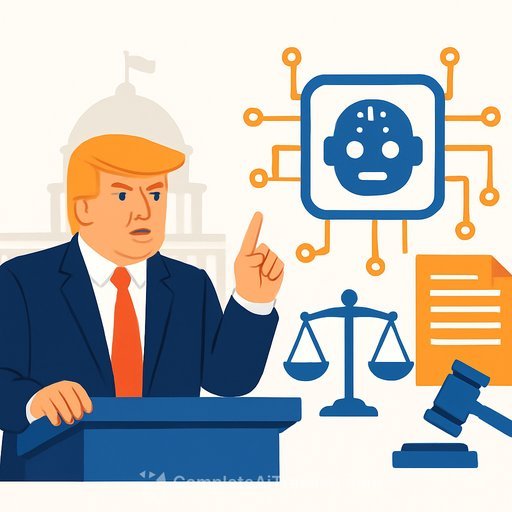
Trump administration proposes single national AI regulatory framework
The Trump administration released a legislative framework Friday designed to create uniform federal AI safety rules and prevent states from establishing their own regulations. The proposal aims to give developers one set of national standards rather than compliance requirements from 50 different states.
The framework rests on six pillars: protecting children and empowering parents, preventing censorship and protecting free speech, enabling innovation, educating Americans, developing an AI-ready workforce, and establishing international leadership.
The administration plans to work with Congress in coming months to convert the framework into legislation. President Trump has made AI competitiveness a priority, stating in July 2025 that the U.S. "started the AI race" and will win it.
What's in the framework
The proposal builds on the broader "America's AI Action Plan" released in July, which focused on accelerating innovation, building AI infrastructure, and leading in international diplomacy. An executive order signed in April created an AI education task force aimed at preparing young people to work with the technology.
Mark Beall, president of the AI Policy Network, told The National News Desk that a single national standard would prevent developers from navigating conflicting state rules. He noted the administration views AI as pivotal to the country's future.
What's missing: national security
Beall pointed to a notable gap: the framework does not directly address national security concerns, particularly AI chip exports. On Thursday, the Justice Department indicted three people for allegedly smuggling Nvidia chips and servers to China in a $2.5 billion scheme.
"When we're thinking about American AI dominance and we know that these AI chips are like the oil of the AI economy, the fact that these chips continue to flow to China, the fact that this framework doesn't directly address that, is something worth noting," Beall said.
Mixed political reaction
Democrats and Republicans have diverged on the proposal. Senator Richard Blumenthal (D-CT) called it "pathetic" and "a non-starter" that favors Meta and OpenAI while offering little protection for workers and families concerned about AI's impact.
Senator Dan Sullivan (R-AR) countered that the administration took a "critical and commonsense step" by providing Congress a roadmap to capitalize on AI's potential and improve healthcare, economic growth, and quality of life.
The disagreement suggests passage will be difficult. As of 2026, all 50 states have introduced some form of AI legislation, with 45 states enacting laws criminalizing AI-generated child sexual abuse material.
Your membership also unlocks: