
AI news ·
Trump reports $1.4 billion in crypto earnings as AI bubble debate intensifies
Trump's 2025 disclosure reports over $1.4 billion in crypto earnings, raising conflict-of-interest questions. AI infrastructure spending could top $500 billion in 2026, stoking bubble worries.
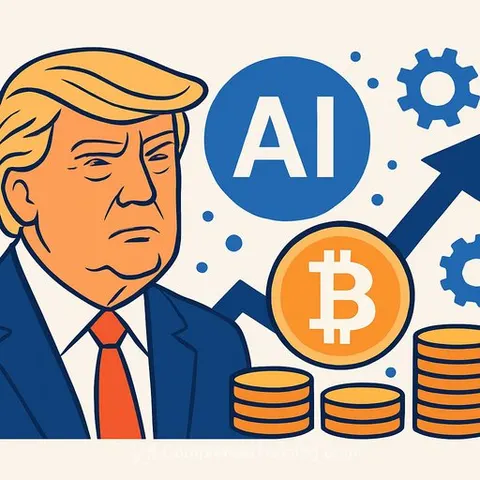
President Donald Trump's 2025 financial disclosure, filed with the U.S. Office of Government Ethics, shows more than $1.4 billion in cryptocurrency earnings - a concentration of personal profit from a policy-favored asset class that forces immediate questions about conflicts of interest at the highest level of government. At the same time, AI infrastructure spending is projected to exceed $500 billion in 2026, intensifying a parallel debate over whether the market is funding a revolution or an investment bubble.
Nearly $800 million of Trump's crypto income came from World Liberty Financial, the venture he co-founded with his sons. That sum includes $520 million from token sales and over $250 million from business interest sales. Another $635 million flowed from Trump meme coin sales. The crypto haul dwarfs the roughly $500 million his traditional golf and resort properties generated in the same year, and Reuters estimates the Trump family has collected at least $2.3 billion from digital assets since January 2025.
The numbers grew alongside policy shifts that directly benefited the industry - federal stablecoin rules, reduced Justice Department enforcement, and a more permissive SEC posture. While the White House maintains the president's business interests are managed by his children and no conflicts exist, the president remains the beneficiary of the trust receiving this income. When a head of state derives the bulk of his earnings from a sector he regulates, the line between public authority and private gain blurs.
The AI Boom by the Numbers
AI hyperscalers poured $394 billion into capital expenditures in 2025, and 2026 projections push that figure past $500 billion. OpenAI is in funding talks that could value the company above $800 billion, driven by annualized revenue that jumped from $2 billion to over $20 billion in two years. These sums are increasingly circular: Oracle has committed $300 billion to OpenAI, is spending $40 billion on Nvidia chips, and Nvidia is reportedly investing $100 billion back into OpenAI.
The earnings picture separates this moment from the dot-com era. The Magnificent 7 - Nvidia, Microsoft, Alphabet, Amazon, Meta, Apple, and Tesla - collectively earn more than $100 billion annually. Their price-to-earnings ratios mostly sit between 20x and 40x, not the 200x-500x multiples of 2000. And adoption is genuine: 80% of Fortune 500 companies adopted ChatGPT within nine months of launch, and 70% of strategy and finance departments report revenue increases from AI deployment. Still, a widely cited analysis flagged a $600 billion gap between AI revenue expectations and actual revenue, while an MIT study found 95% of companies report no measurable ROI on their AI spending.
Concentration, Regulation, and Investment Discipline
Market concentration compounds the risk. Nvidia's market cap alone exceeds $3 trillion, and high correlation among mega-cap tech stocks during stress means a sentiment shift could ripple through index funds and retirement portfolios. The geographic tilt is equally stark: U.S. firms dominate AI value capture, while European components suppliers like ASML and enterprise players like SAP trade at lower multiples that may offer a different risk-return profile.
Evaluating AI investments requires separating companies with durable revenue streams and competitive moats from those riding the hype. Finance managers who can make that distinction will be better positioned - developing that discernment is the focus of AI Learning Path for Finance Managers. Crypto exposure demands similar rigor: position size limits, diversification, and a cold-eyed assessment of regulatory risk. The Trump case makes clear that policy can pivot on political calculation, not just economic fundamentals. Understanding how governance and technology risk intersect is part of the skill set covered in AI for Finance Courses that address both the mechanics of digital assets and the policy frameworks shaping their valuations.
Why this matters for finance professionals
The separation between political risk analysis, technology due diligence, and portfolio construction has collapsed. A president's crypto gains can reshape regulatory climates, and hyperscaler spending can redraw global equity indices overnight. The professional who integrates policy forecasting with hard-nosed valuation work - and limits concentration risk whether in digital assets or tech mega-caps - will be the one who protects capital and identifies genuine opportunity amid the noise.