Trump Executive Order Seeks to Preempt State AI Laws: What Legal Teams Need to Know
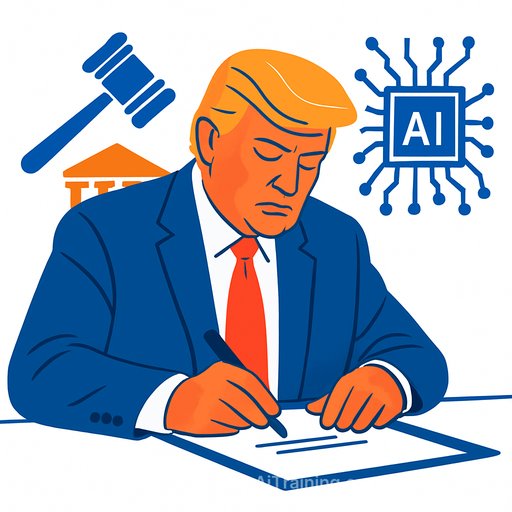
Donald Trump signed an executive order directing the federal government to sideline state artificial intelligence laws. The stated goal: eliminate a patchwork of rules that tech firms say slows development and weakens U.S. competition with China.
The order instructs federal agencies to challenge certain state AI requirements, set national disclosure standards, and pressure states using federal broadband funds. Expect immediate legal tests.
What the order does
- DOJ AI Litigation Task Force: Attorney General Pam Bondi is directed to form a task force to challenge state AI laws, including under the Dormant Commerce Clause and federal preemption theories.
- Federal policy framework: Directs the creation of a federal AI policy intended to preempt conflicting state rules.
- First Amendment focus: Targets state laws that require AI models to alter truthful outputs, or compel developers/deployers to disclose or report information in ways that would violate the First Amendment or other constitutional provisions.
- FCC disclosure standard: Directs FCC Chairman Brendan Carr to adopt a federal reporting and disclosure standard for AI models that preempts conflicting state laws.
- Funding leverage: Warns that states may risk losing certain federal funds tied to rural broadband expansion.
- Carve-outs: Child safety and data-center infrastructure laws are not targeted.
Key context from Congress and industry
Congress rejected a proposal to preempt state AI laws during debate over the One Big Beautiful Bill Act. Sen. Ted Cruz, who was present for the signing, previously pushed a 10-year moratorium on state AI legislation that failed on a bipartisan vote.
Trump's team argues national unity is needed against China, while signaling a lighter touch on AI regulation. The administration has also been cool to compensating creators for training use, a point of friction with Hollywood-highlighted by Disney's cease-and-desist letter to Google over AI use of copyrighted characters.
The legal theories you'll see
- Preemption: An executive order alone does not preempt state law; agencies need clear statutory authority and valid rulemaking. The order sets the policy and directs litigation and rulemaking that could produce conflict or field preemption in specific domains.
- Dormant Commerce Clause: DOJ may argue certain state AI mandates unduly burden interstate commerce, especially where compliance varies by jurisdiction or affects nationwide AI services. See background at Cornell LII.
- First Amendment: Expect challenges to state requirements that compel disclosure or force models to alter truthful outputs. Compelled speech and content-based restrictions will be front and center. Background: Cornell LII.
- Agency authority and APA: States will likely argue that any FCC preemption exceeds statutory authority or is arbitrary and capricious, inviting Administrative Procedure Act claims.
How fast does this move?
Litigation could start quickly if DOJ sues to enjoin state provisions or if states challenge agency actions implementing the order. Watch for forum selection battles, emergency motions for TROs or preliminary injunctions, and requests for nationwide relief.
Which state provisions are most exposed?
- Disclosure mandates about AI use: California's chatbot disclosure rule squarely fits the category the order flags. Expect arguments that uniform federal disclosures should preempt varying state scripts.
- Safety protocols for self-harm: California's requirement that platforms address users expressing suicidal ideation could be attacked as compelled operational conduct or speech. The child-safety carve-out exists, but suicide/self-harm provisions may be litigated over whether they fall within it.
- Right-of-publicity protections: Tennessee's ELVIS Act targets unauthorized use of name, voice, and image in AI works. It may be less vulnerable under the order's stated focus on disclosure/output mandates, but could become collateral if framed as burdening interstate AI services.
Signals from Congress
Sen. Amy Klobuchar called the order "the wrong approach-and most likely illegal," arguing for a federal safety standard without stripping state protections. Sen. Alex Padilla said the order "is attacking state leadership and basic safeguards," urging more support for agencies, research universities, and talent pipelines. These statements preview supportive states' defensive posture and amicus strategy.
What in-house counsel and policy teams should do now
- Inventory exposure: Map your current and planned AI deployments to state AI obligations (disclosures, recordkeeping, guardrails, safety protocols, and right-of-publicity issues).
- Segment by risk: Flag provisions that compel speech or force model output changes; these are priority targets for federal challenges.
- Prepare dual-track compliance: Maintain state compliance while scoping a fallback aligned to a potential FCC standard. Build switchable disclosures and modular compliance artifacts.
- Document First Amendment positions: For each disclosure or output rule, draft internal memos assessing compelled speech, content discrimination, and commercial speech tests.
- Monitor rulemaking: Track FCC proceedings and DOJ litigation. Calendaring likely comment windows is essential for preserving arguments and building record support.
- Contract updates: Add flexibility clauses for disclosure formats and audit/reporting obligations that may change with federal preemption.
- Funding exposure: If you operate in broadband or partner with state programs, model scenarios where federal funds are conditioned or withheld.
- Publicity and copyright: Keep separate workstreams for right-of-publicity risks (voice/image cloning) and copyright training issues; the administration's stance suggests limited relief for creators in the near term.
Expect the core questions
- Does the Communications Act give the FCC authority broad enough to standardize AI disclosures and preempt state rules touching online services?
- Are state AI mandates regulating speech or conduct, and do they trigger strict scrutiny or commercial speech analysis?
- Do certain state laws impose unjustified burdens on interstate commerce when applied to nationwide AI systems?
- Is the executive order an overreach absent clear congressional authorization, or can agencies fill the gap via existing statutes?
Bottom line
The order sets up a federal-state confrontation over who writes the rules for AI. Companies should keep complying with state laws today, but be ready to pivot quickly if courts issue stays or the FCC moves fast on a national disclosure standard.
If your legal team is building AI governance playbooks and training for product, policy, and engineering partners, you may find this resource helpful: AI courses by job role.
Your membership also unlocks: