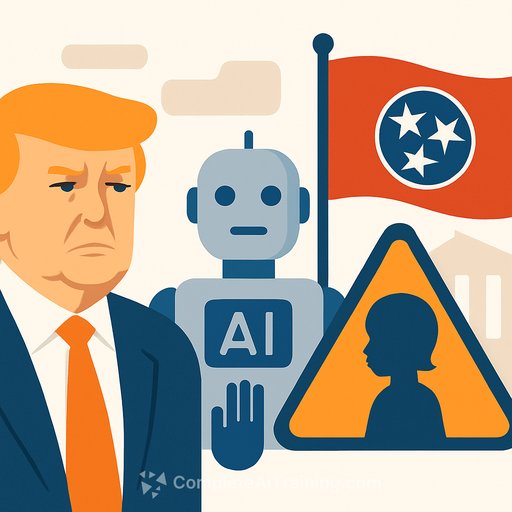
President Trump's AI Legislation Could Impact Tennessee Regulations
President Donald Trump’s new AI legislation carries significant implications for Tennessee’s ability to regulate artificial intelligence. The bill includes language that prevents states from imposing their own AI regulations, threatening to withhold federal broadband funding from those that do. This could effectively pause state laws such as the Elvis Act, which protects artists from unauthorized AI use of their voices and images.
Kaley Bonett, an entertainment lawyer based in Nashville, expressed concern that this move might hinder progress, especially given the current absence of federal AI regulations.
Challenges for Artists and Songwriters
Karl Braun, a managing partner at Hall Booth Smith, highlighted the financial risks to songwriters posed by AI-generated deepfakes. If AI-created copies compete with authentic performances, revenue streams could be diverted, making it difficult for creators to safeguard their earnings legally in a largely unregulated digital environment.
David Kieley, a plaintiffs attorney, pointed out that the bill does not offer alternative regulations, which is highly unusual. This leaves a regulatory gap that could expose individuals and industries to unchecked AI impacts.
Risks to Privacy and Reputation
The legislation also threatens the “Preventing Deep Fakes Images Act,” a Tennessee law that criminalizes the distribution of harmful AI-generated fake images. Meteorologist Bree Smith shared her experience as a victim of AI-generated fake imagery, emphasizing how the bill could permit such abuses for years without legal remedy.
Smith stated, “This bill means we could let people be victimized this way for a decade, which is unacceptable.”
Broader Public Safety Concerns
Kieley further warned that the bill could prevent states from regulating emerging technologies like driverless vehicles, potentially impacting public safety and emergency services such as 9-1-1 dispatch systems.
Recently, Tennessee Governor Bill Lee signed legislation banning AI-generated child sexual abuse material, a law that could also be invalidated under the new federal provisions. Senator Heidi Campbell criticized the bill, arguing it prioritizes predators and big tech over family safety and contradicts bipartisan state values.
Where the Legislation Stands
The bill has passed the House of Representatives and is now awaiting Senate approval, with hopes to finalize by July. Senator Marsha Blackburn has indicated support for federal AI safeguards, stating that without a federal preemption, calls for moratoriums on AI regulations remain ineffective.
Legal professionals and policymakers in Tennessee face an uncertain landscape as this federal legislation moves forward, potentially limiting state-level tools to address AI-related challenges.
For legal experts looking to deepen their understanding of AI’s impact on law and regulation, exploring specialized courses on AI legislation and technology can provide practical insights. Resources like Complete AI Training’s courses tailored for legal professionals offer relevant knowledge to stay ahead in this evolving field.
Your membership also unlocks: