Trump's AI Executive Order Sets Up a Federal-State Clash: What Legal Teams Need to Know
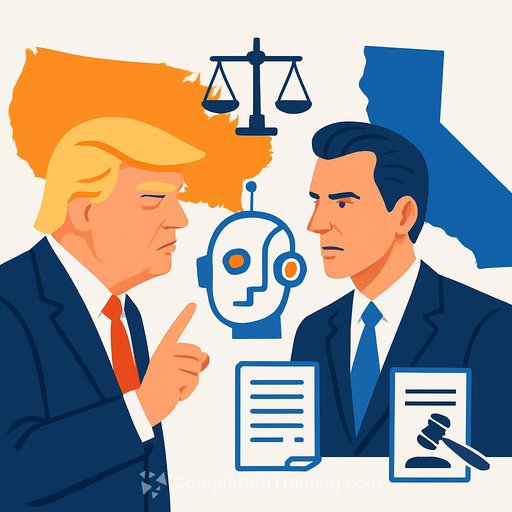
President Trump signed an executive order aiming to centralize approval and enforcement around AI policy, with senior tech figures at his side. The move drew fast pushback from state leaders and Democrats, who say the White House is overreaching and tilting policy toward industry insiders.
California Gov. Gavin Newsom called it a "con," accusing the administration of advancing interests tied to Trump's circle. New Jersey Gov.-elect Mikie Sherrill called the move lawless, while several tech trade groups praised the order's call for a national framework through Congress.
What the order does (at a glance)
The order directs the Department of Justice, Federal Trade Commission, Commerce, and other agencies to challenge or constrain state AI laws. It signals an intent to create one "central source of approval," with Trump claiming bipartisan support.
Compared to a leaked November draft, the final order adds carve-outs: the White House will not pursue a federal law that preempts state AI rules aimed at protecting children, addressing data center issues, or governing state procurement and use. It also drops language labeling California's new AI safety law, SB 53, as "complex and burdensome."
At the signing were Sen. Ted Cruz, Commerce Secretary Howard Lutnick, Treasury Secretary Scott Bessent, AI adviser Sriram Krishnan, and David Sacks, who helped shape the policy.
Immediate reaction
Newsom said, "President Trump and David Sacks aren't making policy - they're running a con," and noted California had threatened to challenge any such order. Sherrill said the President turned a bipartisan issue into favoritism for Big Tech.
The Business Software Alliance supported moving toward a national framework, with Craig Albright saying legislation rooted in consensus is the best path. On the right, Florida Gov. Ron DeSantis pushed back against preemption and Utah Rep. Doug Fiefia warned that states must remain "laboratories of democracy." Sen. Brian Schatz called the order "absurd and dangerous" and plans a repeal bill.
Key legal takeaways for counsel
An executive order alone does not preempt state law. Preemption arises from federal statutes or properly promulgated regulations acting under statutory authority. Expect the administration to rely on agency rulemaking and litigation strategies rather than the EO itself as a preemptive instrument.
Preemption theories will be contested. Express preemption is unlikely without new legislation. Field or conflict preemption will hinge on whether federal actions create direct conflicts or occupy the field. States can argue traditional police powers over consumer protection and safety remain intact. See background on the Supremacy Clause at Cornell LII.
APA risk is front and center post-Chevron. With deference to agency interpretations narrowed, aggressive rules aimed at overriding state AI statutes will face searching judicial review for statutory authority, reasoned decision-making, and procedure. See the Administrative Procedure Act.
Dormant Commerce Clause arguments may surface where state AI or data center rules are said to burden interstate commerce. States will counter with legitimate local interests and narrowly tailored measures, especially around child safety and infrastructure impacts.
Where the order tries to limit blowback
The carve-outs for child protections, data center concerns, and state procurement signal a political calculation: avoid fights that look like attacks on kids' safety, grid capacity, or states' internal operations. Tech companies have also pushed to use elements of California's SB 53 as a model for federal or other state laws.
Even so, the order's instruction to empower federal agencies against state AI laws invites a wave of suits. Trade groups, states, and public interest organizations are all likely plaintiffs or intervenors, and early injunction battles are probable.
Practical steps for in-house and outside counsel
- Map state AI obligations (including deepfake rules and SB 53) against likely federal moves; flag direct conflicts and operational choke points.
- Prepare for fast APA dockets: track agency actions, calendars, and potential interim guidance; draft comment templates now.
- Identify venues and alliances: anticipate where suits may be filed; line up coalitions and amicus partners.
- Build a state-federal conflict matrix for product, marketing, and infrastructure (e.g., data center siting, energy disclosures).
- Update procurement and vendor clauses to handle divergent state AI requirements and any future federal conditions.
- Brief boards and executives on litigation exposure, injunction scenarios, and compliance fallback plans.
- Coordinate with public policy teams on Congressional outreach, given the order's nod to a national framework.
- Establish an incident and evidence log for potential challenges or enforcement actions by DOJ/FTC or state AGs.
Open questions to watch
- Which agency moves first, and under what statutory hook, to attack specific state AI statutes?
- How courts treat claims of conflict preemption where federal rules are thin or guidance-based.
- Whether carve-outs meaningfully limit litigation or simply re-channel it to core consumer protection and model safety rules.
- If Congress advances a narrow framework that leaves most state police powers intact, muting preemption battles.
Bottom line
This order sets the stage, but it doesn't settle the law. The real fight will be in rulemaking records and preliminary injunction hearings over the next few months.
If your legal team needs fast, practical AI fluency to brief executives and draft comments, consider these resources: Complete AI Training - Courses by Job.
Your membership also unlocks: