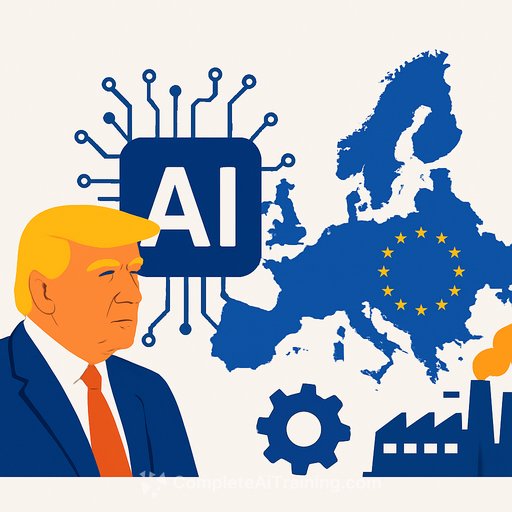
Trump's AI Strategy Exposes Europe's Strategic Ambiguity
The Trump administration announced a comprehensive AI strategy on March 20, 2026, designed to prioritize speed and innovation while minimizing federal regulation. The approach preempts state-level AI laws, consolidating authority at the federal level to prevent what officials see as fragmented compliance that could slow deployment and scale.
The strategy creates immediate tension within the U.S. Congress. Representatives Don Beyer, Doris Matsui, Ted Lieu, Sara Jacobs, and April McClain Delaney, along with Senator Brian Schatz, introduced the GUARDRAILS Act to repeal the preemption provisions. They argue the administration is creating a "regulatory vacuum" by eliminating state safeguards without establishing federal guardrails on safety, bias, consumer protection, and democratic integrity.
Beyer called the result a "lawless Wild West" for AI companies. Schatz labeled it "absurd and dangerous." The administration counters that fifty different state regimes would fragment the market and prevent the scale necessary to compete globally in a technology where early advantage becomes entrenched.
Europe's Regulatory Strength Masks Industrial Weakness
Europe has built sophisticated AI governance through the AI Act, GDPR, Digital Services Act, and Data Act. These rules have become the global standard. The "Brussels effect" extends European regulatory influence far beyond its borders, shaping corporate behavior worldwide.
But this regulatory success obscures a structural problem. Europe governs digital markets without controlling the industrial systems beneath them. Fragmented investment across member states, underdeveloped cloud and semiconductor infrastructure, and reliance on foreign capital mean Europe can set rules it cannot enforce through operational capability.
U.S. hyperscalers-Amazon Web Services, Microsoft Azure, and Google Cloud-control 65 to 75 percent of Europe's cloud market. This dependence limits European technological sovereignty and grants these providers economic leverage over strategic systems. Lobbying to maintain the status quo, while framed as reassurance to European businesses, effectively slows European capacity-building.
From Regulation to Industrial Intervention
European policymakers are beginning to acknowledge this gap. The European Commission's "Omnibus" agenda aims to simplify overlapping regulatory requirements, signaling recognition that compliance burdens may harm competitiveness.
More significant are emerging proposals that move beyond regulation. Mistral AI's CEO proposed a revenue-based levy on AI and cloud providers operating in the EU-not as punishment, but as redistribution to fund European capacity-building. Such proposals would have been politically marginal months ago. Their visibility now reflects a shift from market-correcting regulation to market-shaping intervention.
Europe's approach remains incomplete. Regulation operates largely independently of industrial policy. Infrastructure initiatives stay modest in scale. Debate oscillates between calls for openness and warnings against protectionism. This is strategic ambiguity: Europe is neither fully committed to building autonomous capacity nor entirely reconciled to dependence.
The Temporal Problem
The U.S. debate makes an implicit trade-off explicit: safeguards versus coherence, accountability versus speed. Both sides have merit. The American system allows these tensions to play out within a framework that assumes continued industrial leadership.
Europe faces a different constraint. It must resolve similar tensions while simultaneously building the capacity that would make them less binding. The central issue is temporal. The U.S. assumes governance can evolve alongside deployment. Europe assumes governance should precede it.
In technologies marked by rapid iteration and path dependence, early advantages become entrenched. Markets consolidate. Standards emerge. Ecosystems form. At that point, regulation becomes a tool of adjustment, not design.
Capability Versus Rules
The contrast between U.S. and European approaches is often framed as innovation versus precaution. In reality, it reflects different theories about how power is created and sustained in technological systems.
The United States aligns its governance model with existing industrial and technological strength. Europe attempts to extend regulatory influence into domains where its capacity is still developing. Bridging that gap requires more than incremental reform. It requires accepting that regulation, while necessary, is not sufficient. Capability must be built, not assumed.
The question for European executives and strategists is no longer whether Europe can shape the rules of the AI age. It is whether Europe can shape the system to which those rules apply.
Your membership also unlocks: