Trump's AI Executive Order Sets Up a Federal-State Preemption Fight: What Legal Teams Need to Know
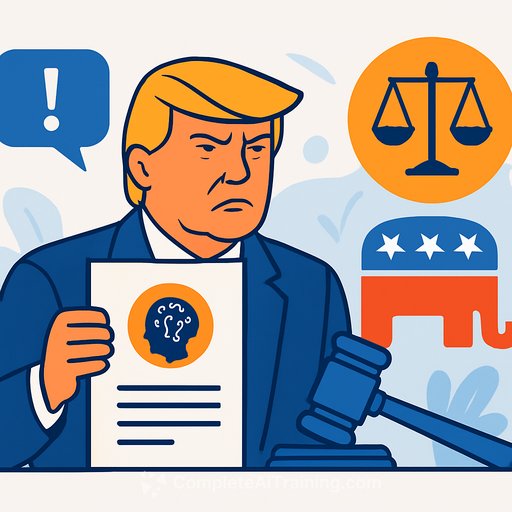
On Thursday, the administration issued an executive order directing the Justice Department to form an "AI Litigation Task Force" to sue states over AI-related laws viewed as "onerous." It also instructs the FTC and FCC to coordinate with DOJ to advance the White House's AI action plan and asks the Commerce Department to study conditioning rural broadband funds on state AI policies.
The order aims to unify national AI policy. "We have to be unified," the president said, contrasting the U.S. with China's centralized decision-making. But policy researchers and practitioners expect immediate court challenges, arguing an executive order cannot preempt state law without congressional authorization.
What the order actually does
- Creates a DOJ "AI Litigation Task Force" to sue states over certain AI laws.
- Directs FTC and FCC to work with DOJ to implement the White House AI plan and sidestep "onerous" state and local rules.
- Directs the Commerce secretary to study whether to withhold federal rural broadband funds from states with disfavored AI laws.
- Assigns AI advisor David Sacks to work with Congress on federal legislation; Sacks says the administration does not plan to target "kid safety" measures but will "push back on the most onerous" state rules.
The legal theory-and its limits
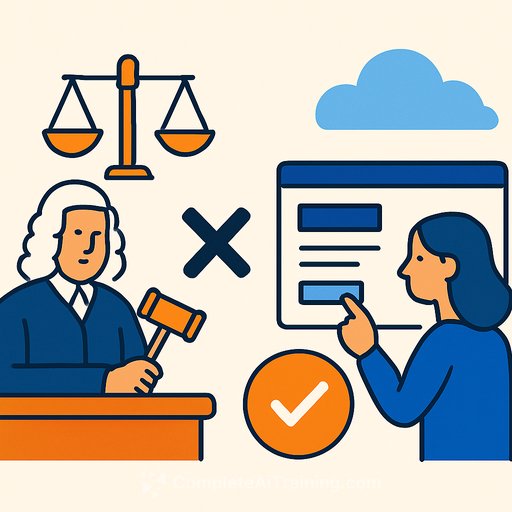
An executive order cannot, by itself, preempt state law. Preemption typically requires an act of Congress or valid agency action under a statute with preemptive effect. Without that, DOJ litigation would need to succeed on constitutional or statutory grounds case by case.
Expect DOJ theories to test three main routes:
- Dormant Commerce Clause: Arguing certain state AI laws unduly burden interstate commerce or regulate extraterritorially.
- First Amendment: Challenging speech-related restrictions (e.g., deepfakes, content labeling) where state rules sweep too broadly or are not narrowly tailored.
- Preemption via federal statutes: If agencies identify specific statutes that either occupy the field or conflict-preempt state rules, subject to the agency's authority.
Key constitutional guardrails
Anti-commandeering: The federal government cannot direct states to enact or enforce federal regulatory programs. Even aggressive coordination among DOJ, FTC, and FCC cannot force state legislatures or state officers to carry out federal policy.
Spending Clause constraints: Conditioning funds to influence state policy must meet limits set by the Supreme Court: clarity, germaneness to the program, and no coercion. Using rural broadband funds as leverage against broad state AI policies risks overreach if the condition is not closely related or is deemed coercive (see South Dakota v. Dole and the coercion analysis from NFIB v. Sebelius).
- NFIB v. Sebelius (2012) on coercion limits for federal funding conditions.
Dormant Commerce Clause headwinds: The Court has recently signaled tolerance for state laws affecting out-of-state actors when tied to legitimate in-state interests. In 2023, it upheld California's pork standards despite interstate effects, complicating broad preemption-by-litigation strategies.
State AI laws in play
Dozens of states have passed AI-related measures. Common categories include:
- Bans on nonconsensual AI-generated explicit imagery.
- Disclosure mandates for government agencies and businesses using AI.
- Algorithmic bias assessments and anti-discrimination checks.
- Whistleblower protections related to AI misuse or risk.
These laws vary in scope and enforcement. Some focus on consumer protection and civil rights, others on public sector transparency. Any DOJ challenge will have to grapple with that diversity-there is no single "state AI law" to knock out.
Politics and process
The administration frames the order as a competitiveness move against China and as a way to streamline AI growth. Critics-including groups working on child safety-argue it sidelines a broad coalition seeking guardrails. They warn of a "chilling effect" on state efforts, even if courts later void parts of the order.
Republicans are split. Some, like Sen. Ted Cruz, aligned with the industry push for fewer state restrictions. Others, including Sen. Josh Hawley, objected to preemption attempts in recent legislative fights. Several Republican governors, including Utah's Spencer Cox and Florida's Ron DeSantis, publicly questioned whether an executive order can preempt state law, pointing to Congress as the proper venue.
Where litigation is likely to land first
- Preliminary injunctions: States and affected parties will seek to block any funding conditions or enforcement actions quickly.
- Venue fights: Expect forum selection battles in circuits with different views on the Dormant Commerce Clause and funding coercion.
- Record-building: Agencies will need a solid administrative record to justify any action that purports to have preemptive effect.
Practical steps for legal teams
- Map exposure by state and law type: Inventory applicable AI statutes-deepfake restrictions, disclosure mandates, bias audits-and note enforcement mechanisms and private rights of action.
- Prepare parallel strategies: Plan for both outcomes: (1) state rules stand; (2) some rules are enjoined. Build compliance pathways that can be throttled on/off by jurisdiction.
- Review speech-sensitive policies: For generative content, ensure moderation, labeling, and takedown protocols can withstand First Amendment scrutiny if challenged, while meeting state requirements where in effect.
- Funding risk assessment: If you rely on rural broadband programs, model contingencies in case Commerce attempts to tie funds to AI policy positions-and be ready to litigate coercive conditions.
- Agency authority check: Track FTC/FCC rulemaking or guidance tied to the order. Confirm statutory hooks and limits before relying on federal preemption arguments.
- Engage early with state AGs and legislators: Where feasible, negotiate clarifications or safe harbors that reduce litigation risk without waiting on federal action.
Notable quotes shaping the dispute
- President: "We have to be unified... China is unified because they have one vote."
- David Sacks: "Kid safety, we're going to protect... but we're going to push back on the most onerous examples of state regulations."
- Michael Toscano (conservative think tank): The order bypasses a "broadly consultative process."
- Adam Billen (child safety nonprofit): The goal is to create "massive legal uncertainty" so companies "do whatever they want."
- John Bergmayer (Public Knowledge): The administration is "trying to bypass Congress" with theories that "don't work very well."
Bottom line
This order sets up a fast-moving test of federal power over state AI policy. Without new legislation, DOJ will be leaning on litigation in a field where states have strong consumer protection and police powers-and where recent Supreme Court signals cut against sweeping Dormant Commerce Clause attacks.
For counsel, build flexible compliance, watch for early injunctions, and keep funding contingencies ready. The real pivot point remains Congress; until then, expect fragmented rules, selective federal challenges, and a long court calendar.
Your membership also unlocks: