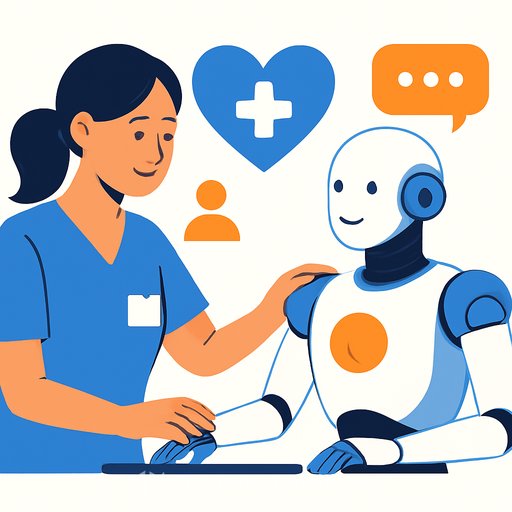
The Insight Series: AI & Digital Health
AI is moving from buzz to bedside. Health systems sit on torrents of clinical notes, images, audio, and device signals - and clinicians bear the load. More than a third of global digital data now comes from health care, yet face-to-face time keeps shrinking. Used well, AI for Healthcare gives that time back.
This conversation brings together Melissa Cha of Amazon and Taha Kass-Hout, MD, Global Chief Science and Technology Officer at GE HealthCare, to ground the topic in what matters to care teams and patients.
Why AI matters right now
Care teams switch constantly between modalities - MRI, CT, ultrasounds, EHR notes, waveforms, and more. Cognitive overload is real. Multimodal, foundation-model-based tools are beginning to make that data usable at the point of care, not weeks later. For those building and evaluating these systems, the AI Research tag collects methods and evidence to ground implementations.
The goal is simple: treat the person with the disease, not just the disease. That means faster signal from noise, consistent decisions, and fewer manual clicks. It also means extending quality care beyond affluent settings - a vital step when an estimated 4.5 billion people lack essential services.
Source: World Health Organization
What's working today
- Imaging workflow and diagnostic confidence: Deep learning tools help capture clearer images with fewer repeats, improving throughput and consistency. GE HealthCare's AIR Recon DL has reported scan times up to 50% faster, supporting productivity and patient comfort. Learn more
- End-to-end care journeys: Tools like CareIntellect for Oncology provide progressive summarization so teams can see the patient story quickly. Generative systems can also compare unstructured records to trial eligibility, matching more patients to appropriate research faster.
- Operational intelligence in hospitals: Command center platforms use predictive analytics to reduce bottlenecks and recommend actions across patient flow, staffing, and equipment. Reported outcomes include thousands more annual treatments through better capacity use and reduced length of stay without new beds. Outcomes and sources
These aren't flashy headlines. They remove friction, build trust, and free up clinicians to do the human work.
Will AI replace clinicians?
No. The problem isn't too many clinicians - it's too few. The WHO projects a shortfall of 10 million health workers by 2030.
AI extends clinical reach. Consider a virtual tumor-board system with specialized agents that synthesize biochemistry, imaging, and pathology, then surface recommendations for oncologist review. That augments judgment rather than replacing it. Automating routine steps and summarizing histories gives back minutes that matter - for difficult conversations, coordinated schedules, and timely treatment.
The next three horizons
- Near term: Scale what already works. Move pilots into production. Focus on flow, staffing, documentation burden, and consistent imaging quality.
- Mid term: From detection to intervention. Examples include automated breast ultrasound and adaptive radiation therapy that improve precision and reduce time to treatment. Trust grows on explainability and reliability.
- Long term: Assistive intelligence embedded across devices and operations - imaging systems that auto-optimize protocols, hospitals that coordinate resources predictively, and connected devices that maintain evolving digital twins.
Policy, payment, and trust
Progress depends on more than algorithms. Regulation, reimbursement, privacy, and cybersecurity must move together. The current Medicare model was built around physical procedures, not algorithmic insights.
Leaders across medtech and policy are collaborating on frameworks, pilots, and payment models that recognize prevention, precision, and throughput gains. The priority now: scale what works and maintain rigorous safeguards.
Medtech + big tech: complementary strengths
Medtech brings clinical depth, regulatory experience, and hospital know-how. Big tech contributes engineering, foundation models, compute capacity, and data tooling.
Joint efforts - for example, GE HealthCare using AWS services for health-specific foundation models, or working with NVIDIA on advanced X-ray capabilities - succeed when they combine clinical context with scalable infrastructure. Shared forums help align on trust, safety, and patient benefit.
What health leaders can do this quarter
- Map the pain points: Identify top throughput bottlenecks (imaging repeats, discharge delays, prior auth, documentation) and quantify impact.
- Pilot with intent: Start with one high-value workflow (e.g., MRI reconstruction, bed management). Define success metrics, guardrails, and a 90-day path to production.
- Set governance: Establish a cross-functional committee (clinical, IT, legal, quality, safety) with clear approval and monitoring criteria.
- Upskill your teams: Provide AI literacy for clinicians and operators - how models work, where bias can creep in, and how to escalate issues.
- Tighten data practices: Update consent, de-identification, PHI handling, and audit trails. Stress-test cybersecurity and vendor access.
- Engage payers and regulators early: Align on documentation for value, safety, and reimbursement pathways.
- Choose partners who ship: Favor vendors with live deployments, measurable outcomes, and transparent model updates.
Equity stays central
Access gaps remain. Thoughtful AI can help expand reach by making care more efficient, scalable, and precise. Design and validate with diverse populations, track performance across subgroups, and keep humans in the loop where risk is high.
Further learning
If you're building workforce readiness for AI-enabled care delivery, explore curated programs by role: AI courses by job.
Data scientists may also find the AI Learning Path for Data Scientists useful for foundations in modeling, data pipelines, and evaluation.
Notes: Results may vary by institution. Data on file.
Your membership also unlocks: