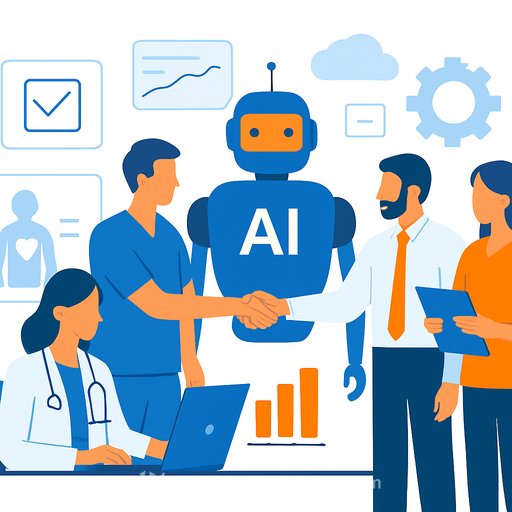
Healthcare AI's Next Step: Trust, Training, and Data
AI can improve diagnostics, personalize care, and reduce administrative load. But adoption stalls without three non-negotiables: trust, clinician training, and clean, consistent data. Add workflow fit and clear governance, and you have the difference between clinical value and shelfware.
The takeaway is simple: treat AI as clinical infrastructure, not a gadget. Build confidence, teach people how to use it, and feed it standardized data. Everything else builds on that.
Trust: Make AI make sense
Clinicians will not rely on systems they can't question. Opaque models, unclear training data, and hidden limitations create friction and risk. Transparency is a safety feature, not a marketing line.
- Use explainability that clinicians can act on (e.g., SHAP/LIME highlights aligned to clinical features), plus plain-language model cards and known failure modes.
- Run fairness audits across subgroups, publish results, and track drift over time. Treat bias like a patient-safety hazard with owners and SLAs.
- Pair every prediction with confidence scores, data provenance, and links to source context.
Clinician training: Close the AI literacy gap
Most clinicians weren't trained on probabilistic tools, confidence intervals, or AI-centric workflows. That gap leads to overtrust, undertrust, or misuse. Education must be ongoing and practical.
- Build CME and onboarding modules that cover basics of ML, interpretability, uncertainty, and bias-anchored in real cases and workflows.
- Use simulation and virtual patients for hands-on practice, plus spaced repetition for retention. Measure adoption, accuracy, and override rationale.
- Design UI that teaches: inline guidance, clear error states, and tooltips that explain why the AI surfaced a suggestion.
If you're spinning up training pathways by role, explore curated options for clinicians, admins, and data teams at Complete AI Training.
Teamwork: Fit AI into the work, not the other way around
AI succeeds when it disappears into the flow. Bolted-on dashboards, duplicate clicks, and noisy alerts erode trust and time. Integration must be bi-directional and event-driven.
- Adopt FHIR APIs for write/read, unify identity, and support real-time data exchange. Reduce swivel-chairing across systems.
- Design human-in-the-loop checkpoints with clear escalation paths and safe fallbacks.
- Measure alert precision, time-to-action, and clinician workload impact-then iterate fast.
FHIR resources and implementation guides are available from HL7.
Governance: Continuous oversight, not one-time approval
Static approvals don't fit adaptive models. You need version control, change logs, and continuous monitoring tied to clinical risk. Treat model updates like medication changes-documented and reviewable.
- Stand up an AI oversight committee spanning clinical, data science, safety, compliance, and IT.
- Implement post-deployment monitoring for performance, equity, and drift with alerting and rollback plans.
- Follow evolving guidance for AI/ML SaMD and risk-based categorization from regulators like the FDA.
Data: Standardize first, then scale
Fragmented data is the silent blocker. Without consistent structure and language, models degrade and don't generalize. Fix the foundation before adding more tools.
- Adopt FHIR, SNOMED CT, and LOINC; enforce terminology governance and semantic mapping.
- Use NLP to structure notes, but validate output quality clinician-by-clinician and specialty-by-specialty.
- For privacy and scale, evaluate federated learning, strong de-identification, and differential privacy with formal risk assessments.
Market reality: Who wins and why
- Trust leaders: Vendors that offer built-in explainability, bias dashboards, and clear model cards earn clinician buy-in.
- Interoperability specialists: Cloud providers and data platforms that connect EHRs, imaging, and claims-plus real-time pipelines-become critical infrastructure.
- Training platforms: Healthcare-focused LMS providers with AI literacy, simulation, and compliance tracking will see steady demand.
- Compliance tools: AI governance software that manages HIPAA/GDPR, audit trails, and risk scoring lowers provider burden.
- Workflow natives: Purpose-built solutions that reduce clicks and integrate with existing systems beat generic AI every time.
Safety, equity, privacy: Non-negotiables
Patient safety
Bad data and unclear outputs lead to bad calls. Continuous validation, override tracking, and clear fail-safes protect patients and staff.
Equity
Poorly sampled data creates unequal care. Measure performance by subgroup, publish results, and remediate with re-weighting, data collection plans, and policy guardrails.
Privacy
AI thrives on sensitive data. Tighten access controls, monitor secondary use, and enforce consent models that patients can understand.
What's next
Explainability grows up
- Near term: More transparent CDS with on-screen rationales and bias checks.
- Long term: Independent auditing seals and stricter standards for clarity and fairness.
Training gets smarter
- Near term: Personalized CME, virtual patients, and scenario-based drills.
- Long term: AI literacy embedded in med school and residency; VR/AR for complex skills and feedback.
Connected care
- Near term: Tools that summarize charts, assist with imaging, and cut documentation time.
- Long term: Interoperable ecosystems with ambient data, remote monitoring, and digital twins for care planning.
Governance matures
- Near term: Risk-based review, post-market monitoring, and clearer model-change controls.
- Long term: Greater global alignment on safety, accountability, and transparency.
Data pipelines evolve
- Near term: LLMs help structure multimodal data; more pilots using federated learning.
- Long term: Higher data quality at scale, better de-identification, and collaborative research without centralizing PHI.
What to watch in the next few months
- Regulatory updates from the FDA and implementation steps for the EU AI Act.
- Data-sharing partnerships that prove real interoperability beyond marketing slides.
- Explainability features embedded in bedside tools, not hidden in PDFs.
- CME programs that improve measured adoption and reduce error rates.
- Pilot results with clear ROI, safety metrics, and pathways to scale.
- Bias monitoring baked into production workflows, with public reporting.
- Agentic and generative tools for documentation and care personalization entering standard practice.
Quick checklist for healthcare leaders
- Stand up an AI governance board and a model registry with version control.
- Adopt FHIR, SNOMED CT, and LOINC; fund semantic mapping and data quality ops.
- Require model cards, bias audits, and drift monitoring for every clinical model.
- Budget for clinician training equal to or greater than the software spend.
- Instrument workflows to track alert precision, overrides, and time saved.
- Build incident response for AI errors with root-cause analysis and rollback plans.
Upskill your teams
If your clinicians and managers need clear, role-based pathways to get AI-ready, see curated learning by role at Complete AI Training or browse current options at Latest AI Courses. Education turns skepticism into safe, confident use-and that's where real clinical value shows up.
Your membership also unlocks: