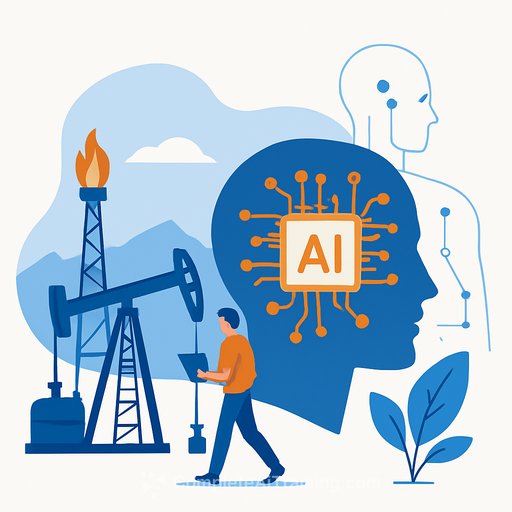
AI, Digital Twins, and the Operations Playbook for Energy Assets
AI and digital twins are moving from buzzwords to daily tools in energy operations. The goal is simple: better decisions, tighter schedules, safer projects, and faster progress on decarbonisation.
According to Sharon Soler, solutions manager for energy at Bentley Systems, operators are applying AI across design, construction, and daily operations to manage both traditional assets and emerging energy sources. Her point is clear: use data where it matters, and bring users into the loop early.
Why this matters for Ops
Operations teams are under pressure to cut downtime, improve predictability, and meet emissions targets without blowing up budgets or timelines. AI gives you pattern detection and predictions. Digital twins give you simulation and visibility you can act on.
Used together, they let you forecast performance, materials, and emissions before a shovel hits the ground - and continuously improve after commissioning.
Where AI is already delivering
Bentley's "Plus" products point to what's working now. Tools like OpenUtilities Substation Plus, OpenSite Plus, and Synchro Plus bring machine learning into project delivery, construction management, and operations workflows.
As Soler notes, the "Plus" label signals AI inside. That means faster model iteration, conflict detection, schedule optimization, and data-driven decisions that reduce rework.
Digital twins: the operations advantage
Digital twins remain the backbone for optimization and sustainability. Teams can simulate performance, plan shutdowns, estimate carbon impact, and forecast material use before committing capital.
Example: carbon analysis to predict steel requirements upstream of procurement. Add AI, and you move from simple predictions to pattern recognition that improves both design choices and live operations.
Subsurface uncertainty, managed
Surface assets are visible. Subsurface conditions aren't. That's where AI-backed modeling helps you test scenarios, compare flow assumptions, and reduce operational risk.
For regions with extensive oil and gas operations like the Middle East and Latin America, this matters. Better subsurface modeling means fewer surprises and tighter control of field performance.
Beyond oil and gas
These same methods apply to geothermal, hydrogen, and nuclear projects. As Soler puts it, digital twins are becoming a requirement to preview how assets will perform and to design for long-term efficiency.
Collaboration builds speed
Soler highlights a practical reality: progress happens when asset owners, engineering firms, and technology providers work together. Bentley's Infrastructure Co-innovation Initiative is one example of bringing users into the product loop to solve actual operational problems, not theoretical ones.
Energy security and the next decade
Operations leaders need stable output today while preparing for new sources tomorrow. Technology is a lever for medium- and long-term energy security, especially while the sector still depends on traditional sources.
The next step is turning decades of project files into usable data. By 2030, data-centric and AI-driven workflows will feel standard - if you build good information management now. For context on energy security drivers, see the IEA's overview here.
What to do now: a 90-day plan
- Pick two high-friction workflows (e.g., constructability reviews, outage planning) and pilot AI-assisted tools with clear success criteria.
- Stand up a basic digital twin for one asset or substation: start with geometry, tag critical systems, add live data later.
- Run a carbon and materials forecast pre-procurement to de-risk cost and compliance.
- Define data ownership and access: who provides, who maintains, how it's validated.
- Capture lessons learned and roll into phase two with a broader scope.
KPIs to track
- Planned vs. actual schedule variance (design and construction)
- Change orders and rework hours per project
- Mean time to detect and resolve issues during construction
- Unplanned downtime and maintenance cost per asset
- Material usage accuracy (e.g., steel forecast vs. actual)
- Estimated vs. actual carbon impact per project stage
Risk areas to manage
- Data quality: poor inputs erode every model. Set up validation gates.
- Cybersecurity: treat twins and AI pipelines like operational systems, not side projects.
- Compliance: emissions reporting and data lineage should be auditable.
- Change management: train project managers, construction leads, and operators on new workflows.
How operators can structure adoption
- Start small, integrate fast: pilot with one asset, one team, one outcome.
- Co-innovate with vendors: share real constraints and failure modes; build the features you need.
- Move from files to systems: standardize naming, metadata, and version control across teams.
- Automate reporting: push schedule, cost, carbon, and reliability dashboards from the twin.
Bottom line
AI-enabled tools and digital twins already improve execution and operations. The advantage goes to teams that pick focused use cases, align data early, and build collaborative routines with technology partners.
If your ops team needs practical upskilling to deploy AI in real workflows, explore curated training by job role here.
Your membership also unlocks: