
AI news ·
TV Academy's vague AI rules draw criticism from Emmy voters and writers
The TV Academy's new Emmy rules allow AI-assisted work to remain eligible, drawing sharp criticism from writers who want a clear ban. Six added words give the Academy the right to ask about AI use-but no power to act on the answers.
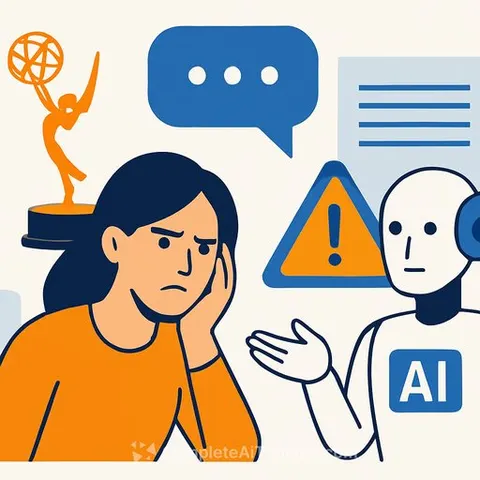
The Emmys' AI Problem: Guidelines That Satisfy No One
The TV Academy added six words to its Emmy rules in January that have sparked a month-long argument among writers, producers, and Academy members. The organization said it reserves the "right to inquire about the use of AI in submissions."
That cautious language, paired with a statement that the Academy centers recognition on "human storytelling, regardless of the tools used," has done the opposite of what was intended. Rather than clarify what's acceptable, the guidelines have opened a door wide enough for AI to play a meaningful role in Emmy-winning work across writing, acting, and other creative disciplines.
Emmy-winning producer Stan Brooks, who votes on the awards, said the guidelines are toothless. "The police can't say, 'Hey, I'd like to inquire about whether or not you robbed that bank,'" Brooks said. "That's not how it works."
Brooks and others want a clear rule: AI-aided scripts or performances should automatically disqualify work from writing and acting categories. Instead, the Academy's current approach leaves the door open for AI to assist in ways that remain largely undetectable and unregulated.
What the Academy Actually Allows
TV Academy CEO Maury McIntyre told The Hollywood Reporter the organization wants to remain "non-committal" about prohibiting AI. He said the tech-friendly guidelines came from discussions with an AI task force led by Eric Shamlin, head of FireBringer Media Group, who sits on the Academy's board of governors.
McIntyre suggested a showrunner assisted by AI could win an Emmy. The only clear disqualifiers, he said, would be extreme cases: someone giving AI a prompt and using the result unchanged, or submitting an entirely AI-written script.
That leaves a wide middle ground. A writer using Claude or ChatGPT for dialogue polish, structure notes, or character development would likely remain eligible. So would visual effects or production design work where AI tools assist human designers making final creative decisions.
The Case for Clear Standards
Veteran TV writer Mark Heyman said the industry would likely accept a straightforward ban: "I think people would probably be okay saying scripts can't be written by AI, full stop."
But Heyman acknowledged the enforcement problem. "Whether there will be people skirting that rule and not getting caught, it still would be meaningful to create the standard."
Victor Levin, who wrote for Mad Men and Mad About You, called for mandatory disclosures. He compared it to food labeling: viewers have a right to know what goes into their brain, just as they have a right to know what goes into their body. Levin now tags his own work "written by a human being."
Chris Auer, a professor at Savannah College of Art & Design who trained writers for decades, said the current framework leaves too much room for AI-generated content to slip through. He supports inquiries about AI usage but wants stronger guardrails.
Models From Other Awards
The Recording Academy, which oversees the Grammys, set a different standard in 2023. It allows work with "elements of AI material" but requires that "the human authorship component of the work submitted must be meaningful and more than de minimis."
The Film Academy's approach for the Oscars - issued roughly a year ago - mirrors the Emmys' hands-off stance. It states that generative AI and digital tools "neither help nor harm the chances of achieving a nomination."
Both the Oscars and Emmys approaches benefit companies with Silicon Valley ties: Netflix, Apple, and Amazon are major Emmy contenders.
The Unresolved Questions
The larger issue remains unresolved: Is art created by a human deploying an AI tool equivalent to art created solely by humans? Should they be judged by the same standards?
Heyman posed the core question plainly: "A human being assisted by Claude is up against the human being who wasn't assisted by Claude. Who are you rewarding?"
One proposal: create separate categories for AI-assisted work, similar to how animation operates. But defining those boundaries would be difficult. How would the Academy account for writers using ChatGPT in early script drafts? Would that require disclosure? Would partial assistance require a separate category?
Some Academy members argue AI-created work shouldn't compete in the main Emmys at all. Brooks said the Academy should state clearly: "We are a human creative organization, and we will continue to recognize human contributions, not AI."
The Labor Threat
The AI debate matters beyond awards prestige. A 2024 study of nearly 300 industry leaders estimated more than 200,000 positions will be eliminated over the next three years, with visual effects and postproduction work most vulnerable.
The Writers Guild recently reached a tentative agreement with studios that maintains writers' consent privileges over AI use in scripts. But many other creative disciplines remain unprotected.
This Year's Test Cases
The 2023 Marvel series Secret Invasion drew criticism for its AI-heavy opening sequence. McIntyre defended it, saying designers used AI as a tool, providing prompts and making final decisions about what to use. Under the Academy's current rules, that would remain eligible.
HBO's The Comeback presents a meta-scenario: the show features a fictional sitcom whose human showrunners are replaced by AI. Voters will be asked to nominate the human writers of a show whose premise critiques exactly that scenario.
McIntyre said the Academy reviews its rules annually and would respond to industry changes. But he added, "I don't see us making any drastic changes at this point."
For writers and producers, the message is clear: the Emmys aren't ready to draw a line. That may leave many creators wondering whether their work - and their careers - can compete on equal terms.
Learn more about AI for Writers and how to understand Prompt Engineering as these tools reshape creative work.