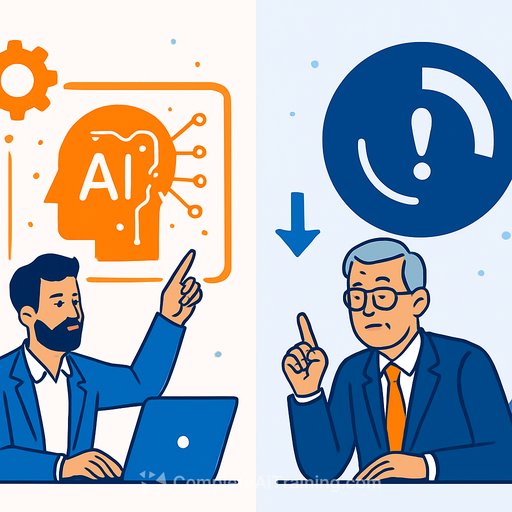
AI is already changing how managers lead - and the divide is generational
New research from KEDGE Business School shows that artificial intelligence is already altering management practice, but not evenly. An OpinionWay survey of managers in October 2025 points to a clear split: younger leaders are adopting AI faster and using it more deeply in day-to-day decisions, while many older managers remain cautious and selective.
The signal is strong in performance management. Managers under 40 are far more likely to use AI to guide reviews, weigh tough calls and handle sensitive situations. Older managers use AI too, but with tighter limits.
What the data says
AI usage has leapt in two years: in 2023, about one in five managers said they used AI tools; by 2025, more than 80 percent reported using them at least occasionally. Most see AI as a boost to Productivity - for Research, summarising documents and drafting communications.
Adoption is broader among younger leaders. According to the survey, 89 percent of managers under 40 have adapted their management practices due to AI, compared with 74 percent of managers over 50. When it comes to performance evaluation, the gap widens: 90 percent of younger managers have revised how they assess staff performance, versus 60 percent of older managers.
Where AI shows up in management
- Research, document summaries and first-draft writing.
- Preparing performance reviews and calibrating assessment criteria.
- Seeking advice on managerial decisions and handling difficult situations.
- Guidance on performance management and conflict resolution - where younger managers are roughly twice as likely as older managers to rely on AI.
The tension inside teams
More than half (55 percent) of younger managers report generational tensions in their teams linked to AI use. Nearly three quarters of respondents say AI saves them time, yet many worry it can complicate the role and weaken human relationships if used carelessly.
These frictions show up in what managers value. Younger leaders lean into creativity and initiative; older leaders continue to prioritise oversight, reliability and consistency. Expectations for the future also diverge: almost half of managers under 40 think management will change dramatically within five years, compared with 28 percent of those over 50.
What this means for your team
"AI is already changing the foundations of management. The real issue is not learning how to use a tool, but redefining what it means to be a manager," said Alexandre de Navailles, general manager of KEDGE Business School.
- Set clear boundaries: where AI can suggest, where it can draft and where only a manager decides. Make the human decision points explicit.
- Refresh performance frameworks to balance creativity and initiative with reliability and consistency. Document the criteria and examples.
- Pair cross-generation mentors. Let early adopters share workflows, and experienced leaders stress judgment, context and ethics.
- Adopt human-in-the-loop reviews for people decisions. Check for bias, context loss and tone, especially in feedback or ratings.
- Train managers on prompts, data privacy and responsible use. Treat AI like any other system that touches performance and careers.
- Be transparent with teams about when AI is used and why. Invite feedback and offer an alternative if an employee prefers a human-only process.
- Track outcomes: time saved, decision quality, employee experience and fairness. Expand use cases only when the data supports it.
- Start with low-risk workflows (summaries, drafts, checklists), then progress to higher-stakes tasks with guardrails.
About the research
The findings come from an OpinionWay survey of managers conducted in October 2025. The report highlights age as the main driver of differences in AI practice. KEDGE has placed AI at the core of its KEDGE 2030 strategy, expanding teaching across degree programmes and executive education.
Next step for managers
If you want structured, job-specific upskilling for your team, explore curated options at Complete AI Training - courses by job. Build practical capability, then standardise how AI supports your management playbook.
Your membership also unlocks: