U of A, UCSF sign agreement to accelerate disease research using AI
December 12, 2025
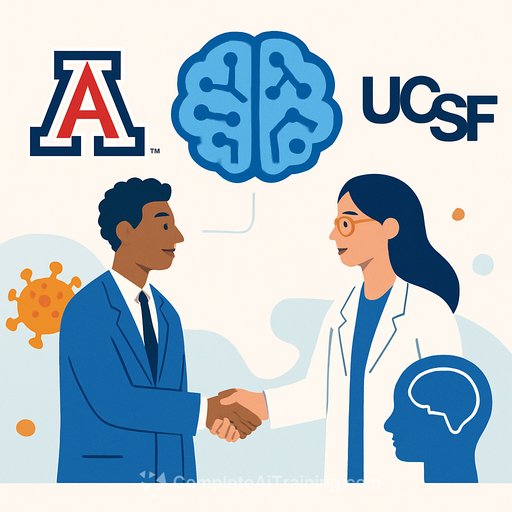
The University of Alberta and the University of California San Francisco have signed a memorandum of understanding to move faster on treatments for complex neurological conditions and infectious disease. The pact links U of A's strengths in AI and virology with the Quantitative Biosciences Institute (QBI) at UCSF, a hub for interdisciplinary biomedical research.
What's in the agreement
- Joint research programs focused on autism, ADHD, and infection-driven neuroinflammation, with early interest in triggers during Epstein-Barr virus infection.
- Access to QBI's capabilities in structural biology, chemistry, and quantitative biosciences, paired with Alberta's digital health environment and strong virology community.
- Training, exchanges, and joint symposia to accelerate method sharing and mentorship across labs.
- Pursuit of shared funding, plus new academic-industry routes for translating AI-enabled diagnostics and therapeutics.
Who's involved
The MOU was signed Dec. 8 in San Francisco by Sam Hawgood, UCSF chancellor, and Bill Flanagan, U of A president and vice-chancellor. "This agreement provides an outstanding opportunity to advance AI-driven biomedical innovation," says Flanagan. "Together, we can expand our leadership and expertise as we address some of the world's most pressing challenges."
The initiative is led on the U of A side by biochemistry professors Joanne Lemieux and Olivier Julien. "Our combined expertise creates a synergistic and powerful resource," says Lemieux. David Bressler, U of A vice-president (international and enterprise), notes the collaboration connects Alberta researchers with an elite global health network that values AI-forward biomedical research.
Why this matters for scientists
- Sharper target discovery: AI-first pipelines will be paired with wet-lab validation across two research ecosystems with complementary strengths.
- Better tools, faster cycles: Teams gain access to QBI platforms in structural biology and chemistry alongside Alberta's AI-in-health expertise.
- Talent flow: Student and trainee mobility between Edmonton and San Francisco to speed skill transfer and collaboration.
- Funding and translation: Coordinated grant pursuits and industry pathways to take diagnostics or therapeutics to market.
Early scientific focus
One of the first priorities is clarifying how infections like Epstein-Barr virus may trigger neuroinflammation that exacerbates neurological conditions. The goal: identify tractable targets and intervention points using AI-driven analyses and targeted experiments.
The broader context
UCSF is regularly ranked among the top institutions in immunology, neuroscience, molecular biology, and clinical medicine. The U of A has been recognized as Canada's top AI university and ranks among the leaders globally. For QBI, the agreement adds a partner with established AI-in-health capacity. For Alberta, it expands access to a proven engine for interdisciplinary discovery and entrepreneurship.
What's next
- Joint symposia and seminars to set shared priorities and methodologies.
- Calls for collaborative projects, with an emphasis on translational impact.
- Structured exchanges for trainees and faculty to co-develop AI-biology workflows.
Upskill your team
If your lab or core facility is building AI fluency for biomedical work, explore curated programs by role at Complete AI Training.
Your membership also unlocks: