U of T launches Hinton Chair in Artificial Intelligence with $20M in support
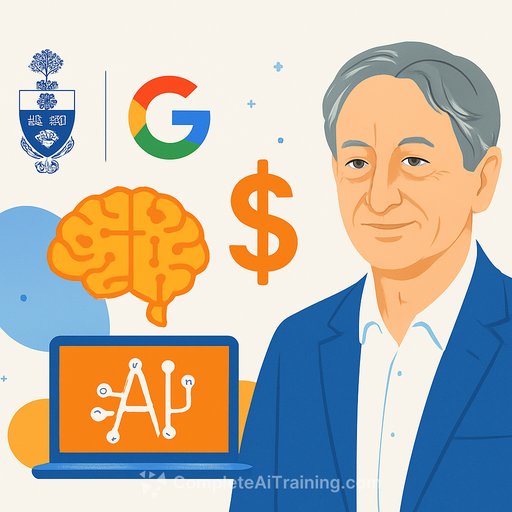
The University of Toronto has created the Hinton Chair in Artificial Intelligence with $10 million in funding from Google, matched by U of T for a total of $20 million. The new chair honours University Professor Emeritus and Nobel laureate Geoffrey Hinton and will help recruit and retain a globally recognized AI researcher.
"On behalf of the university, I would like to express our deepest gratitude to Google for this wonderful investment," said Melanie A. Woodin, University of Toronto president. "This new chair will enable us to build on Geoff Hinton's historic contributions in artificial intelligence and to advance our record of transformational research in fields of crucial importance to the world."
The endowment will provide long-term support for a leading AI scholar and fund fundamental research. The focus is on foundational work that can push core ideas forward and encourage responsible practice across disciplines.
Why it matters for researchers
- Stable, long-horizon funding to pursue ambitious research agendas in deep learning and related areas.
- Cross-disciplinary collaboration across medicine, engineering, discovery science, and the humanities.
- Stronger links with Canada's AI ecosystem, including the Vector Institute and the CIFAR AI Chairs program (CIFAR).
- A larger pipeline of top graduate talent and stronger support for research-driven startups in Toronto.
Part of U of T's Third-Century Chairs program
The Hinton Chair is the first appointment in U of T's Third-Century Chairs program, launched as the university nears its bicentennial to help attract field-defining scholars. It aligns with Canada's broader push to recruit research leaders, including a recent $1.7-billion commitment by the federal government to bring top global talent to the country.
"Google is proud to partner with the University of Toronto in establishing this endowed chair, recognizing the extraordinary impact of Geoff Hinton," said Jeff Dean, chief scientist at Google DeepMind and Google Research. "This chair will enable world-class academic scholars to accelerate breakthrough innovations and advance responsible research for the common good."
Built on Hinton's legacy
Geoffrey Hinton joined U of T in 1987 as a CIFAR fellow and, with his students, pushed forward neural networks as a practical path for AI. His contributions include backpropagation, distributed representations, time-delay neural nets, mixtures of experts, variational methods, deep learning, and Boltzmann machines.
In 2013, Hinton joined Google while continuing his work at U of T. Together with John J. Hopfield, he received the 2024 Nobel Prize in Physics for foundational advances that enabled modern deep learning.
"I am grateful for having been able to pursue my research at the University of Toronto, which afforded me the time and resources to develop the ideas that would eventually grow into the success of neural nets," Hinton said. "I'm encouraged that the chair will help the next generation grow new ideas that benefit humanity."
U of T's AI strengths and what the chair adds
Based in the Faculty of Arts & Science's department of computer science, ranked 12th globally by the 2025 QS World University Rankings by Subject, the chair-holder will join a dense concentration of expertise in deep learning and generative AI. "It's thrilling to consider the possibilities of welcoming a globally leading AI researcher into this setting," said Stephen Wright, Interim Dean, Faculty of Arts & Science.
U of T's track record includes CIFAR AI Chairs, Canada Research Chairs, and startups such as BlueDot (infectious disease intelligence), Waabi (autonomous trucking), and Deep Genomics (RNA-focused AI for disease detection). Faculty and alumni distinctions include two Turing Awards, two Herzberg Gold Medals in computer science, and 15 Sloan Research Fellowships.
Google and U of T: a long-standing research partnership
This chair builds on years of collaboration between U of T and Google, including joint involvement in the Vector Institute and prior funding that helped establish Toronto as a leading centre for AI research. "We are extremely grateful to Google for partnering with us to establish a chair dedicated to advanced research on the defining technology of our time," said David Palmer, U of T vice-president, advancement.
What to expect next
The chair will support recruitment of a world-class AI researcher and provide resources to run an ambitious, curiosity-driven program. Expect deeper collaboration across faculties, stronger graduate training, and fundamental work that moves core AI ideas forward while keeping responsibility at the centre.
Your membership also unlocks: