The AI adoption gap: Why the UAE and Singapore are racing ahead-and what to do about it
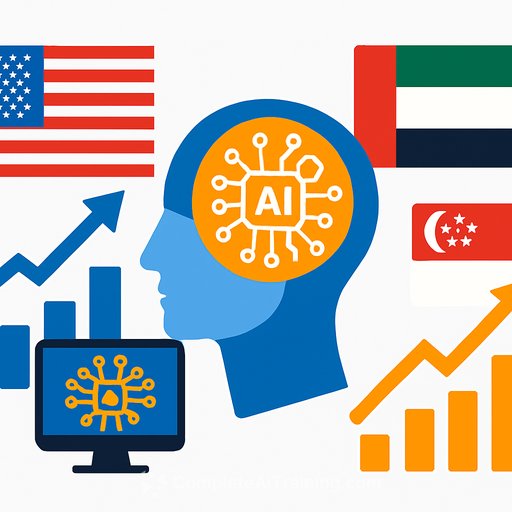
AI is spreading fast, but not evenly. Two small nations-the UAE and Singapore-top global adoption charts, with more than 60% of working-age adults using AI tools. Meanwhile, the U.S. sits at 24th globally despite leading in AI innovation, funding, and research (as cited in a Microsoft report).
So what are these countries doing differently? Short answer: they made AI a national utility-clear rules, shared infrastructure, and zero ambiguity about skills and outcomes.
What smaller nations got right
- Top-down clarity: National AI strategies with deadlines, budgets, and ownership. Every ministry and agency knows its role.
- Skills before scale: Mass upskilling for the public sector and SMEs. AI literacy isn't optional; it's baseline.
- Procurement that moves: Sandboxes, fast-track pilots, and pre-approved vendor pools to cut the wait from months to weeks.
- Shared rails: Digital ID, secure cloud, and data exchange standards so teams can build without starting from zero.
- Clear guardrails: Practical AI policies (privacy, model usage, data retention) that make "yes" safer and faster than "no."
- Incentives that matter: Leaders are measured on adoption and outcomes-time saved, quality gains, and service uptime.
Why the U.S. lags in adoption (despite leading in innovation)
- Fragmented decision-making: Thousands of agencies and enterprises, each with different risk thresholds and procurement rules.
- Legacy sprawl: Complex systems and data silos slow integration and model access.
- Policy ambiguity: Teams wait for legal sign-off instead of working from clear, pre-approved templates.
- Training gap: Tools exist, but workers don't get hands-on workflows, prompts, or measurable targets.
For government leaders: move from pilots to policy-backed practice
- Set a national (or agency) AI baseline: Publish an acceptable use policy, data-classification rules, and approved AI tools.
- Centralize enablement: Create a small AI enablement office to provide templates, model access, and vendor guidelines.
- Fund "public goods" first: Identity, data-sharing standards, and a secure cloud zone with audit-by-default.
- Tie adoption to outcomes: Make time saved, case throughput, and citizen satisfaction part of KPIs.
Useful primer: AI for Government
For IT and development teams: ship value fast and safely
- Start with contained, high-ROI use cases: summarization, ticket triage, search, document generation, code assist, and analytics.
- Put guardrails in code: data loss prevention, role-based access, prompt filtering, and audit logging.
- Standardize your stack: one prompt library, one evaluation method, and a small set of approved models and providers.
- Measure everything: adoption rate, time saved per task, quality scores, and human review rates.
Implementation help: AI for IT & Development
For business leaders: make usage the metric
- Pay for outcomes, not licenses: tie budgets to verified time savings and quality improvements.
- Train by workflow, not feature: show teams exactly where AI fits in their daily tasks.
- Reward adoption: recognize teams that document wins and share reusable playbooks.
90-day adoption plan
- Days 0-30: Inventory tasks, classify data, pick 5-7 high-volume use cases, publish a one-page acceptable use policy, and enable a secure AI workspace.
- Days 31-60: Run 3-5 pilots with clear owners and metrics. Build a prompt library and evaluation checklist. Train pilot teams for one hour per week, minimum.
- Days 61-90: Expand what works. Add procurement templates, vendor standards, and a lightweight review board. Roll out dashboards to track adoption and impact.
Common blockers-and how to handle them
- Security/legal: use private endpoints, redact sensitive fields, and keep humans in the loop for high-risk actions.
- Data quality: fix the top 20% of data sources that drive 80% of use cases; don't wait for perfect.
- Vendor lock-in: adopt an abstraction layer so you can swap models without rework.
- Change resistance: publish before/after time savings, make wins visible, and give managers weekly talking points.
What this means for you
The UAE and Singapore made AI normal at work-clear rules, easy access, constant training, and metrics that reward use. Any country, agency, or company can follow the same playbook.
Set policy, pick use cases, measure results, and scale what works. That's the gap-and the path to close it.
Your membership also unlocks: