UAE launches the first sovereign financial cloud: what it means for banks, CFOs, and regulators
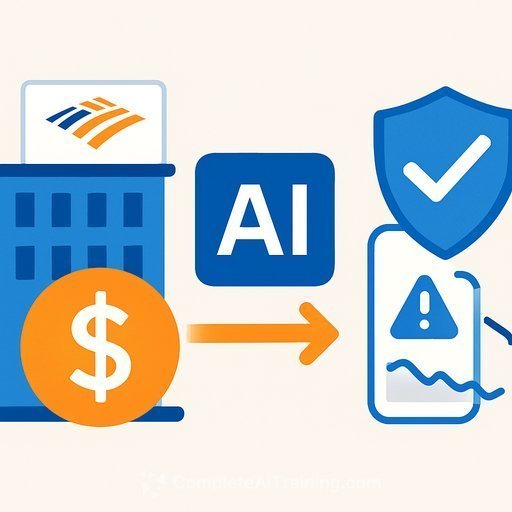
The Central Bank of the UAE has introduced the Sovereign Financial Cloud Services Infrastructure (SFCSI), developed with Core42, a subsidiary of G42. It's a secure, AI-enabled cloud built for the country's licensed financial sector-kept within national borders and governed by UAE law.
Think of it as a dedicated digital backbone for banks, insurers, and fintechs. It centralizes data, security, and compliance while letting institutions run private and hybrid clouds under a single control plane.
What makes the SFCSI different
- Data stays in-country: Fully isolated infrastructure keeps critical data within the UAE's legal and security perimeter.
- Integrated security and compliance: Regulatory controls, logging, and governance are embedded into the platform.
- AI at the infrastructure layer: Real-time analytics and automation for risk, operations, and service quality.
- Unified multi-cloud management: A single framework to run private and hybrid environments with consistent policies.
Why this matters for finance leaders
- Regulatory confidence: Data residency and embedded oversight reduce exposure to shifting foreign rules.
- Operational resilience: Centralized controls and observability lower downtime risk and speed incident response.
- Faster product cycles: Standardized infrastructure and AI services shorten time-to-market for digital offerings.
- Cost and control: Consolidated security, tooling, and governance help contain cloud spend and improve accountability.
Architecture and controls you should expect
- Segmentation and zero-trust access across tenants and workloads.
- Encryption in transit and at rest; hardware-backed key management with customer-controlled keys or split custody.
- Continuous monitoring with SIEM/SOAR, threat intel feeds, and automated response playbooks.
- Immutable audit logs, data lineage, and policy-as-code for consistent enforcement.
- Built-in business continuity targets (clear RPO/RTO) and geo-redundancy within national borders.
AI on the core: practical use cases
- Financial crime: Real-time AML, sanctions screening, and fraud detection with lower false positives.
- Risk and treasury: Credit scoring, early-warning signals, liquidity stress testing, and scenario analysis.
- Operations: Straight-through processing, exception handling, and predictive maintenance for critical systems.
- Customer experience: Personalized insights, smarter routing, and automated service while maintaining privacy.
- Regulatory reporting: Standardized data models and automated submissions with full audit trails.
Impact across the UAE financial system
For licensed institutions, this is a core step in digital transformation. Oversight becomes more immediate, while product launches can move faster without trading off security or compliance.
It also strengthens the UAE's position as a secure base for global finance and fintech expansion. A clear, sovereign framework attracts institutions that value speed with control.
Downstream effects for customers and businesses
- Safer banking with stronger protections against fraud and cyber risk.
- Better digital experiences built on real-time insights.
- Faster rollout of new features and services.
- Higher confidence in privacy and data control.
Regulation and governance considerations
Embedding controls into infrastructure helps meet UAE data protection requirements and sector rules while simplifying audits. Expect tighter model governance for AI-versioning, explainability, testing, and drift monitoring-plus clear approval workflows.
Institutions should map workloads to relevant frameworks (e.g., UAE Federal Data Protection Law, DIFC DP Law 2020, ADGM Data Protection Regulations), define data residency rules, and set up provable key custody and access policies.
What to do in the next 90 days
- Prioritize workloads: Start with AML/fraud, regulatory reporting, payments, and customer analytics where data residency and latency matter.
- Set governance baselines: Access controls, encryption standards, key management, retention, and incident SLAs.
- Validate portability: Ensure exit strategies, data export formats, and contractual rights are explicit to avoid vendor lock-in.
- Model risk management: Establish policies for approval, monitoring, retraining cadence, and bias testing.
- Cost and capacity planning: Tag workloads, forecast unit costs, and set budget guardrails with automated alerts.
- Run a pilot: Pick one high-value use case; define success metrics; measure before/after.
Key metrics to track
- Fraud loss rate, false-positive rate, and case resolution time.
- Time-to-detect and time-to-contain security incidents.
- Transaction latency, uptime, and change lead time for releases.
- Model accuracy, drift, and regulatory exceptions.
- Unit cost per transaction/report and cloud spend variance to plan.
Looking ahead
The SFCSI sets a base for national payments upgrades, cross-border rails, and potential CBDC experiments. With AI and real-time analytics built in, the system can support faster settlement, smarter compliance, and safer interoperability.
For reference, see the Central Bank of the UAE's site for policy direction and updates here, and the BIS hub on central bank digital currencies here.
Bottom line
A sovereign, AI-enabled cloud gives UAE institutions speed with control. If you lead finance, risk, or technology, this is the moment to update your operating model-governance, data, AI, and cost discipline-so you can scale safely on day one.
For deeper practical guidance on applying AI in financial operations, explore AI for Finance.
Your membership also unlocks: