UAE issues strict school rules for generative AI: what educators need to implement now
The UAE Ministry of Education has released a comprehensive framework for using generative AI in schools. The goal is clear: protect academic integrity, safeguard students, and keep classrooms disciplined and secure. Any use outside approved guidelines will be subject to accountability under existing school regulations.
Below are the key rules, what they mean for your policies and classrooms, and a practical rollout plan for leaders and teachers.
Key rules at a glance
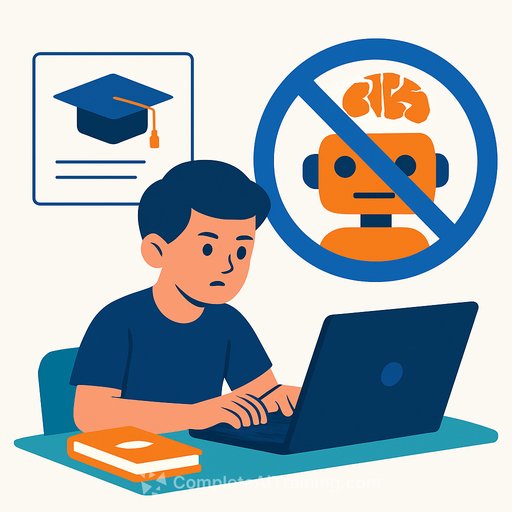
- Age limit: Students under 13 and those below Year 7 are not permitted to use generative AI tools.
- Exams: No generative AI during formal examinations or official assessments.
- Originality: Presenting AI-generated work as personal work without disclosure or prior teacher approval is prohibited.
- Oversight: AI may be used only with direct teacher supervision and clear instructional guidance.
- Verification: Teachers and students must check AI content for accuracy, relevance, and fit with approved curricula before use.
- Content standards: Producing or sharing material that violates religious, national, or cultural values-or includes violence, hate speech, discrimination, misinformation, or harmful psychological content-is banned.
- Privacy: Do not input or upload personal data (names, photos, audio/video, IDs, contact info) of students, teachers, or parents into AI systems.
- IP and safety: No use of copyrighted material without permission, no deepfakes, no impersonation, and no collecting or sharing others' sensitive information.
- Platforms: Only ministry-approved generative AI platforms may be used in classrooms. No bypassing filters, no VPNs, and no creating external student accounts that require personal data without permission.
What this means for school leaders
Your systems, policies, and communications need to reflect the new framework. Prioritize clarity, enforcement, and training.
- Publish an AI use policy that defines approved tools, age restrictions, disclosure requirements, privacy rules, and sanctions for misuse.
- Create an approved tools register and keep it current; block unapproved services at the network and device level.
- Prohibit student account creation on external AI tools that request personal data unless explicitly approved and compliant with privacy rules.
- Update exam and coursework procedures to prevent AI use during assessments. Detection tools are not enough-adjust task design and proctoring.
- Provide parents with a plain-language briefing on the rules, consent boundaries, and how the school will supervise AI use above Year 7.
- Establish an incident response process: reporting, documentation, investigation, and proportional consequences under student behavior policies.
Practical classroom guidance for teachers (Years 7+)
Keep AI use purposeful, supervised, and transparent. The student-not the model-must demonstrate understanding.
- Use AI only with clear learning objectives, in structured activities, and under direct supervision.
- Require an AI use disclosure with every assignment stating the tool used, prompts, outputs referenced, and how the student verified accuracy.
- Insist on thinking evidence: outlines, drafts, notes, citations, and brief oral checks. Discourage copy-paste or simple rephrasing of AI outputs.
- Verify content against textbooks, official curriculum documents, and trusted sources before acceptance.
- Ban entry of personal data and identifiable student work into AI tools. Use anonymized or fabricated datasets for practice.
- Do not record or transcribe classroom interactions using AI without explicit consent from all parties.
Safeguarding and content standards
AI must never be used to produce or share harmful or inappropriate content. That includes anything conflicting with the country's religious, national, or cultural values, as well as violence, disturbing imagery, hate speech, discrimination, misinformation, and materials encouraging illegal or unethical behavior, self-harm, cyberbullying, or misuse of technology.
Data privacy and intellectual property
Protect digital identity and privacy at all times. Do not upload personal data, confidential school materials, or copyrighted content without permission. Creating deepfakes, impersonating others, or collecting and distributing sensitive information is a serious breach of privacy and digital rights.
Technology controls to put in place
- Whitelist only ministry-approved AI platforms and block the rest via firewalls, DNS filters, and MDM profiles.
- Disable VPNs and proxy tools on student devices; monitor for attempts to bypass restrictions.
- Audit logins and usage where possible; require staff approval for any new AI tool requests.
Assessment integrity
AI is banned during exams and official assessments. Copying or lightly rephrasing AI outputs without real understanding violates authenticity. Design assessments that require process evidence, in-class writing, oral defenses, practical demonstrations, and source triangulation.
30-day implementation checklist
- Appoint an AI lead and form a small cross-functional working group (academics, IT, safeguarding).
- Publish and socialize the school AI policy; include age gates, disclosure rules, privacy protections, and consequences.
- Update AUPs, student/parent handbooks, and assessment handbooks to reflect the framework.
- Reconfigure filters, device settings, and login policies to block unapproved tools and disable VPNs.
- Issue teacher guidance: supervised use only, verification steps, disclosure template, and prohibited content examples.
- Redesign at-risk assessments to reduce opportunities for AI misuse and require evidence of learning.
- Run a parent briefing and Q&A; collect and track any required consents.
- Set up an incident reporting form and clear escalation paths.
Where to learn more
- UAE Ministry of Education
- AI training by job role - Complete AI Training
- Design AI Courses - Complete AI Training
Bottom line: generative AI can support learning under strict conditions, but it cannot replace teachers or students' intellectual effort. With clear guardrails, supervision, and purposeful task design, schools can protect integrity, uphold privacy, and raise the quality of learning.
Your membership also unlocks: