Agentic AI: A new force for government-citizen relationships
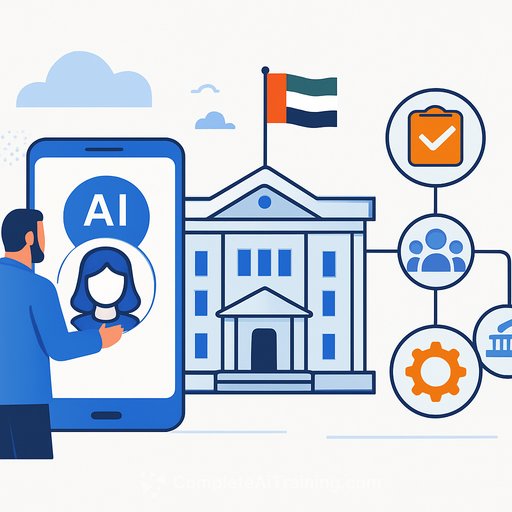
The UAE has made bold moves in artificial intelligence, and the public sector is setting the pace. From identity services to health, safety, and transport, AI is already improving accuracy, speed, and citizen experience. The next leap is here: agentic AI - systems that can reason over data, take actions within guardrails, and deliver outcomes across departments.
Here's the point: agentic AI isn't replacing leadership. It's accelerating the reforms leaders are already driving. As we enter 2026, the UAE has the strategy, the projects, and the momentum to deliver simpler, faster, more trusted government services.
What agentic AI looks like in practice
Identity and residency services are being streamlined as the Federal Authority for Identity, Citizenship, Customs, and Port Security speeds up visa, residency, and work permit processing with AI. In healthcare, AI is monitoring and even predicting trends in conditions, while tools assist clinical teams and lighten operational workload.
Public safety is evolving as data-driven surveillance and predictive analytics make cities safer with smarter deployment. In transport, AI is easing congestion and improving travel experiences in Abu Dhabi and Dubai.
Finance operations are moving too. Dubai's Department of Finance launched Project ASCEND, a scalable agentic AI system to automate verification of transactions and related financial processes. LLMs with RAG assess internal workflows against external compliance requirements and recommend changes - a practical step toward cleaner controls and faster cycles.
From silos to a single platform
Agents work best in secure environments where data is integrated. That fits the UAE's long-term eGovernment and mGovernment push - and opens the door to unified services, end to end. The Ministry of Human Resources and Emiratization has already announced a unified portal to streamline private-sector employment processes for Emiratis.
With agentic AI, services can finally flow across departments. Forms can be pre-filled using verified personal, health, and tax data. Information can route to the right decision maker at the right time, with audit trails by default. The result: fewer handoffs, less duplication, better governance.
Why now: measurable gains and broader impact
Early programs are showing tangible results. In a recent proof-of-concept, ADNOC reported a 70% improvement in accuracy across major seismic interpretation tasks, plus advances in reservoir monitoring and anomaly detection. Those gains signal what's possible when data, agents, and clear outcomes come together.
Public-sector leaders can apply the same playbook. Environmental teams can combine asset monitoring with logistics data to improve waste collection and reduce congestion - lowering emissions as a by-product. Healthcare providers can resolve cases faster. Schools and universities can align curricula with workforce signals coming from industry agents to raise long-term skill levels.
Trust first: guardrails that earn public confidence
Integration at this level only works if people trust it. The UAE has been explicit about this, emphasizing transparency, safety, privacy, and accountability through policy and guidance. The UAE Strategy for Artificial Intelligence sets clear expectations for human oversight, fairness, and responsible deployment.
Read the UAE Strategy for Artificial Intelligence to align programs and governance models from day one.
A simple playbook for agency leaders
- Start with a high-friction service that crosses departments (permits, benefits, licensing).
- Map the process: actors, systems, rules, documents, and failure points. Remove steps before you automate them.
- Create a secure data layer. Standardize schemas and access policies so agents can operate safely.
- Choose an agent architecture: LLM + RAG for policy interpretation; tool use for transactions; human-in-the-loop for final approvals.
- Run a 60-90 day pilot with clear KPIs: time to decision, error rate, cost per case, and satisfaction.
- Build guardrails: role-based access, red-teaming, bias checks, and immutable audit logs.
- Integrate with existing case, identity, and payments systems via APIs. Avoid one-off integrations.
- Set up live monitoring: service-level health, data drift, model quality, and security alerts.
- Redesign work. Shift staff to exception handling, outreach, and quality - don't just "add AI."
- Communicate with citizens: what's automated, what stays human, and how data is protected.
What "good" looks like in 12 months
- One front door for a cluster of related services, with shared identity and status tracking.
- Cross-agency workflows that auto-collect required data and pre-fill forms.
- Human approvals on high-impact decisions, with clear escalation paths.
- Full auditability: who saw what, when, and why an action was taken.
- 30-60% faster processing times on target services; lower rework rates.
- Sustainability dashboards that tie service performance to resource usage and emissions.
Skills and capacity
Success depends on people as much as platforms. Equip teams in policy, operations, IT, and legal with the skills to scope use cases, write policies agents can interpret, and run safe pilots.
For structured upskilling paths aligned to practical public-sector work, explore curated programs here: AI courses by job role.
The takeaway
Agentic AI turns "better services" from a talking point into a plan: integrated platforms, measurable outcomes, and transparent controls. The UAE's public sector is already proving what's possible with focused pilots and clear governance. Keep the citizen at the center, keep humans in the loop, and build once for many services - the rest compounds quickly.
Your membership also unlocks: