
AI news ·
UC Davis researcher develops AI brain interface to restore speech for paralyzed patient
A brain-computer interface lets an ALS patient communicate with over 99% word accuracy using only brain signals. The system generated 2.7 million words in two years.
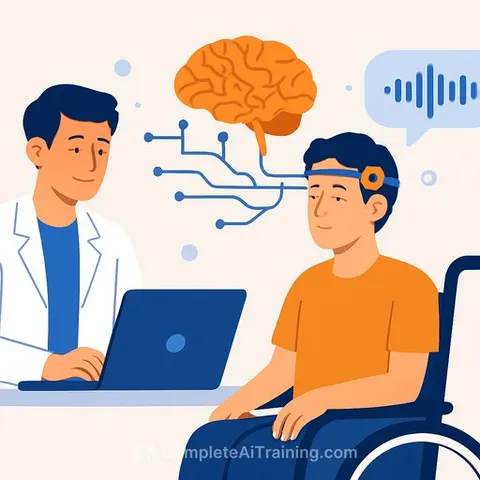
A brain-computer interface developed by UC Davis neurosurgeon Sergey Stavisky has allowed a person with amyotrophic lateral sclerosis to communicate with greater than 99% word accuracy using only brain signals. The system, which produced approximately 2.7 million words over two years, earned Stavisky the 2026 Chen Institute and Science Prize for AI Accelerated Research.
Stavisky's work sits at the intersection of neuroscience and machine learning, a vivid example of AI for Science & Research that is reshaping clinical prosthetics.
AI tackles neural data overload
Modern neural recording arrays capture signals from hundreds of neurons at once, a flood of data that broke traditional statistical methods. "Brain signals are really complicated," said Stavisky, associate professor of neurological surgery at UC Davis. "AI turned out to be uniquely powerful for that." His team built a system where one deep learning model decodes brain activity into phonemes, the basic sound units of language. A second model, drawing on large language modeling approaches, converts those phonemes into words and sentences. In an alternative straight-to-voice path, deep networks reconstruct speech sounds directly, generating a synthetic voice with delays as short as 30 milliseconds.
From movement to speech
Stavisky began his career building BCIs to restore movement, such as controlling a cursor or robotic arm. Across patients, he noticed a consistent pattern. "Communication was always the number one priority," he said. That insight, combined with rapid advances in machine learning around 2018 when consumer dictation systems reached usable performance, led him to pivot toward speech decoding-a problem widely seen as the hardest in neuroprosthetics.
Clinical results and real-world impact
In a study published in Nature Medicine in June 2026, Stavisky and colleagues reported that the participant with ALS used the system at home to hold rich conversations with family and friends, control his personal computer, and sustain full-time employment. Over two years, he expressed roughly 2.7 million words through the device.
"Stavisky developed an AI-based speech neuroprosthesis with immediate and transformative practical impact," said Yury V. Suleymanov, senior editor at Science. "It restored communication for a paralyzed patient with amyotrophic lateral sclerosis with over 99% word accuracy, enabling the patient to express 2.7 million words over two years using only brain signals. His team achieved real-time voice synthesis, allowing the patient to modulate intonation and even sing."
The long-term goal, Stavisky said, is a "high-fidelity surrogate voice"-so natural that a phone listener couldn't tell it wasn't the person's original voice. Achieving that will require devices that are smaller, fully implanted, and invisible, as well as a move from laboratory prototypes to widely available clinical tools. The approach is already expanding to clinical trials for speech BCIs, and researchers are exploring whether similar models could help people with stroke-induced aphasia, cerebral palsy, or other language disorders.
Chrissy Luo, cofounder of the Chen Institute, said, "Ten years ago, Tianqiao and I founded the Chen Institute to pursue a fundamental question: how does the brain give rise to intelligence? We could not have imagined then that AI would change not just how we study the brain, but what we could learn from it. Dr. Stavisky's research has done something once considered nearly impossible: decode brain signals directly into speech, giving patients back the ability to communicate in their own voice."
Why this matters for Science and Research
For neuroscientists and biomedical engineers, Stavisky's results demonstrate that pairing high-channel-count neural recordings with flexible deep learning models can produce clinically viable speech prostheses. The path from raw, noisy brain signals to fluent output required no single leap but a disciplined combination of bioengineering and modern AI. That template-confronting extreme data complexity with models that learn directly from the data-is increasingly relevant across high-dimensional biomedical research.