UChicago's AI initiative: building bridges for discovery
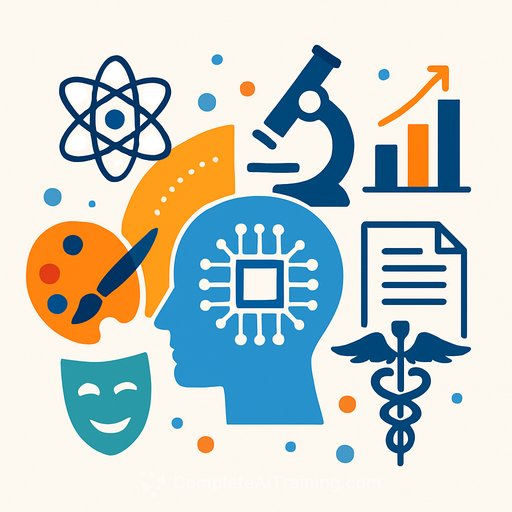
Artificial intelligence is changing how we learn and discover. In 2024, President Paul Alivisatos and Provost Katherine Baicker convened a university-wide committee to guide a campus response. The result: a new AI initiative that funded 15 proposals-10 centered on research and five on education-spanning archaeology, visual arts, public policy, natural sciences, economics, law, medicine, and philosophy.
Opening a Feb. 12 campus event, Alivisatos called this "a signal period in intellectual history," urging scholars to center human experience as they explore new ways of thinking with machines. Faculty director of AI at the Data Science Institute, Prof. Rebecca Willett, emphasized the plan: build durable bridges across disciplines to pursue questions no single field can answer.
Culture and creativity in an AI-empowered society
Teams in this theme study how AI can extend human creativity. Assoc. Prof. Jason Salavon highlighted work visualizing the interior of text models and using electrical muscle stimulation to collaborate with dancers on improvised choreography. The throughline is practical: treat creativity as exploration and invention, then design tools that support real workflows in the arts.
Learning the rules of life and the universe
Spanning cognitive science, physics, and cell biology, these projects test whether AI can help surface governing principles in minds, matter, and living systems. Prof. James Evans's group is building "curiosity" into model structure to enable disruptive hypothesis generation, aiming for the "least human AI" to probe beyond our biases. Prof. Margaret Gardel and collaborators are creating AI frameworks to predict, explain, and engineer life across scales, supported in part by the NSF-Simons ecosystem and the Chan Zuckerberg Biohub Chicago.
AI for resilient and adaptive societies
Researchers from Chicago Booth, the Becker Friedman Institute, the Harris School of Public Policy, the Crown Family School, and the Law School are partnering with companies, NGOs, and governments. Prof. Nicole Marwell's team asks a core policy question: governance needs stability and predictability, while AI introduces uncertainty and risk-so what rules, incentives, and oversight actually work?
Assoc. Prof. Pedram Hassanzadeh reported on AI-driven weather models built with Harris colleagues and the Indian government. Their team delivered monsoon onset forecasts to 38 million farmers in 2025-at speeds up to 100,000 times faster than traditional methods-showing how AI can move from lab prototype to public value.
AI in the service of therapeutics
Two efforts aim to compress the path from discovery to treatment, building on the partnership between the University of Chicago Medicine Comprehensive Cancer Center and Argonne National Laboratory. Prof. Rick Stevens's team is pushing beyond data review to models that reveal new dynamics, interactions, and modules-broadening target space while lowering costs. Prof. Rama Ranganathan's group is using generative and statistical approaches to engineer biological systems and identify design rules across scales.
Teaching students to think with and about AI
Five projects from the AI and Education Working Group probe how AI changes classroom dynamics and learning. Julia Koschinsky's team is developing ways for students to use AI to strengthen, not bypass, reasoning. Asst. Prof. Mina Lee's group is deliberately adding friction to LLM interactions to promote more mindful use-slowing the loop so students explain, critique, and verify.
What this means for scientists and research leaders
- Cross-domain methods matter: Curiosity-driven model design, generative biology, and physics-informed surrogates are being tested against real data and real decisions.
- Governance is a research target: Teams are quantifying risk, accountability, and incentives so AI can serve the public good without eroding trust.
- Bench-to-impact is the bar: From monsoon forecasting to oncology discovery, deliverables are moving from prototypes to field deployment.
- Education is part of the stack: Training students to reason with AI-rather than outsource thinking-will determine the quality of future research.
Why UChicago's approach stands out
In closing remarks, Baicker underscored a cultural advantage: rigorous questioning across disciplines. That posture-doctors talking to artists, statisticians to historians-raises the standard for evidence and accelerates idea selection.
Get involved
- Project teams will host workshops, events, and community-building sessions over the coming year.
- For information or collaboration, contact aiinitiative@uchicago.edu.
- For applied techniques and tools, see our roundup on AI for Science & Research. For pedagogy and classroom practice, explore AI for Education.
Bottom line: The initiative is set up to test big ideas with real constraints-across culture, fundamental science, policy, medicine, and education-and to share results that other institutions can build on.
Your membership also unlocks: