UGA funds eight cross-campus AI seed projects to advance high-impact research
The University of Georgia's Institute for Artificial Intelligence has awarded $276,250 in seed grants to eight projects spanning 11 schools and colleges. The goal is simple: give faculty the resources to build strong, interdisciplinary teams and generate the results needed to win external funding.
Support comes from the Office of the Senior Vice President for Academic Affairs and Provost and the Office of Research, with additional backing from the College of Agricultural and Environmental Sciences. Teams also gain access to OpenAI's latest models through UGA's participation in the NextGenAI consortium.
"Artificial intelligence is a powerful catalyst for innovation that transcends traditional academic boundaries," said Benjamin C. Ayers, senior vice president for academic affairs and provost. "By investing in these interdisciplinary seed grants, UGA is empowering faculty to develop AI-driven solutions that address critical needs in a wide range of fields, including health care, agriculture and human development."
"Artificial intelligence is fueling innovation across disciplines at UGA," added Chris King, interim vice president for research. "These seed grants will enable our faculty to take vital early steps in applying AI shrewdly and ethically to address some of the most pressing challenges facing the world today."
Why this matters for researchers
- Seed capital for pilot data, prototype systems and early findings that strengthen NIH/NSF-ready proposals.
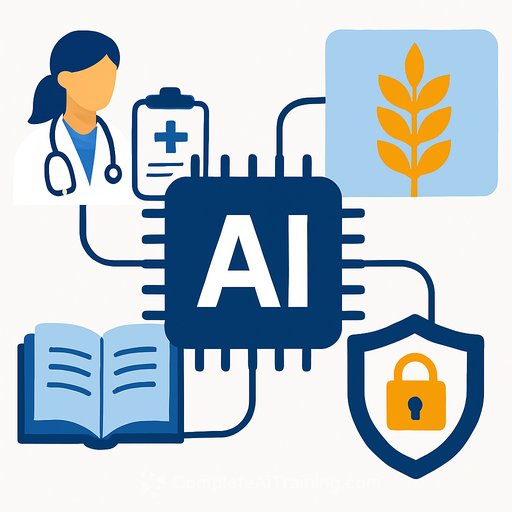
- Built-in cross-college collaboration to tackle complex problems in health, agriculture, security and education.
- Direct access to state-of-the-art models via the NextGenAI consortium to accelerate iteration while testing ethical safeguards.
Convergence themes and funded projects
AI in education
- Developing multi-agent world model for training AI systems and clinical personnel in emergency department (Zhen Xiang and Tianming Liu, School of Computing; and Jie Lu, Mary Frances Early College of Education)
Ethics of AI for human society
- Responsible causal AI: Reproducible designs, testable mechanisms (Jason Anastasopoulos and Ryan Powers, School of Public and International Affairs; and Akshat Lakhiwal, Terry College of Business)
Ethics of AI for human society and AI and future of health and work
- Interpretable deep learning linking adverse childhood experiences, biology and cognition: Identifying modifiable supports (Hee Yun Lee, School of Social Work; Yana Zavros, School of Medicine; and Khaled Rasheed and Jaewoo Lee, School of Computing)
AI and future of health and work
- AI-driven multimodal biomarker discovery and reasoning in depression and related mental health disorders (Chao Huang, College of Public Health; Rongjie Liu, Franklin College of Arts and Sciences; and Tianming Liu, School of Computing)
- Building multimodal foundations for AI-pathology at UGA (Eugene Douglass, College of Pharmacy; Suchendra Bhandarkar, School of Computing; and Megan Corbett and Lilian Oliveira, College of Veterinary Medicine)
AI for 3F (farm, food, forest)
- Building the first million-level benchmark dataset and foundation models for cost-effective poultry management (Guoming Li, College of Agricultural and Environmental Sciences; and Tianming Liu, Lakshmish Ramaswamy and Ramviyas Parasuraman, School of Computing)
- AI-assisted breeding for anthracnose resistance in pepper (Amol Nankar, Bhabesh Dutta, Luan Oliveira and Zhihang Song, College of Agricultural and Environmental Sciences; and Jin Lu and Ramviyas Parasuraman, School of Computing)
AI for cyber and societal security
- Edge-AI for safe and efficient autonomous vehicles (Qianwen Li, College of Engineering; and Geng Yuan, School of Computing)
Funding and institutional support
These seed grants are funded by the Office of the Senior Vice President for Academic Affairs and Provost and the Office of Research, with additional support from the College of Agricultural and Environmental Sciences. UGA's Institute for Artificial Intelligence is jointly supported by the Office of the Senior Vice President for Academic Affairs and Provost, the Franklin College of Arts and Sciences and the Office of Research, and counts more than 90 affiliated faculty across campus.
Practical next steps for research teams
- Use seed funds to generate pilot data, preregister study designs, and assemble multi-PI proposals with clear cross-disciplinary milestones. Project leads may find the AI Learning Path for Project Managers helpful for coordinating complex, multi-PI efforts.
- Adopt the NIST AI Risk Management Framework for evaluation plans, documentation and governance to strengthen compliance and review readiness. NIST AI RMF Teams focused on policy and regulatory compliance can consult the AI Learning Path for Regulatory Affairs Specialists for role-specific training.
- If your team needs structured upskilling in model development, evaluation or prompt workflows, explore curated, research-focused options such as AI Research Courses.
Your membership also unlocks: