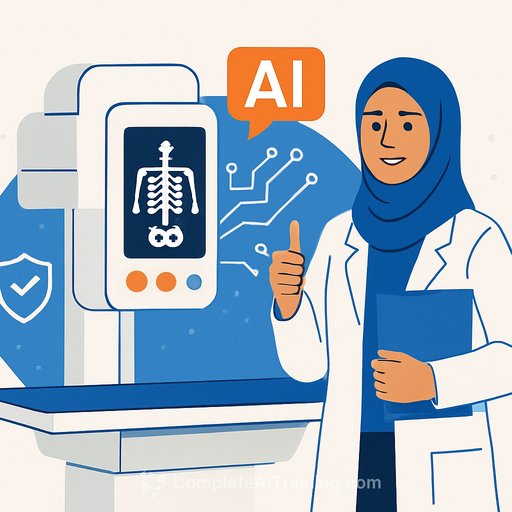
DDR Madeena: UGM's AI-Ready Digital Radiography Device Secures Health Ministry Approval
UGM's research team led by Professor Gede Bayu Suparta has taken Digital Fluorescence X-ray Radiography (RSFD) from lab work in the 1990s to a market-ready device: DDR Madeena. Through PT Madeena Karya Indonesia, the product now holds a distribution permit from Indonesia's Ministry of Health, alongside IPAK, CPAKB, and a Medical Device Distribution License. With a TKDN of 57.62 percent, it's built to fit national procurement priorities and reduce reliance on imports.
The intent is straightforward: make DDR Madeena a primary imaging device across hospitals, clinics, and Puskesmas. Image-based results improve transparency for patients and families, speed up treatment decisions, and connect frontline care with specialist interpretation through teleradiology and AI support.
Why this matters for product teams
- Local manufacturing plus TKDN 57.62% can lower total cost of ownership and improve access to public tenders.
- A product lineage from university research to industrial scale shows a viable downstreaming model you can replicate.
- AI-ready imaging, DICOM/PACS, and teleradiology build a service pipeline-not just a device-supporting recurring revenue.
- Procurement hook: aligns with the government's Free Health Check (CKG) program budget and distributed care delivery.
From lab to market: milestones that de-risk scale-up
- 1990: RSFD research initiated at UGM (Image Physics).
- 2012: Downstreaming via PT Madeena begins.
- 2021: DDR Madeena introduced.
- 2026: Ministry of Health distribution permit; IPAK; CPAKB; Medical Device Distribution License; TKDN 57.62%.
System highlights built for integrated care
- DICOM and PACS compatibility for seamless data exchange (DICOM standard).
- Teleradiology for remote reads and coverage in under-resourced regions.
- AI-based diagnostics for decision support and workflow triage (clinician-in-the-loop).
- Mobile and portable configurations to reach Puskesmas, community screening, and MCU programs.
- Industry 4.0 features and "new normal" remote workflows for updates, monitoring, and fleet management.
Regulatory and compliance path you can emulate (Indonesia)
The team secured approvals that matter for hospital buyers and public procurement. This stack shortens purchase cycles and signals manufacturing maturity.
- Medical Device Production License (IPAK) - permission to manufacture.
- Good Manufacturing Practices for Medical Devices (CPAKB) - quality and process assurance.
- Medical Device Distribution License - market access and legal distribution.
- Distribution permit from the Ministry of Health - registration to sell nationally.
- TKDN 57.62% - supports domestic-content requirements in state-backed purchasing.
- Product teams should align quality systems with international best practices such as ISO 13485 for future export.
Go-to-market fit: CKG program and beyond
DDR Madeena is positioned to support the Rp47 trillion CKG budget for nationwide health checks. That means distributed deployments, fast reads, and consistent quality across sites.
- Business models: direct purchase, managed service, or pay-per-study for budget-constrained facilities.
- Placement: regional hospitals as hubs, Puskesmas and clinics as spokes with teleradiology coverage.
- Service: centralized maintenance, spare parts logistics, and remote monitoring to protect uptime SLAs.
Integration patterns product teams should plan for
- Data pipeline: modality (DDR Madeena) → DICOM node → PACS/VNA → teleradiology viewer → EHR/EMR.
- AI workflow: acquisition → quality check → AI triage → radiologist review → structured report.
- Connectivity: offline-first for remote sites, batch sync to central PACS when bandwidth allows.
- Security: encryption in transit, role-based access, audit logs, and regular vulnerability patching.
Supply chain and partnerships
PT Madeena's partnerships-such as with Oneness International Group-add financing options, component access, and global tech exchange. The same collaboration model is now accelerating AI-assisted ultrasonography development, signaling a broader imaging platform play.
Clinical value proposition
Performance is reported as on par with, and in some cases ahead of, hospital systems in use today. For buyers, that translates to lower acquisition cost without sacrificing image quality, transparent information flow to patients, and faster time-to-report through teleradiology and AI support.
Risks and open questions to manage
- AI clearance: confirm regulatory status for any diagnostic claims; position as decision support until approvals are explicit.
- Data governance: PHI protection, consent flows for teleradiology, and cross-border data rules if cloud is used.
- Service footprint: ensure parts availability and certified field engineers outside major cities.
- Benchmarking: publish dose metrics and image quality KPIs (MTF/SNR) to reassure radiologists and HTA committees.
- Financing: offer payment terms aligned to public budgeting cycles and private clinic cash flow.
Product development checklist (use/adapt)
- Define target clinical workflows: screening vs. diagnostics vs. MCU; map reporting SLAs.
- Lock DICOM conformance statement; validate with buyer PACS vendors early.
- Build clinician-in-the-loop AI: dataset curation, bias checks, and monitoring in production.
- Qualification and verification plans for hardware, software, and radiation safety.
- Quality system aligned to CPAKB now; plan ISO 13485 if export is on the roadmap.
- Spare parts strategy and remote diagnostics to keep uptime above contractual SLAs.
- Training: radiographers, radiologists, and biomedical engineers-onsite and remote.
- Commercial model: TCO calculator (device + service + IT integration + training + upgrades).
- Procurement readiness: TKDN documentation pack, technical specs, and clinical evidence set.
- Post-market surveillance: incident response, software update cadence, and feedback loops to R&D.
Where this goes next
With approvals secured and a scalable partner network, DDR Madeena is positioned to anchor a broader imaging platform-radiography today, USG tomorrow, AI across the stack. The playbook here-sustained research, domestic manufacturing, and integrated software-offers a clear path for product teams working on medical devices in emerging and developed markets alike.
Learn more
- AI for Healthcare - workflows, clinical AI integration, and product strategies relevant to imaging and diagnostics.
Your membership also unlocks: