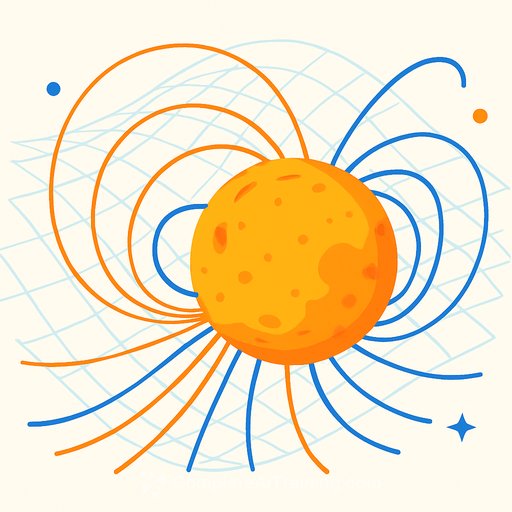
AI maps the Sun's magnetic field in 3D with high accuracy
Researchers at the University of Hawaiʻi Institute for Astronomy have built a machine-learning tool that reconstructs the Sun's magnetic field in three dimensions. The system supports research with the Daniel K. Inouye Solar Telescope on Haleakalā, operated by the NSF National Solar Observatory, and the results are published in the Astrophysical Journal.
Why it matters: the Sun is the strongest source of space weather affecting satellites, power grids, aviation, and communications. "The Sun's magnetic field drives explosive events like solar flares and coronal mass ejections. This new technique helps us understand what triggers these events and strengthens space weather forecasts, giving us earlier warnings to protect the systems we use every day," said Kai Yang, an IfA postdoctoral researcher who led the work.
The measurement problem
Magnetic field measurements on the Sun face two core issues. First, instruments often capture the field's tilt but leave a 180-degree ambiguity in whether it points toward or away from us-like seeing a rope from the side. Second, observations mix multiple heights at once, making it hard to assign each structure to the correct layer. Sunspots add another wrinkle: their strong fields depress the surface (the Wilson depression), skewing perceived heights.
AI-powered insights
The team partnered with the National Solar Observatory and the High Altitude Observatory to develop the Haleakalā Disambiguation Decoder. The approach blends real observations with a simple physical rule: magnetic fields form continuous loops and don't start or end. With that constraint, the algorithm resolves the true field direction and estimates layer heights.
Tests on detailed solar models show strong results across quiet regions, active regions, and sunspots. The method is especially effective on high-resolution data from the Daniel K. Inouye Solar Telescope, helping researchers extract reliable magnetic and electric current maps at scales where small errors can mislead downstream models.
What the tool delivers
- Resolves the 180-degree ambiguity in vector magnetograms (toward/away).
- Estimates the geometric height of magnetic structures across solar layers.
- Accounts for the Wilson depression in sunspots for more accurate layering.
- Enables inference of vector electric currents from a consistent 3D field.
- Improves inputs for flare/CME modeling and space-weather forecasting.
Why this matters for your research
- Fewer manual disambiguation steps and more reproducible pipelines.
- Better boundary conditions for coronal NLFFF and MHD models.
- Higher-fidelity data assimilation with DKIST's resolution and cadence.
- Greater lead time potential for operational geomagnetic storm forecasts.
Explore the telescope and related science at NSO's Daniel K. Inouye Solar Telescope. For the publication venue, see the Astrophysical Journal.
What's next
Expect efforts to scale the approach across instruments and time-linking DKIST with broader-coverage assets, improving cross-height consistency, and benchmarking on both synthetic and real observations. As methods stabilize, integration into observatory pipelines could standardize 3D magnetic mapping for the community.
Resources
Building your ML stack for scientific data and instrumentation work? See curated options at AI courses by job or the latest additions at Latest AI courses.
Your membership also unlocks: