AI "Scientists" Just Got UK Funding. Here's What That Means for R&D Leaders
The UK's Advanced Research and Invention Agency (ARIA) has funded 12 projects building AI systems that design and run lab experiments end-to-end. The agency received 245 proposals-enough signal to double its intended funding and back a diverse set of teams across the UK, US, and Europe. Each award is roughly £500,000 for nine months, with a simple bar at the finish line: show novel findings.
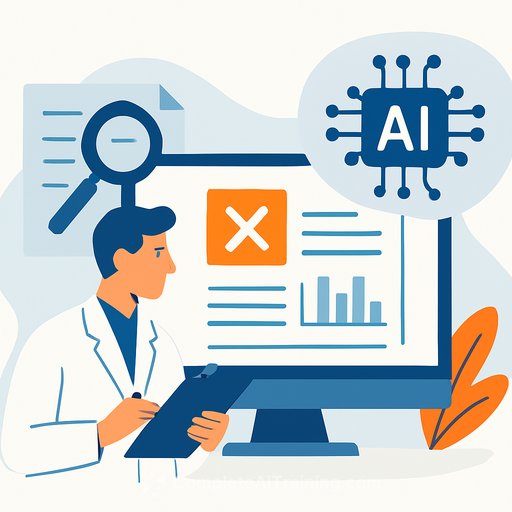
ARIA defines an AI scientist as a system that proposes hypotheses, designs experiments, executes them, analyzes results, and loops-without hand-holding. Humans set the research question, then supervise. "There are better uses for a PhD student than waiting around in a lab until 3 a.m. to make sure an experiment is run to the end," says Ant Rowstron, ARIA's chief technology officer.
Who got funded
Winners include startups and universities building robot chemists, autonomous biologists, and agentic systems that orchestrate existing tools. The mix matters: academic rigor paired with industrial speed, nine months to produce something real.
- Lila Sciences (US): Building an AI "nano-scientist" to optimize the composition and processing of quantum dots used in imaging, solar, and QLED displays. "The grant lets us design a real AI robotics loop around a focused scientific problem, generate evidence that it works, and document the playbook so others can reproduce and extend it," says Rafa Gómez-Bombarelli.
- University of Liverpool (UK): A robot chemist that runs multiple experiments in parallel and uses a vision-language model to troubleshoot errors on the fly.
- ThetaWorld (London, stealth): Using LLMs to design experiments on physical and chemical interactions that drive battery performance, executed in an automated US lab environment. For training on designing AI-enabled experiments and workflows, see AI Design Courses.
Why this matters for funders and lab heads
Compared with ARIA's typical £5 million, multi-year efforts, these are small, fast probes. ARIA is taking the temperature of where automation and AI can move the needle now, then using those learnings to shape larger bets.
There's hype. Press releases arrive faster than peer review. Rowstron is blunt about the job to be done: "To do things at the frontier, we've got to know what the frontier is." This program is a reality check with deliverables.
How the stack works today
Most teams are building agentic systems that call existing tools on demand. LLMs handle ideation and planning; other models handle optimization; robotic platforms run the experiments; results feed back into the loop.
Think in layers. At the base are human-built tools for humans, like AlphaFold. Above that sits the AI scientist layer, which composes those tools to execute workflows. Rowstron expects a near-future step where that layer can spin up new tools as needed-automating much of the base-but we're not there yet. For hands-on curricula that cover AI-driven scientific workflows, consider AI Research Courses.
Limits remain. Agentic systems can drift, misread specs, and "declare success despite obvious failures." One recent study found LLM-driven workflows failed three out of four times. As Rowstron puts it, "I'm not expecting them to win a Nobel Prize." The bet is speed: if they help labs move faster, we need to be ready.
What to do in the next 90 days
- Run a contained pilot: Pick a narrow, high-value problem with abundant data and clear success criteria. Timebox to 12 weeks.
- Get the plumbing right: Standardize data schemas, metadata, provenance, and experiment logging. Automate sample handling where possible.
- Set guardrails: Define human-in-the-loop checkpoints, safety constraints, and audit trails. Pre-register protocols for higher-risk experiments.
- Procure with proof: Require baselines, ablation studies, and reproducibility reports-not just demos. Favor teams that publish playbooks, not just results.
- Measure what matters: Track time-to-result, experiments per week, replication rate, and cost per experiment. Compare to human-only baselines.
- Upskill your team: Train scientists on LLM prompting for experiment design, agent monitoring, and lab automation. If you need a starting point, explore role-based learning paths here: AI Learning Path for Training & Development Managers.
- Line up facilities: Secure access to automated labs for throughput and after-hours runs. Make sure integration with your data stack is feasible.
What success should look like in nine months
- A reproducible, end-to-end workflow documented as a playbook others can run and extend.
- At least one credible, novel finding validated by follow-up experiments.
- Clear ROI evidence on speed, cost, and reliability versus current practice.
That's the bar ARIA has set: working systems, measurable value, and reusable know-how. If your organization funds or runs labs, this is the moment to test, instrument, and learn-before you scale.
For program details and future funding signals, keep an eye on ARIA.
Your membership also unlocks: