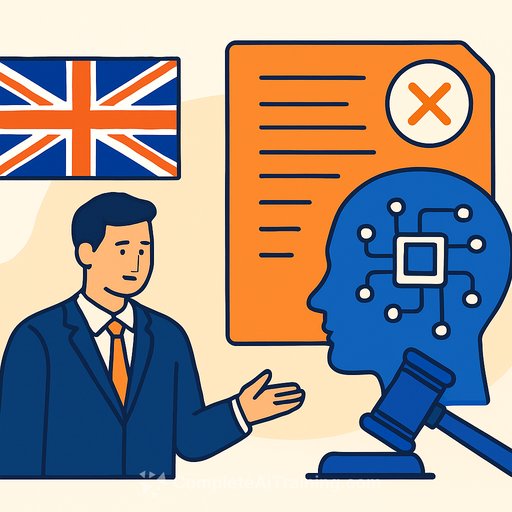
UK government delays AI copyright reform, opts for monitoring over legislation
The UK government will not rush into copyright reform for artificial intelligence. Liz Kendall, Secretary of State for Science, Innovation and Technology, said the government needs time to "get this right" in a written statement to Parliament on 6 March 2026.
The government abandoned its previous preference for a broad text-and-data-mining exception with an opt-out mechanism. Instead, it will monitor ongoing litigation, international developments, and market activity before committing to any specific course of action.
What the government will focus on instead
Kendall identified four areas for immediate attention:
- Digital replicas and personality rights
- Labelling AI-generated content
- Creator control and transparency
- A working group of independent creatives
The government will also establish a creative content exchange and launch a consultation on digital replicas in summer 2026.
More than 11,000 consultation responses and subsequent technical working groups did not produce a clear path forward. The government will instead commission further research, track the EU AI Act implementation, and monitor US litigation before deciding on reform.
Why the government reversed course on licensing exceptions
Consultation responses highlighted practical and economic difficulties with opt-out regimes. International experience, particularly in the EU, reinforced those concerns.
The strongest support came for a licensing-first approach. Most respondents from the creative industry backed this option, viewing it as consistent with existing UK copyright law. They argued that developers should continue seeking permission rather than relying on broad exceptions.
Only 3% of respondents supported a broad text-and-data-mining exception without opt-out provisions. Those supporters came mainly from AI, technology, and research sectors who saw it as a compromise aligned with EU rules.
Transparency remains contested
Over 90% of respondents from both creative and AI sectors agreed that developers should disclose their training data sources. The disagreement lies in how far disclosure should go and whether it should be regulated.
Creative industry respondents backed legislative or regulatory transparency, citing its importance for understanding copyright use, enabling licensing, and supporting enforcement. Many favoured an EU-style market-access approach that applies to all systems regardless of where they are developed.
AI developers pushed back on work-by-work disclosure, warning it would be costly and impractical. They preferred high-level, industry-led transparency over mandatory regimes.
The government will not legislate on transparency at this stage. Instead, it will publish a review of mechanisms available for creators to control their works online, including standards, technical solutions, and best practice on input transparency.
No new regulator for enforcement
The government concluded that UK legal frameworks are fundamentally sound but hampered by limited visibility over training data and the cross-border nature of AI development. It will not create a new regulator.
Instead, it will work with industry, enforcement bodies, and courts to ensure effective routes to redress for systems developed outside the UK. It will track enforcement models overseas and build evidence on what works for both AI development and rightsholder remedies.
Statutory licensing ruled out for now
Neither creative nor AI respondents supported legislative licensing. The government will not pursue statutory or compulsory licensing, arguing the market is developing quickly. It will continue monitoring collective licensing initiatives and international developments.
AI output labelling taskforce established
Respondents broadly supported labelling AI-generated content to mitigate risks such as deepfakes and misinformation. They distinguished between wholly AI-generated content, which should be labelled, and AI-assisted works involving human input, which should not.
The government will establish a taskforce to propose best practice for labelling. An interim report will be published in autumn 2026. The government is avoiding immediate intervention, preferring industry-led guidance aligned with international models once they settle.
Computer-generated works protection to be removed
The government confirmed strong support for removing protection for computer-generated works under the Copyright, Designs and Patents Act 1988. It proposes doing so while maintaining the existing originality test for AI-assisted works.
Digital replicas identified as a gap
Existing legal tools provide incomplete protection for digital replicas, including synthetic voice, image, and likeness. The government will explore potential new rights or models but has not adopted a definitive approach.
The summer consultation will seek views on addressing harms caused by digital replicas while protecting legitimate innovation.
What creatives should know
The decision to abandon the broad mining exception aligns with concerns raised by the House of Lords Communications and Digital Committee, which warned the creative industries face a "clear and present danger" from generative AI trained on copyright-protected works without authorisation or payment.
However, creatives will find limited clarity on contested issues. Many proposals have been deferred while the government gathers evidence. Creators and developers will continue navigating uncertain waters.
Creators currently lack easy routes to identify when their works are being used, seek remuneration, or enforce their rights. AI developers face challenges accessing works on a licensed basis and uncertain litigation risks.
This uncertainty may push AI development to more permissive jurisdictions such as the EU and US, undermining the UK's stated goal of becoming "one of the best places in the world to build and adopt innovative AI".
Learn more about AI tools designed for creatives to understand how these policy shifts may affect your work.
Your membership also unlocks: