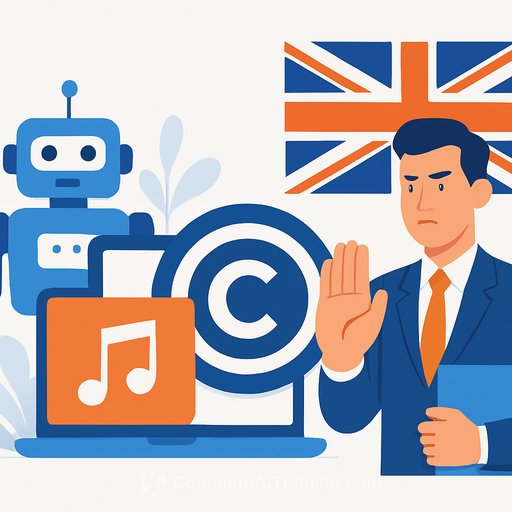
UK Government Drops Plan to Let AI Companies Train on Copyrighted Music Without Permission
The UK government reversed its position on artificial intelligence copyright rules on Wednesday, abandoning a proposal that would have allowed AI developers to train models on copyrighted music without seeking permission from artists or rightsholders.
Technology Secretary Liz Kendall announced the government "no longer has a preferred option" on AI copyright reform. The shift came after extensive consultation with creatives, AI firms, unions, academics, and industry bodies.
What Changed
The government had previously backed a "commercial research exception" that would have let AI developers use copyrighted works for training without permission, though they would need licenses before selling resulting products.
The creative sector rejected this approach overwhelmingly. Sophie Jones, Director of Strategy at the BPI, which represents the UK's recorded music industry, called the proposal "deeply troubling" and said it would give AI developers more power to use music commercially than earlier discredited proposals.
More than 400 artists and industry figures-including Sir Elton John, Sir Paul McCartney, Dua Lipa, and Coldplay-had previously signed a letter to Prime Minister Sir Keir Starmer demanding transparency requirements for AI training data.
The Government's Reasoning
Kendall emphasized that the creative sector generates £146 billion ($194 billion) annually for the UK economy and accounts for 7% of all jobs. The AI industry grows 23 times faster than the rest of the economy, she noted.
"The UK must be an AI maker, not an AI taker," Kendall said, arguing that the country cannot afford to depend on foreign tech firms while abandoning domestic creative industries.
What Comes Next
The government will now focus on four areas:
- Digital replicas
- Labelling AI-generated content
- Creator control and transparency
- Supporting independent creatives' ability to license their work
Trade organizations welcomed the reversal. Tom Kiehl, CEO of UK Music, said the sector's 220,000 workers should "work and earn a living without the constant fear that the fruits of their labour could effectively be taken by AI firms without payment or permission."
Paul W Fleming, General Secretary of performing arts union Equity, described the original plan as "an act of national self-sabotage" that would have sold out UK creatives to benefit US tech companies.
Government professionals involved in AI policy may find the AI for Government resources useful for understanding how copyright and AI regulation intersect with broader policy goals. The AI Learning Path for Policy Makers covers similar governance questions in depth.
Your membership also unlocks: