
AI news ·
UK law firm faces regulatory probe over AI errors as AI legal service wins first court case
A UK judge rebuked Pinsent Masons for submitting AI-hallucinated court references, while AI-powered firm Garfield AI won a £7,000 claim in what it calls a landmark for access to justice.
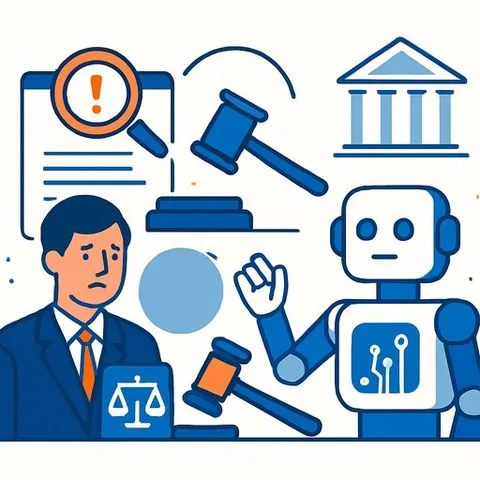
A UK High Court judge has condemned a law firm's "cavalier attitude" after it submitted AI-generated hallucinations to the court, while a separate AI-powered legal service has won a £7,000 claim in what it calls a landmark moment for access to justice. The two cases, emerging within weeks of each other, expose the widening gap between reckless AI adoption and disciplined use of the technology in legal practice.
The Pinsent Masons rebuke
International law firm Pinsent Masons misled a court twice in the case of Cork & Anor v Smith, first by providing references that featured AI hallucinations, then by using AI to produce an explanatory letter that itself contained errors. High Court Judge Mullen said an unnamed junior lawyer "almost entirely outsourced the thinking process" to an AI program, while solicitor Samantha Poulton and partner Steven Cottee failed to supervise properly.
"It struck me as likely to be an AI hallucination, which had not been checked. The attempt to explain it away in what appeared to be an untruthful manner in the [second] Letter only heightened my concerns," Mullen said. The firm has referred itself to the Solicitors Regulation Authority, which will examine whether any parties breached the code of conduct.
Mullen added that AI "has the potential to be wholly unreliable. AI may of course provide a jumping off point for research and legal reasoning but it does not, at least at present, do away with the need for proper research and thought on the part of a legal professional, even a very junior legal professional."
Research warns of over-reliance
New research from Positive Group, based on 16 in-depth interviews with law firm leaders across the US, UK, Singapore, Australia, Hong Kong and Spain, suggests more crises of judgment are likely if lawyers become too reliant on AI. The data shows that more than 60% of lawyers now actively use AI for drafting, research and client delivery. The risk, according to the firm, is that time-pressured lawyers accept AI outputs uncritically without applying necessary scrutiny.
Tasks such as research, drafting and due diligence are increasingly handed to AI, and the technology is also playing a growing role in complex work like litigation strategy and risk analysis-identifying patterns, stress-testing arguments and surfacing alternative perspectives. These are the highest-value tasks, Positive Group notes, and where professional expertise has traditionally been brought to bear. For legal professionals seeking structured guidance on integrating AI into these workflows, AI for Legal Professionals Courses offer training that covers research, document review and practical tool use.
Will Marien, CEO of Positive Group, said the fundamentals of legal practice remain constant. "Clients continue to value judgement, trust and accountability. As AI becomes more capable, these qualities become more, not less, important." The research identifies three leadership qualities that successful firms will need: strategic framing, role modelling and disciplined experimentation.
AI wins in court
In a first for the English legal system, AI law firm Garfield AI won a claim over unpaid fees for a freelancer at Wandsworth County Court last month. All trial documents, including witness statements, were created by AI and delivered into the court. The client was charged £400 and recovered £7,000. Barrister Dominic Li, who represented the client in court, said: "Garfield AI's preparation helped ensure the case was presented clearly and efficiently, while the advocacy at trial remained essential and a fundamentally human exercise."
Garfield AI, approved by the Solicitors Regulation Authority in 2025, has handled more than 600 debt claims. Co-founder and CEO Philip Young, a former City litigator, said: "This is a landmark moment, not just for Garfield AI, but for access to justice. AI did not replace the judge, the barrister or the legal system; what it did was make the process more accessible, more efficient and more affordable." Co-founder and CTO Daniel Long added that the case is "an important proof point-regulated, AI-powered legal services can help real people recover real money through the courts."
Why this matters for legal professionals
The two cases frame a clear boundary: AI can cut costs and expand access to justice when used under strict human oversight, but it invites professional and regulatory risk when lawyers delegate judgment to the machine. For paralegals and support staff handling document review, contract analysis and research automation, structured learning paths such as the AI Learning Path for Paralegals can build the discernment needed to verify AI outputs before they reach a court. The lesson from the Pinsent Masons rebuke is not that AI is too dangerous for law-it is that the profession's duty of care cannot be outsourced to a model that hallucinates without warning.