Ukraine jumps 14 spots in global AI readiness, targets top 3 by 2030
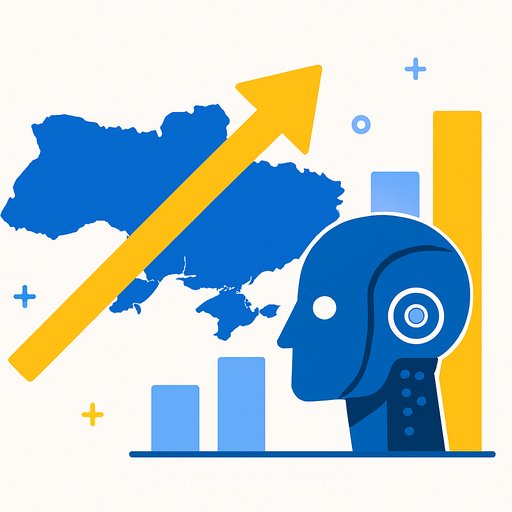
Ukraine moved up 14 positions to 40th out of 195 countries in the Government AI Readiness Index 2025. The push came from Diia.AI, a national large language model, and fast-moving defense tech programs.
Minister of Digital Transformation Mykhailo Fedorov says the goal is clear: reach the global top three by 2030. The approach is state-led, execution-focused, and centered on real deployments, not hype.
What changed: product, infra, and policy working together
- Diia.AI: a national AI assistant integrated with public services.
- National LLM: a language model aligned to government use cases.
- AI Factory: infrastructure to train, serve, and scale AI systems.
- Defense tech: AI is already supporting battlefield operations.
Metrics that matter
- Digitalization of public services: 99.63%.
- Alignment of legislation with international AI standards: 92.25%.
- On select indicators, Ukraine outscored both the U.S. and the U.K.
The index from Oxford Insights focuses on how governments build, regulate, and deploy AI, and how they partner with industry and academia while managing risk. Source: Government AI Readiness Index.
What this means for engineers and builders
- Real workloads: Citizen service automation, identity, compliance, and multilingual interfaces need production-grade LLMops, evals, and observability.
- APIs over pilots: Expect concrete interfaces into Diia and related services. Build for scale, latency budgets, and SLA-backed integrations.
- Data and safety constraints: Privacy, provenance, audit trails, and prompt/content safety will gate deployments. Ship with red-teaming and eval harnesses.
- Defense tech: Edge inference, comms-constrained models, sensor fusion, and rapid model update loops are in scope.
- Standards-aware delivery: High compliance scores signal tighter adherence to international guidelines. Map your stack to policy and procurement requirements early - regulatory teams should consult the AI Learning Path for Regulatory Affairs Specialists.
Strategy and near-term roadmap
Ukraine set a national mission last year: top-three AI implementation and development by 2030. Since then, the WINWIN AI Center of Excellence launched and began shipping large-scale projects.
By year-end, the state plans to present AI assistants across the Diia ecosystem and publish the AI Development Strategy through 2030. Expect clearer procurement paths, target KPIs, and technical guidance for vendors and teams. Technical managers and vendors can prepare via the AI Learning Path for Technology Managers.
Governance and partnerships
- Joined the Council of Europe Framework Convention on AI and Human Rights in May 2025.
- Launched a sandbox in June for testing AI and blockchain products.
- Announced cooperation with NVIDIA in November to build national AI infrastructure and a domain-aligned LLM for public and defense sectors.
Opportunities for the IT/dev community
- LLM engineering: Retrieval, fine-tuning, prompt tooling, safety layers, and multilingual support for Ukrainian and regional languages.
- Govtech integrations: Identity, payments, records, and case management powered by AI assistants.
- MLOps: Model registry, eval pipelines, canary rollouts, drift detection, and cost-aware serving (CPU/GPU mix, quantization).
- Defense dual-use: Perception models, geospatial analytics, and decision support with strict latency and reliability needs.
What to watch next
- Public release of Diia-adjacent AI assistants and developer access.
- AI Development Strategy 2030 with technical standards and funding priorities.
- Details on the national LLM's training data, safety policy, evals, and API availability.
- Expansion of the sandbox and pathways from pilot to production inside government.
If you're upskilling for LLM engineering, evals, and MLOps, explore curated tracks here: Complete AI Training - courses by skill.
Your membership also unlocks: