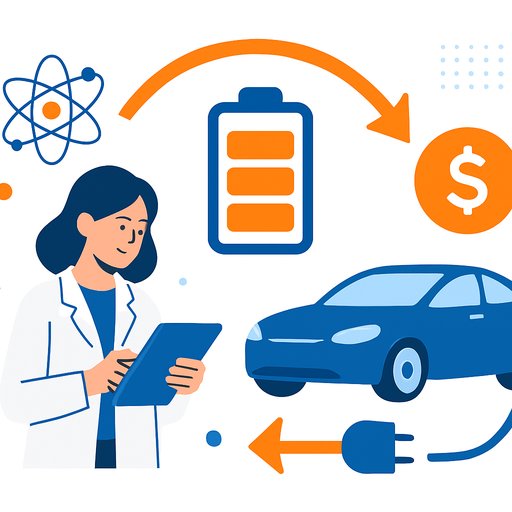
Polaron Raises $8M To Speed Up EV Materials Discovery With AI
Image credit: Polaron
Despite political headwinds in the US, investment in clean energy tech continues abroad. UK-based startup Polaron has secured $8 million to apply AI to EV-related materials discovery.
The round was led by Racine2 with co-investment from Speedinvest and Futurepresent. Funding of this size typically goes into data infrastructure, lab validation, and early industry pilots - the unglamorous work that turns models into manufacturable parts.
Why This Matters For Researchers
EV efficiency gains rarely come from one big change. They stack from better magnets, higher-conductivity thermal interfaces, tougher coatings, and smarter battery chemistries. Case in point: the electric MINI Countryman improved range without a larger pack by refining its tech, not by brute force.
That's where materials discovery earns its keep - lower losses, higher stability, improved charge rates, safer packs, and fewer scarce elements. For background on AI methods and materials workflows, see Research.
Likely Focus Areas In The EV Stack
- Battery: cathode/anode formulations, solid/gel electrolytes, separators, binders, coatings (energy density, ionic conductivity, interfacial resistance, cycle life, safety).
- Thermal management: gap fillers, phase-change materials, heat spreaders (thermal conductivity, viscosity, pumpability, aging).
- Power electronics: SiC/GaN substrates, die-attach materials, encapsulants (thermal and electrical performance, reliability under high dT/dt).
- Drive units: permanent magnets, electrical steels, advanced lubricants (coercivity, losses, temperature stability, rare-earth reduction).
- Corrosion and safety: coatings, flame retardants, sealants (durability, manufacturability, environmental compliance).
How AI Can Compress The Discovery Loop
For lab teams, the value isn't a single model - it's a closed loop. Aggregate multi-fidelity data, train surrogate models with uncertainty, run active learning to propose candidates, then validate with high-throughput experiments. Feed results back in. Repeat.
Two practical anchors help: a common materials schema and ruthless standardization of test protocols. Resources like The Materials Project can complement in-house datasets, and recent work on large-scale discovery pipelines shows what's possible at scale (Nature coverage).
What To Watch Next
- Data ops: ingestion from DFT/MD, HTE, and historical lab notebooks; metadata completeness; versioned pipelines.
- Optimization targets: multi-objective search across performance, cost, supply risk, and recyclability - with constraints you'd actually ship.
- Validation: statistically sound sample sizes, accelerated aging that maps to field conditions, and cross-lab reproducibility.
- Scale-up: synthesis routes, precursor availability, process windows, and quality control that won't collapse at pilot scale.
- Partnerships: early technical evaluations with OEMs and Tier 1s, with clear TRL gates and IP frameworks.
Practical Next Steps For R&D Leaders
- Stand up a clean, queryable materials data room and retire orphaned spreadsheets.
- Agree on a small set of canonical test protocols and units across teams and vendors.
- Use uncertainty-aware, multi-fidelity models; budget for negative results and log them properly.
- Plan IP early: composition windows, process claims, and data rights with partners.
- Bake in supply constraints and life-cycle metrics before you lock the search space.
Polaron's raise is another signal: capital is moving toward teams that can turn predictions into parts. For scientists and engineers, the advantage now goes to groups that connect domain data to closed-loop discovery and prove it on hardware, fast.
Level Up Your AI Workflow
If you're building AI skills for materials and engineering work, explore focused course lists here: AI courses by job or browse the latest AI courses.
Your membership also unlocks: