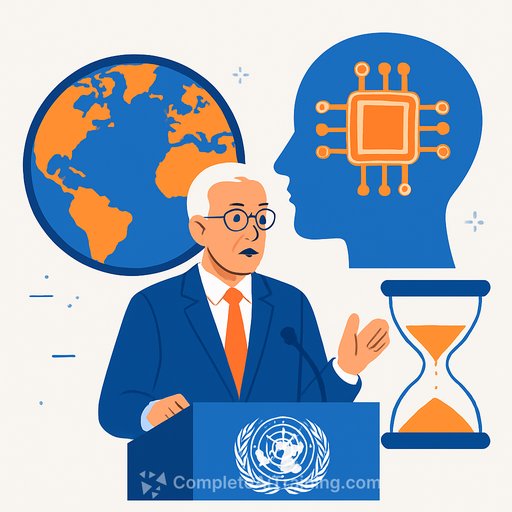
UN Chief to AI Experts: Deliver Global Clarity, Grounded in Science
The United Nations Secretary-General, António Guterres, opened the first meeting of a new Independent International Scientific Panel on AI with a clear brief: build a shared, science-based picture of artificial intelligence for the benefit of humanity.
The 40-member panel spans regions and disciplines and will operate independently of governments, companies, and even the UN. Their mandate is to close the AI knowledge gap and give countries a common basis for action so no one is guessing or working at cross-purposes.
Why this matters for science and research
AI will influence peace and security, human rights, and sustainable development for decades. When facts are thin or distorted, fear fills the void and trust collapses. With geopolitical tensions rising, the need for safe, responsible AI-and a shared language for evidence-has never been greater.
What "global clarity" should include
- Common taxonomies for AI capabilities, risks, and system categories, so evidence travels across borders and sectors.
- Transparent reporting of training data sources, data governance, compute used, and evaluation methods for major models.
- Benchmarks that map to real outcomes (safety, biosecurity, civic integrity, labor markets, education, health), not just synthetic leaderboards.
- Standardized uncertainty reporting, error analysis, and confidence intervals for model claims.
- Independent red-teaming protocols and incident reporting systems that feed into public registries.
- Socioeconomic impact assessments with clear methodologies for causality, externalities, and distributional effects.
- Environmental accounting for training and deployment (energy mix, water use, lifecycle emissions).
- Content provenance and attribution standards to curb deception and protect rights holders.
- Compute and model access governance that enables research while managing high-risk capabilities.
- Human rights due diligence embedded in the AI lifecycle, with safeguards for vulnerable groups.
Practical steps labs and universities can take now
- Adopt model and dataset documentation (e.g., Model Cards, Datasheets for Datasets) and publish evaluation protocols up front.
- Report compute, data lineage, and evaluation details for any release that could influence policy or markets.
- Join or help build cross-institutional, reproducible benchmarks linked to social and scientific outcomes.
- Stand up internal safety review boards for high-risk research and pre-deployment testing.
- Contribute to open incident databases and share failure cases, not just wins.
- Prioritize reproducibility: fixed seeds, versioned datasets, deterministic pipelines, and independent replication.
- Train students and staff in security, bioethics, human subjects protection, and misuse analysis alongside model development.
- Partner with institutions in the Global South to ensure diverse data, perspectives, and benefits.
A race against time
Guterres warned that AI is moving fast-and that "never in the future will we move as slow as we are moving now." The panel will draw on the UN's existing High-Level Advisory Body on AI, which tackles policy questions, so this scientific effort does not start from zero.
Who is involved and what to watch
The panel includes 40 independent experts, with Nobel Laureate Maria Ressa among them. Expect scientific assessments that clarify real-world impacts across economies and societies, along with methods countries can apply consistently.
For researchers, this is an invitation to contribute evidence, methods, and standards that reduce noise and increase trust. If you're building capacity in this space, explore practical resources for scientists here: AI for Science & Research.
Your membership also unlocks: